
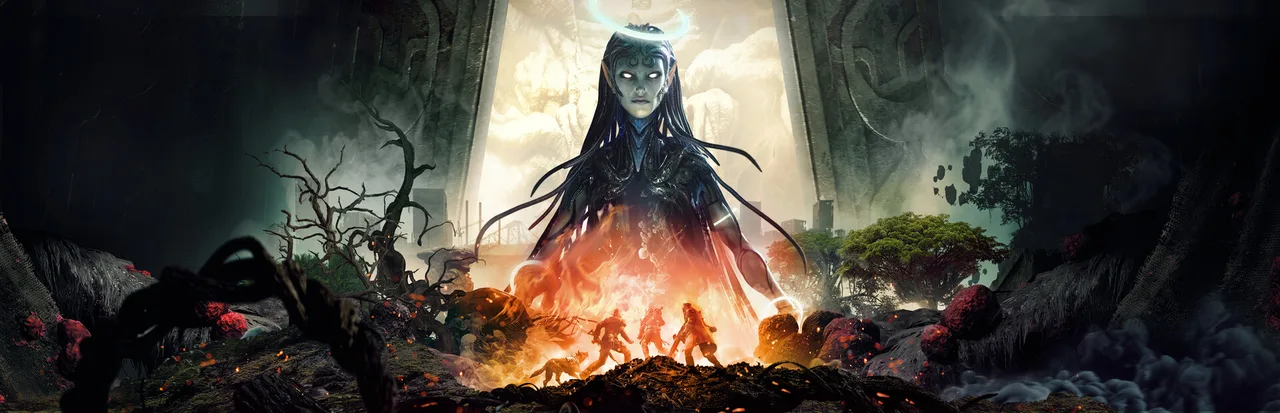
About Remnant II
Developed by Gunfire Games and published by Gearbox Publishing, Remnant II released on July 25, 2023 for PlayStation 5, Windows and Xbox Series X|S as the sequel to Remnant: From the Ashes. This review covers the base game, the three DLC packs and the free updates up to The Dark Horizon in September 2024.
The shooter part comes first
You carry two guns and a melee weapon, you dodge on a stamina bar, and you rest at checkpoints that bring the ordinary enemies back. In other words the skeleton is familiar, and the borrowed parts are the ones that work: read the wind-up, respect the reach, and treat a boss as a moveset to learn rather than a number to out-grow.
Where the game marks out its own ground is health. Half of the damage you take converts into grey health that you can heal back by making space, so a bad trade reads as a debt rather than a death sentence and healing builds are a real choice rather than a crutch. Guns split in two directions: standard ranged weapons take swappable weapon mods, which are active abilities charged up by fighting, and special weapons arrive with a fixed mod that cannot be moved onto anything else. Check which one you own before you plan a build around it.
The reroll is the whole design
The order of the three major worlds is not fixed. Your first campaign world is dealt to you rather than chosen, and each of those worlds rolls one of two main storylines, which changes the dungeons, the events, the NPCs you meet inside them and the world boss waiting at the end. Each DLC has since added another storyline inside one of those worlds, so Losomn, Yaesha and N'Erud now hold more than the two they shipped with, and the new ones are folded into fresh campaigns as well as into a one-shot adventure roll of their own. Only the Labyrinth and Root Earth are locked to the story and stay consistent.
Two consequences follow from that. The campaign is short by the standards of the genre, because you are running one branch of a tree rather than walking a curated path. And the most useful answer to a boss you cannot beat is often a reroll rather than a guide, because what a reroll buys you is a different dungeon, event or boss rather than an easier one: the level of a place is set the first time you walk into it, one step above your own power level, and never below that area's own minimum, which climbs as the campaign moves on. Adventure Mode is the tool for that, rerolling a chosen world on its own without disturbing your campaign, and it is what you use to hunt one specific drop or to see the other version of a fight. In multiplayer that level is mainly the host's, and it only climbs further if a client is further ahead than the host.
Two archetypes, one Prime Perk
A new save starts with four archetypes on the list: Challenger, Handler, Hunter and Medic, plus Gunslinger if you pre-ordered the game. The rest have to be found in the world, converted into an Engram by Wallace in Ward 13 and equipped, and there are fourteen archetypes once the DLC additions are counted. Those four are the default list for a first playthrough rather than a ceiling: an archetype you have already unlocked can be picked when you start a later character, so the choice widens with everything you find. Each archetype carries its own perks, a choice of three skills, and a trait that unlocks permanently for other builds once that archetype reaches its maximum level.
You can run two archetypes together, and the slot order matters. Only the first slot, the Prime, activates its Prime Perk, while both archetypes contribute their ordinary perks, the skill you selected from each, and their traits. In practice that means the Prime is the effect you want firing on its own, and the secondary is there to cover whatever the fight keeps punishing you for. Put the panic button in the front and the utility behind it.
The gear table is the real campaign
Underneath the shooting, this is a build-crafting game built on scarcity. Traits are permanent passive bonuses that cap out at level ten each, and the points you get to allocate yourself will never cover all of them, so a build is defined as much by what you leave on the floor as by what you take. Past the cap, the Tomes of Knowledge you keep finding convert into experience and scrap instead, and the Orb of Undoing resets your allocation whenever you like, which is the game quietly inviting you to move points around per encounter rather than per character.
Mutators are the second layer: passive weapon effects in their own slot, upgraded with scrap and Corrupted Lumenite Crystals at Dwell, and given a second bonus when they hit level ten. Relic fragments are the third, small stat bonuses with three slotted at once. Those fragment stats were reworked wholesale with The Dark Horizon, which cut more than a dozen of the old ones and added about twenty new ones, so treat any older list as out of date.
Prisms are the long version of the same idea and the most interesting system in the game. A prism levels with experience and fills five slots from random offers, and the two ways you steer it are worth knowing before you start: feeding it a fragment destroys that fragment and only biases future rolls toward the stat rather than guaranteeing it, and compatible pairs of stats can fuse into one slot carrying both effects, which reopens space for more. Built carefully, a single prism ends up holding far more than five bonuses, with a legendary effect on top once it is fully levelled. It is also the slowest thing here to be rewarded for, which makes it the right system to ignore until the campaign has stopped fighting you.
Difficulty is a setting, Hardcore is a commitment
There are four difficulty settings, and they are not cosmetic. Experience rises modestly with each step while enemy health and damage climb hard, and the higher settings gate rewards you cannot collect anywhere else. Survivor is the honest starting point even though the bottom of the ladder is already steep, because the jump from there to the next setting is bigger than the label suggests.
Hardcore is a different promise, chosen when you create the character: death ends that save permanently, and you can only play with other Hardcore characters rather than in open lobbies. Two details are worth having before you commit. The mode has documented exceptions, a short list of scripted captures and story beats that do not count as deaths, and six rewards are exclusive to it, only one of which asks for a difficulty above the baseline. The rest of that list is a reason to play carefully, not a reason to start on the hardest setting.
Co-op changes the maths
Three players, drop in and out, with crossplay added in a February 2024 update that also brought friend invites on PlayStation 5. Cooperative play is wired into the systems rather than bolted on: resting at a checkpoint needs every player to use it, downed allies get back up on a rest, and every extra player hands the enemies more health and damage on top of whatever the world level is already doing. That level is mainly the host's rather than the group's best character, pushed up only by a client who is further ahead, so joining a friend in a later world is a harder fight for you rather than a carried one. Solo is entirely viable, and if you want an easier time of it alone the archetypes with a companion or minions are the closest thing the game has to a difficulty dial.
Boss Rush, and where the updates stopped
Three DLC packs arrived between November 2023 and September 2024: The Awakened King, The Forgotten Kingdom and The Dark Horizon, each adding a new region inside an existing world, an archetype, and another pile of gear. The last of them shipped alongside a free update that plenty of players got more out of than the paid content, because it added Boss Rush: a mode launched from the World Stone in three lengths, from a three-boss run up to a nineteen-boss run, with temporary buffs earned as you go. The same update also added the prism system.
Reception landed where the design would predict. The review aggregate sits at 82 from roughly 120 critics with 84% recommending, the overall user-facing Metascore is 80, and the storefront summary reads Very Positive from about 68,000 reviews. Sales moved quickly, with a million copies in the first week and two million by the end of September 2023. One practical note for anyone buying now: the official patch notes in the store feed run out in November 2024, so the sensible assumption is that you are buying the finished thing rather than watching a roadmap fill in.
Should you play it
Yes, if the loop you want is gear and builds. Remnant II is at its best the third time a boss kills you, when you change a mutator and a ring, come back with the same hands and a different gun, and the fight reads as a problem you solved in a menu. The reroll feeds that habit generously, and the free content around the final DLC gives the endgame a much better home than the campaign ever had.
Skip it if you need the campaign to be the point. The story is serviceable, the levels are assemblies of tiles rather than places you will describe to anyone afterwards, and the writing sits well behind the shooting. Skip it as well if procedural generation reads to you as variation without craft: what changes between runs is the order of the parts and the contents of the rooms, not the standard of the layout.
Three things worth knowing before you buy. The Ultimate Edition is the one that includes all three DLC packs, so check which packs an edition actually contains rather than paying for a name, and note that the DLC regions were folded into campaigns and are reachable through a one-shot adventure roll rather than a separate menu. There are no gear sets to chase here either: armour carries no set bonuses and cannot be upgraded at all, so the upgrade budget belongs to weapons, which is where the iron and scrap go, with a weapon mod, a mutator and the amulet and rings around them doing the rest of the work. And the archetypes you have not unlocked yet are frequently the answer to the build problem you have right now, which is a strange thing for a game to teach you slowly and a good one to be told early.
Go deeper with V4mp
- Developer
- Gunfire Games
- Genre
- Action RPG shooter
Explore Remnant II further
Explore the wiki for detailed reference pages on the game's world, systems, items and locations.