
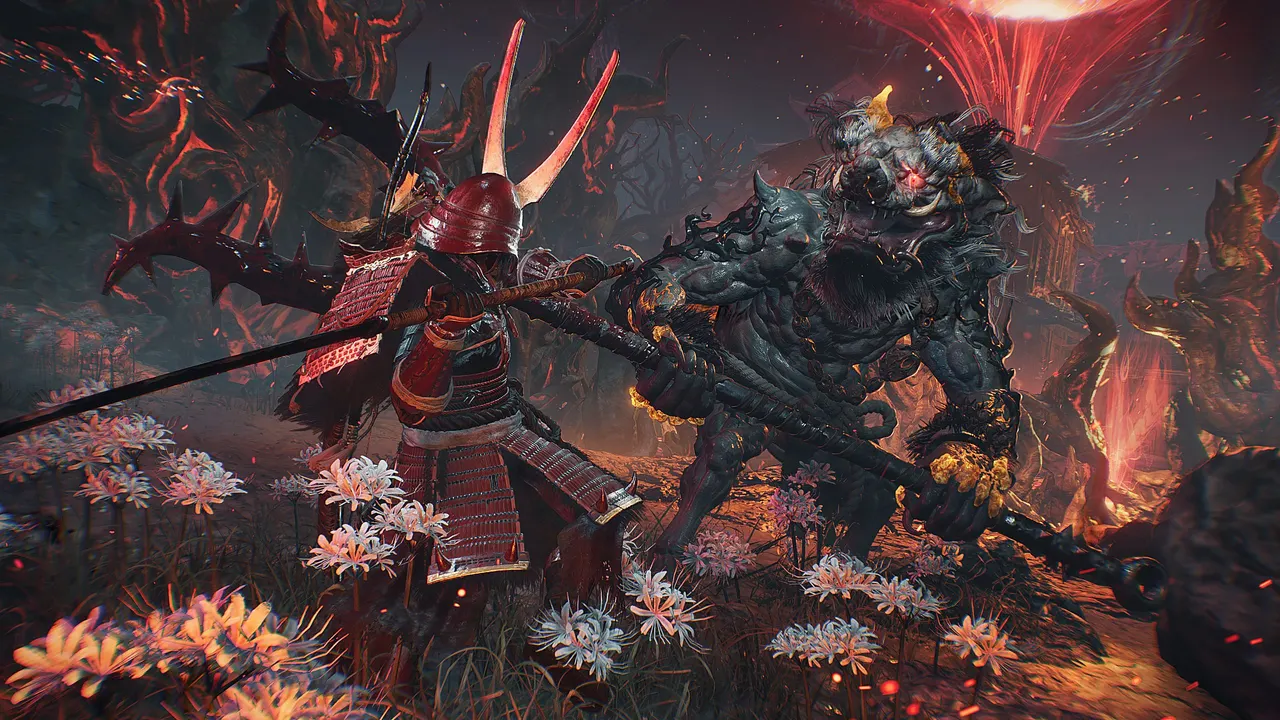
About Nioh 3
Developed by Team NINJA and published by Koei Tecmo, Nioh 3 launched on 6 February 2026 for PS5 and PC: Samurai Style, Ninja Style, Ki, Crucibles and yokai. This review covers the base game only, so the first expansion, Hell Rising, is out of scope.
The counter is the class
Nioh has always been two games arguing with each other — a precise stamina duel, and a loot-and-build RPG that would rather you were in a menu. Nioh 3 turns that argument into the feature. You carry Samurai Style and Ninja Style on the same character, each with its own weapon, armour, accessories, Guardian Spirit and skill tree, and you move between them with Style Shift.
The reason it works is Burst Break. When an enemy winds up a Burst Attack it is marked with a red aura, and the answer is not a parry, and it is not Nioh 2's Burst Counter. You change style at the exact moment of the attack to interrupt it, damage Life and Ki, and take a serious bite out of a yokai's maximum Ki. That means the series' signature defensive input and its new class system are the same input, so the second style can never be the novelty you forget about. The dangerous fights become a question about which fighter you want to be standing in — and the answer can change mid-swing. If the combined style-shift input fights your hands, it can be split in the System menu, and we'd sort that out early rather than spend an evening arguing with the controller.
Ki is still the real boss
Underneath the new toy, this is still a game about one bar. Attacking and guarding both spend Ki, and an empty bar means you can do neither, which is the actual death condition in a bad fight — not the health total. Samurai Style owns the clean answers: a precise guard becomes a Deflect, which nullifies the attack, restores Ki, and charges both the Arts and Ninjutsu gauges. A well-timed block is closer to an investment than a concession.
The Ninja half is deliberately not allowed to solve the same problems. Mist costs no Ki and can drop a decoy, and a precise Evade extends your invulnerability, but neither restores Ki or clears a Yokai Realm pool. So when the ground under you is strangling your recovery, the game sends you back to Samurai and a Ki Pulse after your next attack. That's a tight piece of design: "just dodge everything" is not an answer here the way it can be elsewhere.
The prologue teaches that before it hands over anything else. Escape from Hitokoto Slope opens with a Level 1 duel against Yamagata Masakage, a human Odachi fighter, while the early Samurai stances are still locked away. You can't out-build him. You learn to let a long combo finish, punish the recovery, and keep enough Ki to leave — which is the rest of the game in miniature.
The series finally stopped taxing respecs
Once the prologue is done and the Warring States map opens, stats can be redistributed freely at any shrine: pray, open Level Up, use the reset prompt, spend the returned points again. There's no consumable to farm for it — the series stopped charging you for changing your mind. Samurai and Ninja skill points reset separately, and so does skill capacity, so the two halves of your build don't drag each other around.
That one change rewrites the deal the series has always offered. Nioh's depth used to come with a quiet tax — get a build wrong and you either lived with it or went looking for an item. Nioh 3 asks a better question. Not "are you sure?" but "do you know what you're building toward?" We'd take that trade every time, and it makes this the friendliest place the series has ever offered to start.
Friendly is not the same as simple. Weapon familiarity still rewards staying with a weapon — it strengthens that weapon's special effects and raises the Amrita you'd receive for offering it up later — so a free respec does not make a fresh weapon free. The Crucibles take the opposite approach as well: they cut into your maximum Life, so a sloppy exchange becomes a compounding problem rather than a reset button.
Where it asks too much
Everything above is the good news. The price of it is volume: Nioh 3 adds a second full kit to everything the series already wanted you to track. Every weapon, piece of armour, accessory and Guardian Spirit is equipped twice, once per style, so the screen you used to read once now asks you to read it twice. It also wants you weighing Break and Block values, familiarity, armour weight, Toughness and elemental resistance, with heavier armour raising the Ki cost of the attacks and dodges you'll be doing constantly. Soul Cores have to be purified at a shrine before they do anything at all, and the slot you give one changes what it is: Yin opens the Core's Onmyo Magic, Yang gives the attack and defence bonuses and can eventually hand over a Summoning Seal — but only after you have beaten that Core's associated Crucible Wraith. Guardian Spirits are equipped separately for each style and paid for with the Spirit Force you build by attacking. Then there is Living Artifact when the Amrita Gauge fills, Crucible Spikes that widen your Guardian Spirit options when you break them, later enhancement menus gated behind Soul Fragments, and Resting Rites to turn spare Cores into Soul Fragments.
None of it is unreadable — each system is documented somewhere in the game or its manual — but it is a second full loadout to hold in your head on top of stance, Ki, element and skills. If your instinct in an action game is "one clean answer, and a hard fight", Nioh 3 will spend a lot of its runtime showing you menus.
The other risk sits with the player rather than the game. Burst Break is so important and so specific that it's easy to end up with one real style and one panic button — shifting only when something glows red, and never letting the other kit do anything else. Nioh 3 gives you two fighters and does not insist you learn both. If you don't, you're carrying half a game around.
The pulse
Nioh 3 is landing well. Within two weeks of the 6 February launch, the publisher announced over a million copies sold — the fastest the series has managed it — and followed that with an accolades trailer built around the critical response. Critics have the game in the mid-eighties. That is a comfortable reception for a sequel that replaced its predecessor's most famous input, and it means the argument worth having about Nioh 3 is about the game rather than about whether it worked.
The friction is specific. Burst Break is a new verb wearing an old costume: Nioh 2 answered a red aura with a Burst Counter that depended on your Guardian Spirit type and spent Anima, and the Nioh 3 manual even ships a control preset described as close to Nioh 2's. If your hands still reach for the old counter, that's why. The other tell is a name — the Hamamatsu Castle Crucible boss is Jakotsu-baba in the publisher's own material, but you will still find guides spelling it Yakotsu-baba, so search both before you decide a source is wrong about the fight.
Should you play it
Yes, if you want the systems. Nioh 3 rewards the player who enjoys assembling an answer — who likes the idea that a boss presents three problems and the equipment screen is where two of them get solved. The Burst Break loop is the most satisfying defensive idea Team NINJA has built, the Ki economy underneath it is as sharp as this series has ever been, and free respecs mean you can experiment your way into understanding it instead of studying up first.
Also yes if you have bounced off Nioh before. It sounds odd to recommend the third game in a difficult series for that reason, but the build safety net means the cost of a wrong idea is one shrine visit, not a restart, and that is a real change in what the game demands of you.
Skip it if what you want is the clarity of something like Sekiro, where the vocabulary is small and the difficulty is entirely execution. Nioh 3 is dense on purpose and the density is the argument for it — but if you hoped the sequel would trim the loot and the stat screens, it went the other way. It added a second fighter's worth of gear to manage and it expects you to care about all of it. That's the whole review in one line: the counter is the class, and the class is homework.
Go deeper with V4mp
- Developer
- Team NINJA
- Genre
- Samurai action RPG
Explore Nioh 3 further
Explore the wiki for detailed reference pages on the game's world, systems, items and locations.