

Use Verticality and the World as a Tool
On this page
The publisher calls verticality a vital part of exploration in Baldur’s Gate 3, and lists the actions that make it work: sneak, dip, shove, climb and jump.
Start high, start unseen
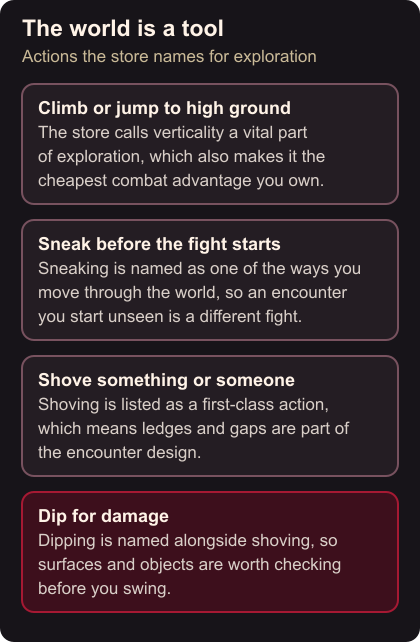
Verticality is not just a way to reach treasure. High ground changes who gets attacked first and who can be pushed, and sneaking is named as one of the ways you move through the world at all. Opening a fight from above and unseen is usually the difference between a hard encounter and a manageable one.
Shoving is an attack, not a joke
Shoving is listed as a first-class action, which is a strong hint that the encounters are built with ledges, gaps and hazards in mind. Before spending your turn on damage, check whether a shove removes an enemy from the fight entirely.
Check surfaces before you swing
Dipping is named alongside shoving, so surfaces and objects are meant to be part of your damage plan rather than scenery. The store backs this up by describing a world filled with characters, dangers and deceit, and an engine built for exploring and experimenting.
Explore upward, not just outward
The described journey runs from the Underdark to the rooftops of Baldur’s Gate itself. When a district seems finished, look up: the vertical layer is where the described secrets usually sit.
The environment works best when the party is built for it: see building a party you can actually run. For the other half of the campaign, read companion trust as a resource.