
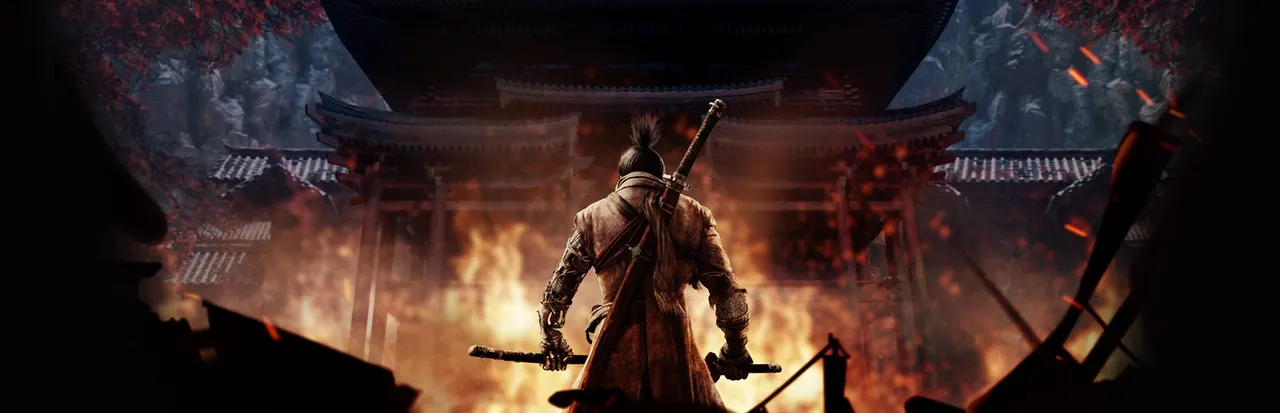
About Sekiro: Shadows Die Twice
Released in March 2019, Sekiro looks like a Souls game from the outside and behaves like nothing else the studio has made. You cannot grind past a wall here, and you cannot bring a friend.
It plays like a ninja, not a knight
The change that reshapes everything is the prosthetic arm, and specifically the grappling hook. Earlier protagonists in this genre were pinned to the ground — trudging corridors, climbing ladders slowly, always a dead end away from being cornered. Sekiro can reach rooftops almost at will, and the level design grows upward to match. When a fight goes wrong, there is usually an exit if you think like a shinobi rather than a knight.
The same idea reaches the checkpoints. The Sculptor's Idols do what bonfires always did — rest, refill, reset enemies, spend progression, fast travel — but the routes between them are shorter and more linear than the studio's usual sprawl. The result is that you are rarely far from safety. That matters more than it sounds, because carrying an hour of progress toward an uncertain next checkpoint is the specific anxiety this genre trades in, and Sekiro quietly removes most of it. We have never found a FromSoftware game as easy to keep playing for that reason.
Why "fair" is the right word here
People apply "hard but fair" to these games reflexively, and it fits Sekiro far better than the games it was inherited from. Nothing collapses under your feet. Nothing one-shots you from a corner you could not see. Falling somewhere you should not be does not kill you — it puts you back with a small penalty and lets you get on with it. Very little about dying here feels like the game cheated you, which is exactly why it is so hard to stop when you do.
That fairness makes the challenge land harder rather than softer. There is no farming souls to out-level a boss, no summon sign to call in help, and money buys you nothing that wins a fight. If deflection and posture never click, no amount of preparation rescues you. Boss encounters are built as duels against opponents carrying similar tools to yours — closer to a rival with a defined moveset than a screen-filling monster to chip down. It is the purest this genre has been, and it asks you to be better rather than bigger.
And the story is finally told to you
One change gets overlooked because it is not mechanical. The protagonist is a person with a voice, and the story arrives through dialogue and cutscenes rather than only through the item descriptions and environmental fragments the studio had always hidden it in. The mythos is still deliberately unspoken, and the themes of death and rebirth are still there to be pieced together, but for the first time the game will simply tell you what is happening. For a studio whose storytelling has always been an archaeology project, that is a bigger departure than the grappling hook.
The pulse
The conversation around Sekiro settled quickly and has not moved much since. It is held up as the studio's sharpest combat and its tightest structure, and the recurring complaint is the same one we would raise: losing build variety and co-op is a real loss for people who played the earlier games for exactly those things. The difficulty argument that surrounded release has largely faded — the consensus now treats it as demanding and legible rather than punishing for its own sake.
Should you play it
Yes, if you want the genre stripped to its fundamentals — no build-crafting, no grinding, no summons, just whether you can learn a fight. It is also the one we would hand to someone who bounced off the opacity of earlier FromSoftware games, because it is markedly more direct about what it wants from you.
Stay away if what you love about Dark Souls is the build tinkering or the co-op escape hatch. Neither exists. And if a skill check with no statistical workaround sounds like a wall rather than a challenge, believe that — this is the entry that stopped pretending the difficulty was negotiable.
Go deeper with V4mp
- Developer
- FromSoftware
- Genre
- Shinobi action adventure
Explore Sekiro: Shadows Die Twice further
Explore the wiki for detailed reference pages on the game's world, systems, items and locations.