
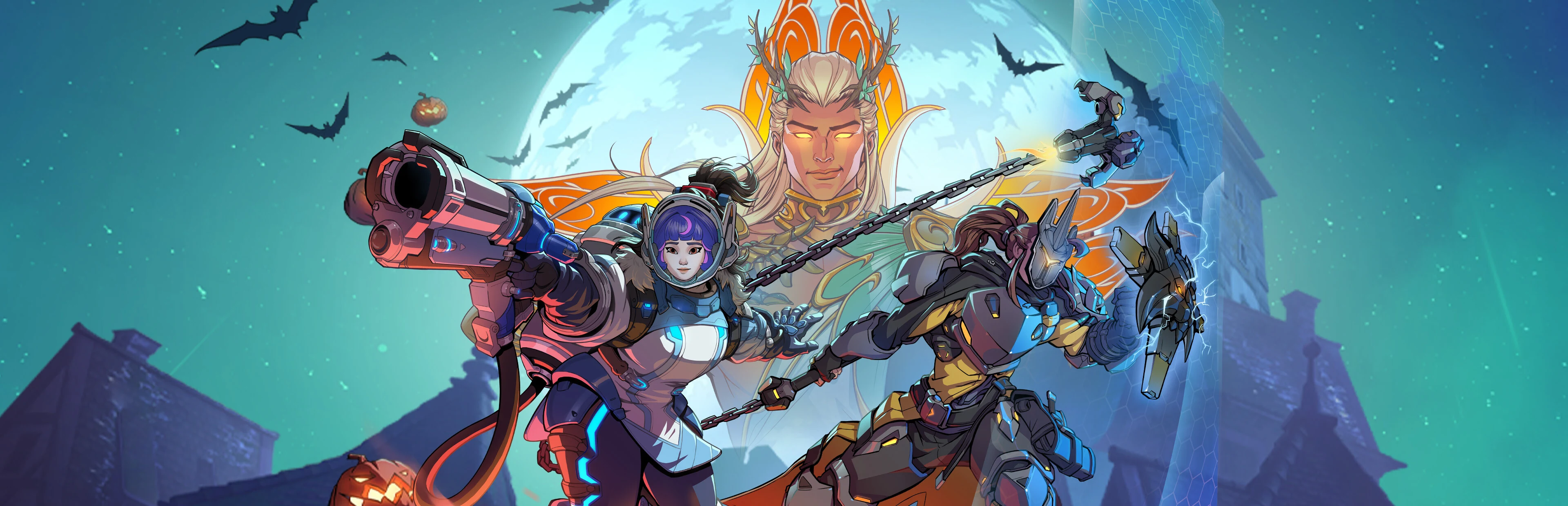
About Overwatch
It is free to play, the live game is called simply Overwatch, and heroes are not locked behind the pass. The format you queue into decides how much a hero swap can change, and that is the part worth understanding before you pick a favourite.
What you are actually playing
Overwatch is a free-to-play, team-based action game from Blizzard. In its core 5v5 format, teams meet over an objective and can change heroes within the rules of the selected queue. That last part is the whole idea: the enemy team is a question, and swapping heroes is how you answer it.
The roster runs past fifty heroes, sorted into Tank, Damage and Support. The live game is partway through the year-long Reign of Talon story arc, and the current season, Heroes of Busan, added D.Mon to the Tank line-up. Blizzard has said Season 5 closes that arc with the Support hero Doctrine, the Escort map Watchpoint: Grímsvötn, and reworks for Sombra and Roadhog. Doctrine appeared first in a limited-time Hero Trial ahead of his full debut.
Cross-play lets friends group across supported platforms, while cross-progression carries unlocks and progress through a linked account. Competitive matchmaking has separate pools and input rules: using a controller on PC does not move you into the console pool. Check the selected queue before planning a competitive session across platforms. Virtual currency bought or redeemed on Nintendo Switch stays on Nintendo Switch.
Competitive play is not open from the first match. You unlock it by winning fifty games in Quick Play or Stadium, and Stadium wins count double toward that.
The three roles, and the sub-roles under them
Every hero sits in one of three roles, and the role carries the job the rest of the team leans on. Tanks soak damage and hold ground, taking the first step into a chokepoint. Damage heroes seek out and eliminate, and they are the ones with the tools to break a defence open. Supports keep everyone else standing by healing, shielding, boosting and disabling.
Underneath that, each role now splits into focused sub-roles with a passive of their own, replacing the older setup where everyone in a role shared one bonus. Damage covers Flanker, Recon, Sharpshooter and Specialist. Tank covers Bruiser, Initiator and Stalwart. Support covers Medic, Survivor and Tactician. The passives are small but they are not flavour. A Medic heals themselves while healing an ally with their weapon. A Bruiser takes less damage from critical hits and moves faster below half health. A Sharpshooter gets movement cooldowns back faster with every critical hit, which quietly changes how far a dive can go.
The objective changes with the mode
Objectives vary by map type. Some maps ask you to escort a payload, some ask you to hold a point, and hybrid maps ask for both in sequence. Control, Push, Flashpoint and Clash each put different pressure on a team, so the shared part is the win condition rather than the shape of the fight: you win by completing the objective, not by topping a kill count. Neon Junction, one of the newer hybrid maps, runs a train on its own clock. Once the first point unlocks it departs for the station every fourteen seconds, so the map itself keeps changing the answer.
Quick Play and Competitive use the same modes with different stakes, and Competitive adds two layers before the shooting starts. You pick a preferred hero and vote on Hero Bans, then play the heroes who survive the vote. Four heroes are banned in total, two per team, and no more than two can be banned from the same role. Your preferred hero gets no protection, and if you do not pick anything the vote goes on without you.
What a hero swap can and cannot do
Role Queue is the format most players picture: you queue for a role, you keep that role for the match, and swapping changes the hero rather than the job. The composition is fixed going in, so a Damage player cannot come back as a second Tank. What changes mid-match is which Damage hero you are, and that is plenty. A pick that is losing its duel usually has a different answer inside the same role.
Open Queue is the looser alternative, and its standard size is 6v6 with a two-Tank ceiling. Here you can move between roles during a match, which is exactly the freedom the format sells. Nothing is assigned, so a squad can reshape itself into whatever the fight is asking for, including handing a role to whoever is actually playing well that match.
Stadium deliberately gives up that flexibility. You choose a hero at the start and play that hero for the entire match, so the game moves from swapping heroes to building one. It is a best-of-seven, five-a-side mode with a smaller roster than the core game, a third-person camera by default and a first-person option, Powers you take for free at set rounds and cannot remove once equipped, and Items bought with Stadium Cash, up to six at a time and sellable for their full value. Its ladder is separate from Competitive, it starts everyone in Rookie at the beginning of a season, and ranked Stadium unlocks after ten wins in Stadium Quick Play.
Perks: the choice inside a match
Perks arrived in both Quick Play and Competitive with Season 15, and they let you adapt part of your kit during a match. Each hero has two Minor Perks and two Major Perks. During a match you choose one of the two Minors, and later one of the two Majors. You are picking a speciality rather than collecting both.
Minor Perks offer smaller adjustments such as cooldown changes or passive benefits. Major Perks can change an ability more substantially or add a new option. Either tier can affect numbers as well as behaviour, and both can be rebalanced between seasons. The choice is how to adapt your current hero to the fight.
What it costs
Overwatch is free to download and play, and every hero is unlocked for players who have finished the new-player experience. That includes new heroes as they arrive, so the roster is not something you pay to open up. Money goes to cosmetics: the seasonal battle pass, the in-game shop, and the bundles that come with events and crossovers.
The battle pass was rebuilt in Season 4. Instead of one fixed list of eighty tiers, there is a short introductory track and then five tracks you complete in whatever order you like, each ending in a Legendary or Epic skin. Premium owners get one Tier Hack charge, which swaps an end-of-track Legendary for another from a curated pool of past shop and loot-box skins, and that pool refreshes each season. The pass pays out skins, currencies and Mythic Prisms.
Loot boxes return as rewards rather than a purchase. They arrive on the free track, with additional ones on the premium track, and through weekly challenges and events. Belgium is the exception Blizzard names: loot boxes are not available there.
The tradeoff is the usual one for a live game. The cosmetic cadence never really stops, the shop is always open, and there is always something new to want. What the pass and the shop sell is appearance, currency and prestige, and none of that is needed to compete once you have unlocked the heroes.
Should you play it
Yes, if you like a shooter where reading the match is half the skill. The swap inside your role, the sub-role passives and the Perks all reward noticing what the other team is doing and changing your answer to fit.
Skip it if you would rather pick one hero and never think about the roster again. Heroes get reworked, Perks are reworked again on top of that, and a new competitive year resets the ladder you were climbing. The game keeps moving, and keeping up is part of what you are signing up for.
Go deeper with V4mp
- Developer
- Blizzard Entertainment
- Genre
- Hero shooter
Explore Overwatch further
Explore the wiki for detailed reference pages on the game's world, systems, items and locations.