
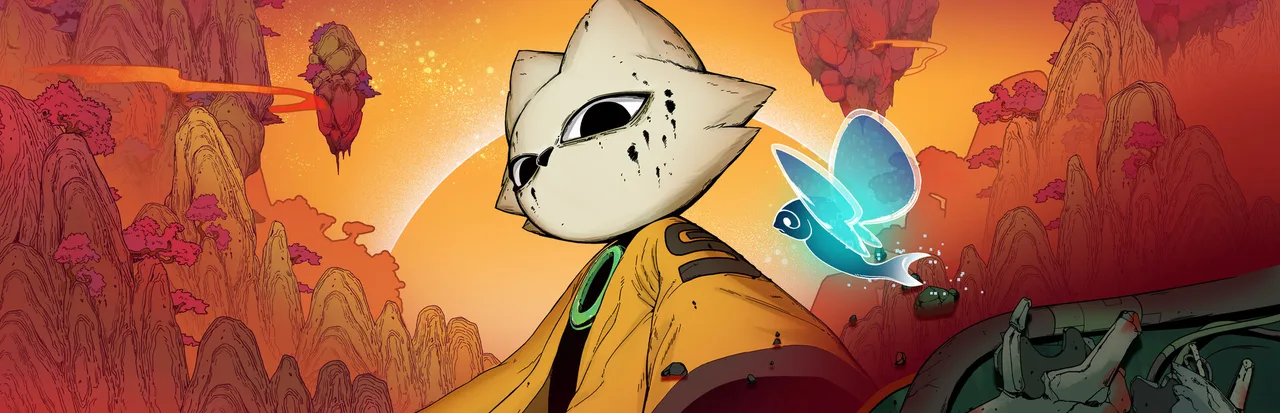
About Nine Sols
Red Candle Games released Nine Sols on 28 May 2024 for Windows and macOS, with PlayStation 4, PlayStation 5, Xbox One, Xbox Series X|S and Nintendo Switch versions following on 26 November 2024. This review covers the base game and its free updates. The only paid extras are a soundtrack and a digital art book.
A parry-first game, and it means it
The store describes Nine Sols as a hand-drawn 2D action platformer with deflection-focused combat, and the word choice is honest. The parry is not a safety net here. It is the resource system. Every parry that lands hands Yi one Qi charge, and Qi is what the good damage costs.
Timing is graded rather than passed or failed. A precise parry negates the attack outright and staggers some of the smaller enemies. An early, imprecise parry blocks half the damage and turns the other half into internal damage rather than simply deleting the mistake, and it still pays one Qi. That single rule tells you what kind of game this is: the game would rather you stay in the exchange and pay for it than back off and reset.
The three exceptions worth knowing before the first boss
A standard parry cannot stop crimson attacks. They read as red and black, they usually charge up long enough to see coming, and the answer is movement instead: the Immortal Dash gives a burst of invulnerability on a roughly one-second cooldown, refreshed early by landing. Fire on the ground is the other half of that lesson, because it cannot be parried or countered and it keeps ticking after you leave it.
The two ways around those rules arrive later, and both are worth the detour to find. The Tai-Chi Kick turns a specific class of crimson attack into an opening: when an enemy's body glows green during the wind-up, the kick counters it, knocks the enemy back and pays Qi. The Unbounded Counter is the blunt answer, a charged parry that blocks nearly anything in the game including crimson attacks, in exchange for a wind-up you have to commit to before you know the attack is coming. Both sit on the world map rather than the skill tree, which is the game's way of telling you that exploring New Kunlun is combat preparation.
Internal damage is the part that makes fights readable
An imprecise parry leaves recoverable internal damage, drawn dark red on the health bar. It regenerates at a trickle a few seconds after the last hit, and it converts into permanent damage the moment something else lands cleanly on you. Healing follows the same logic in reverse: the Medicine Pipe clears internal damage before it gives you real health back. So a fight's real question is not how much health is missing but how much of it is still on loan.
Enemies play by the same rule, which is what ties the whole combat system together. Their internal damage regenerates too, and the way you stop that is to parry their next attack or stick a talisman on them. Stack internal damage on a boss, then detonate, and all of it becomes permanent at once.
The talisman is the payoff, not the opener
A talisman works in two stages. The dash closes the gap and attaches it, dealing internal damage; the detonation converts everything the enemy is already carrying into real damage, which is why it belongs after a parry rather than at the start of a fight. Three spell styles change how the detonation behaves: the default Qi Blast dumps up to three charges at once, Water Flow detonates automatically for two charges, and Full Control lets you choose how much to spend, up to five charges, with an upgrade that staggers even bosses.
Kuafu sells talisman transmutes as well, and the rule is that you can carry one at a time. They convert a kill into health, Jin or a Qi charge, so the choice tracks whatever your run is short of. None of it is complicated. All of it is a decision you make before the fight rather than during it.
Small numbers, spent carefully
Nine Sols is not a loot game, and the upgrade list is deliberately short. Health starts at 120 and climbs to 240 through the brews Shennong gives you. The Medicine Pipe heals 60 at base and up to 120 fully upgraded, and it holds two charges before upgrades take it to eight. The Azure Bow holds two shots of Azure Sand at the start, five at the end, with three arrow types covering a piercing shield-breaker, an explosive and a homing shot.
The interesting piece is the jade system. Jades are the equippable modifiers, and they are limited by computing power rather than by money: you start with two points of it and can reach ten, while the better jades cost more of it each. A jade that makes talisman detonations uninterruptible, one that completes a charged strike when you land a precise parry, one that chains Unbounded Counters together, and one that lets an imprecise parry bounce projectiles all compete for the same budget. Tao Fruits add a small permanent damage bonus each as well, so the collection loop feeds the build rather than replacing it.
A metroidvania with a story clock
New Kunlun is a set of interconnected regions rather than a straight line, and Resting at a Root Node is the pivot: it heals you, refills the pipe and the bow, and resets the area, bringing the ordinary enemies back. A later upgrade turns the same node network into fast travel, which matters more than it sounds, because the map is generous. A detailed map is available from the start, and the Shanhai chips you find fill in the item-collection bar rather than the shape of the rooms.
What is not generous is the ending. Late in the game there is a genuine point of no return, and the game warns you exactly once, at the boundary of the research institute where it happens. The warning is not repeated, so the first one you see is the last one you get. Interacting with the sanctum beyond it saves automatically, closes most of the map and switches the fast travel horn off for good. There is a mercy, though, and it is a real one: the game keeps a separate save from just before that point, so loading your completed file puts you back on the safe side of the door instead of forcing a new campaign.
Two modes, one locked achievement
Difficulty is a choice made when you make the save. Standard is the intended fight. Story Mode hands you two sliders in the options menu, one for the damage you deal and one for the damage you take, and both move far enough to turn a wall into a corridor. The defaults are already generous, and the bow is affected twice by the damage slider, which is worth knowing before you assume the top of the range is reasonable.
The one catch is that switching from Standard to Story is permanent for that file. It also locks out the single achievement for finishing on Standard. Everything else still unlocks, including in Story Mode, so the mode is a real way to see the game rather than a compromised one.
Bosses, and the mode that keeps them
The nine rulers are the spine of the game, and each one is a moveset to learn rather than a stat check. Some are readable the first time you see them; others punish exactly one of your answers and force you into the tool you have been ignoring. That is where the game is at its best, and it is also where the difficulty complaints you will see in user reviews come from: a couple of fights lean hard on hitboxes and on how long you stay stunned after a hit, and a pattern that clips you can feel like the game arguing with you rather than testing you.
Once you finish any ending, Battle Memories unlocks from the main menu. It is a boss rematch mode that hands you your full kit back and lets you refight eight of the Sols, with their health and damage pushed up, and the older bosses scaled harder than the late ones. It is the cleanest reason to keep a finished save around.
Where it lands
Reception has been strong and durable. The critic aggregate sits at 84 from around eighteen reviews, with only one of those landing mixed, and the user score sits in the low eights. On Steam the overall summary is Very Positive from roughly 45,000 reviews, and the recent thirty-day window is running at about 94% positive. Red Candle reported more than 800,000 copies sold across all platforms by the game's first anniversary.
Support has continued well past launch, and mostly in the form of small practical fixes rather than new content. A red-green colour-blind assist mode arrived early in 2025, converting red indicators to orange and green to blue, and a built-in frame limiter defaulting to 120Hz came shortly before that. The patch notes run to the end of 2025, so this is a finished game that is still being maintained rather than one with more coming.
Should you play it
Yes, if you want a boss game where defence is the offence. Nine Sols is at its best when a fight finally clicks because you stopped dodging and started answering: parry the string, bank the Qi, dash in behind it, detonate, and watch half the boss's health bar turn from borrowed to spent. Very few games make the defensive button this interesting, and the hand-drawn art and comic-panel cutscenes carry the quieter stretches between fights.
Skip it if you want the metroidvania part to lead. The exploration is serviceable and the regions are memorable, but the map opens on the story's schedule rather than yours, and story-driven action platformer is a more accurate label than metroidvania. Skip it as well if grind is what you enjoy in this genre: there is no loot to farm, no build to optimise beyond a handful of jade slots, and no way to out-level a boss. The only lever that reliably helps is understanding the fight.
Three things worth knowing before you buy. The Deluxe Edition is the base game plus the soundtrack and the digital art book, and those are the only two paid extras that exist, so do not go looking for a story expansion that is not there. The art book needs a Steam account that owns the game, which matters if you were planning to buy it on its own. And it is a single-player game with no co-op, so the only way past a boss is through it, which is either the whole appeal or the whole problem.
Go deeper with V4mp
- Developer
- Red Candle Games
- Genre
- Taopunk action platformer
Explore Nine Sols further
Explore the wiki for detailed reference pages on the game's world, systems, items and locations.