
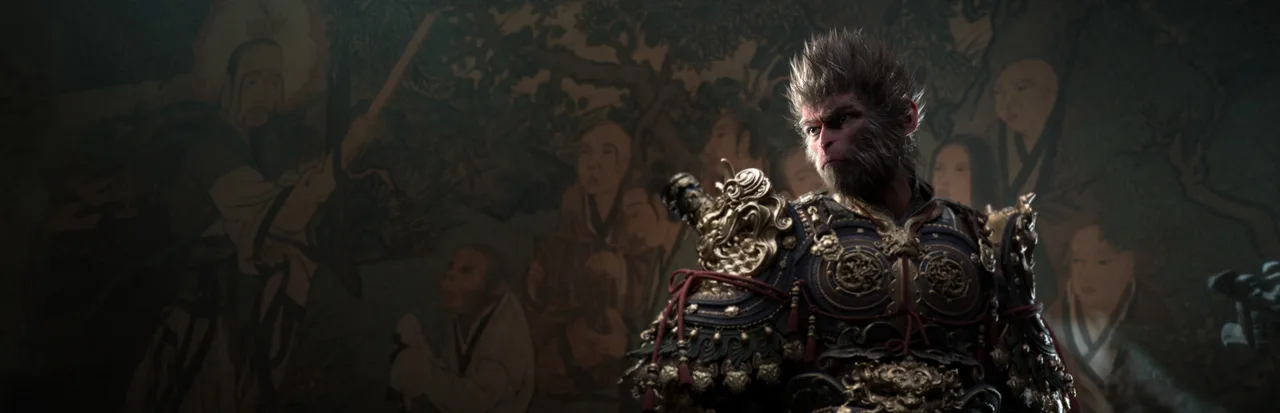
About Black Myth: Wukong
Developed and published by Game Science, Black Myth: Wukong released on 20 August 2024 for PlayStation 5 and PC, and reached Xbox Series X|S on 20 August 2025. This review covers the base game: all six chapters, the secret areas tucked inside five of them, and the challenge modes that unlock once the story is finished.
Six chapters, six different places to be
You play the Destined One, a monkey with a staff walking the road from Journey to the West, and the game is organised the way the novel is: in episodes. Each one is its own region, and the regions do not look or feel anything like each other. A wolf-haunted forest gives way to baked sand and a wind formation, then to snow and a tower, then to silk-strung caverns under a mountain, then to a valley that is on fire, and finally to the mountain itself.
The places are the best argument the game makes for itself, because you are never asked to look at the same view twice. Underneath that, five of the six chapters hide a secret area behind their own chain of optional steps - Chapter 1 puts a temple behind three bells, Chapter 5 buries a cave behind the elemental cart quest - and those detours are where the hardest optional fights and the best rewards sit. Chapter 6 is the one that breaks the pattern: it opens the mountain up instead, so its secrets are hidden chests and optional bosses rather than a region that unlocks for you. Every chapter also ends the same way: with a boss, and then with a short animated film about what you just did.
One staff, three stances
Staves are the only weapon type here and there is no second character to build, but that is not the same as having no gear to think about. Staves are equipment, crafted and upgraded like everything else, each with its own attack value and effect, and they sit in the same equipment screen as the armour and curios you carry. The core staff combat offers three stances. Smash is there from the start and covers mobile charged heavies and close-range punishes. Pillar unlocks at level 5 and lifts you up the shaft for a different angle over ground attacks. Thrust unlocks at level 20 and trades height for reach. You can switch mid-combo, and that switch is the skill ceiling of the whole game.
Light attacks and clean timing build Focus, and a charged heavy spends it, so the rhythm is slower than the animation suggests: much of a fight is about refusing to swing until the heavy is worth more than the hit you are giving up. The skill trees push that further: a perfect dodge is rewarded with Focus, and the Foundation talent called Vengeful Mirage leaves an illusion standing where you dodged that explodes immediately, damaging whatever is nearby.
Every meter is a different decision
The kit is wider than one weapon suggests, and what keeps it readable is that each family of tools draws on its own meter. Mana pays for every spell: Immobilize holds a target in place, Ring of Fire builds you an arena where a swig from the gourd heals for more, Cloud Step leaves a decoy and a screen of mist to slip through, Rock Solid turns you to stone and staggers anything that hits it on time, and A Pluck of Many spits a crowd of duplicates out of a plucked hair. Qi is shared by the Spirits you take off the yaoguai you beat - one borrowed move per cast - and by the Vessels that carry a passive effect plus one big active. Might pays for Transformations, which are full second movesets with their own health bar, so eating a bad phase in the wrong body costs you the transformation rather than the attempt.
Sparks are the skill points, and they come from levelling and from the first use of every Meditation Spot. What makes all of it generous is that none of it is permanent: any Keeper's Shrine will hand back every Spark you have spent, or just the ones you want to move, for nothing. Walk into a boss that punishes the build you brought, spend a moment rebuilding, and try again. A wall in this game usually has an answer that is already somewhere in your kit.
Where the stitching shows
The cost of that many fights is the space between them. Wukong is a corridor of arenas rather than a place you get lost in: the scenery is a gallery you walk through on the way to the next exhibit, and it is worth looking at, but the exploration arrives in set pieces - a bell tucked into a boss arena, a quest that opens a gate - rather than a map that invites you to wander. It launched with no map at all; the Journeyer's Chart, which finally draws each chapter for you, only arrived in the free update at the end of 2024, which says plenty about how little help it offered you in finding your way.
The camera has to work as hard as you do when two big yaoguai share a tight courtyard, and the lock-on makes decisions for you at the worst moments. The bigger trade is the story. The animated shorts that close each chapter are the most interesting thing the game does with Journey to the West, because each one reframes the fight you just survived - but their existence also means the campaign itself plays as a run of introductions to fights rather than a tale you are standing inside.
The pulse
Critic averages settle at 81, with 82% of those reviews positive, which is warm rather than ecstatic. Players were far louder. On Steam the game carries more than 1.2 million user reviews and roughly 96% of them are positive, and it peaked above two million concurrent players on release day. It also cleaned up at the 2024 awards: Game of the Year, Best Game You Suck At and Outstanding Story-Rich at the Steam Awards, Ultimate Game of the Year at the Golden Joysticks, and Best Action Game plus Players' Voice at The Game Awards.
The commercial story is simple. Game Science's own last published figure was ten million copies inside four days, and the game has been a fixture of Steam sales ever since. It is still being worked on, too: the free December 2024 update added the Challenge section at any Keeper's Shrine - Return of Rivals for rematches and the Gauntlet of Legends boss rush - alongside the Journeyer's Chart maps, and 2025 and 2026 brought performance patches, including FSR4 support and a fix for a super-resolution setting that had been quietly costing frames.
What it has not done is sell you the rest of the story. There is no paid expansion, and the announced next step is a different legend: Black Myth: Zhong Kui was announced in 2025 and shown again in 2026, and it is a new hero in the same myth-soaked series rather than more Wukong.
Should you play it
Yes, if you want spectacle with your difficulty. Wukong is built around its fights and never pretends otherwise: one staff, three stances and five meters is a small vocabulary on paper, and it carries a long campaign without repeating itself.
Skip it if the walking is part of the appeal. If what you love about these games is the map, the secrets and the feeling of being somewhere, Wukong will read as a very beautiful corridor. And if you need the plot told to you rather than shown at the end of a chapter, you will spend most of the campaign wondering what anyone is doing.
On the edition question, the base game is the whole game. The only paid extra is a Deluxe Edition upgrade that adds an exclusive weapon, an equipment set, a curio and a music library - pleasant, never needed, and nothing in it changes a fight. If a physical copy matters to you, the PlayStation 5 disc followed after launch and includes a voucher for that same Deluxe content.
Go deeper with V4mp
- Developer
- Game Science
- Genre
- Action RPG
Explore Black Myth: Wukong further
Explore the wiki for detailed reference pages on the game's world, systems, items and locations.