
Plan Rotations and Find Cover Before the Final Circles
On this page
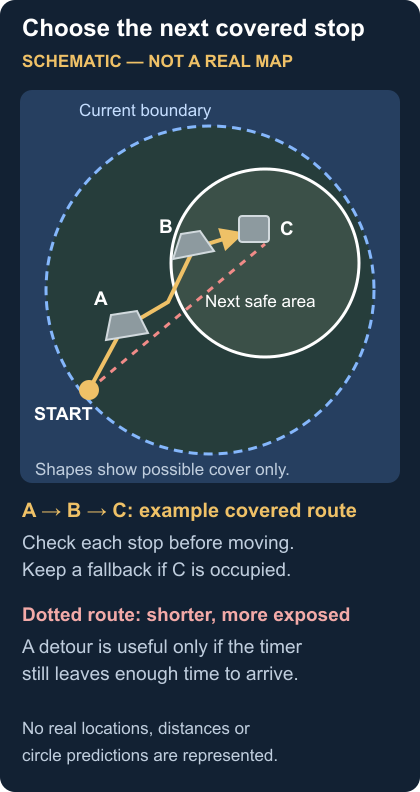
When a new white circle appears, choose a covered destination and a fallback before you start running. A rotation is the move that puts you in a useful position for the next zone. Planning where to stop helps you avoid arriving inside the circle with nowhere to recover or watch for enemies.
Read the destination and the deadline together
The white circle marks the next safe area, and the Blue Zone closes toward it. PUBG Support explains the map symbols. Check the current timer and trace the route from your position, including crossings or obstacles that could slow you down.
The June 2026 Blue Zone revamp introduced damage scaling based on time spent in the damaging zone instead of distance from safety. Prolonged exposure becomes a worse option later in a match. Leave yourself a margin rather than planning to use every second outside the next circle.
Ask three practical questions: where will I stop, what can interrupt the route, and where will I go if the destination is occupied? In a team, communicate the destination and fallback together so everyone is planning the same move.
Compare the crossing, not just the distance
A direct run across open ground may be shorter, while a route through terrain dips and substantial cover may give you places to pause. Neither choice is automatically correct. A long detour can run out of time; a short crossing can expose you to a player you already spotted.
Look for visible rocks, buildings and terrain that interrupt the likely firing angles. Check bridges, water crossings and narrow approaches before committing. The goal is to reduce exposure without creating a route you cannot finish before the zone arrives.
Choose the vehicle’s stopping place first
Vehicles allow faster travel, as the official game overview notes. Consider securing one early when the walking route is long. Before approaching your destination, identify where you want to stop and what cover you will use after leaving it.
Driving into the centre of an unfamiliar compound without an exit plan can leave you making several decisions under fire. Approach a place you can assess, watch likely enemy angles, and keep an alternative available if your preferred stop is occupied. A vehicle gets you there; you still need a useful position when you arrive.
Separate concealment from a dependable stopping place
Grass and bushes can obscure a view, but do not build the whole plan around being unseen. Prefer substantial cover and terrain that shield you from the threat’s direction, while checking other angles. A position that helps against one opponent may expose you to another.
Use smoke to interrupt a sightline during a crossing or recovery, then continue toward cover. Under the interactive smoke rules, explosions can temporarily disperse smoke and vehicles can push it aside. Treat the cloud as a temporary opportunity rather than guaranteed concealment.
After arriving, check likely approaches and preserve a way out. If you reveal your position by shooting, consider whether a nearby change of angle would make the next move safer.
Adjust as the last circles remove options
In the late game, prioritise space, cover and known threats over another round of looting. A central position may leave more routes available but more directions to watch. Playing an edge may simplify the immediate angles while making the next circle harder to reach. Decide from the terrain and opponents you can actually observe.
Before starting a fight, consider whether it helps secure the route or simply delays a necessary move. With teammates, call the direction of a threat and the cover you intend to use. Keep the plan short enough to act on.
Learn from the failed move
After a failed rotation, identify the main cause: leaving late, crossing exposed ground, arriving at occupied cover or stopping for an unnecessary fight. Set one practical goal for the next match. For preparation before leaving, revisit looting and recovery; for the opening phase, use the first-match guide.