Your First PUBG Match: Land, Gear Up and Reach the Next Circle
On this page
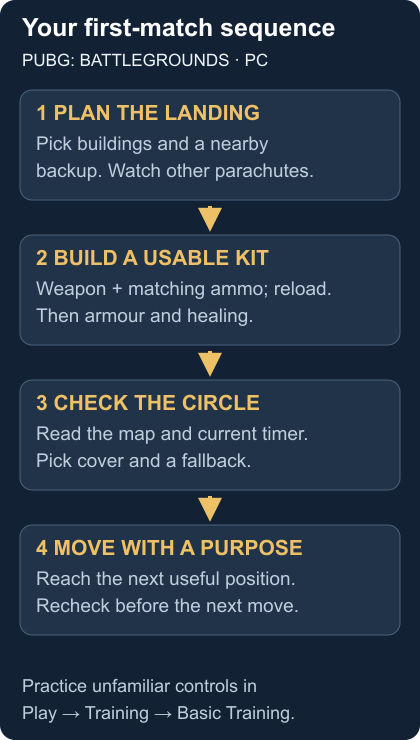
Before your first match, open Play → Training → Basic Training and practise the actions that would otherwise slow you down under fire. Then give your first live match three manageable goals: land somewhere you chose, assemble a usable kit, and reach cover in the next safe area.
Practise the controls you will need immediately
Find your current bindings for the map, inventory, reload, aiming, crouching and healing. Practise picking up a weapon with matching ammunition, reloading it and aiming at a target. Check how shoulder aiming differs from aiming down sights instead of discovering the distinction during a fight.
The current Basic Training sequence teaches these actions alongside parachuting, attachments, armour, healing, throwables, Radio Messages and team systems. Work through its prompts, then repeat whichever action still feels awkward. You do not need to memorise every weapon before playing.
Pick a landing spot with an alternative
Open the map while you are on the plane and choose a small group of buildings. Pick a nearby alternative at the same time. As you descend, look for other parachutes and adjust if your first destination looks too crowded. The official overview explains the landing and looting sequence; the choice of a quieter building group is a useful practice strategy, not a promise that nobody will follow you.
Aim to land where you can reach supplies without an immediate race for the same doorway. In a team, agree on the building group before jumping. Stay close enough to help each other while avoiding a scramble over every item in one room.
Build a kit you can use now
Start with a weapon and the ammunition it actually uses. Load it, check the selected fire mode, then collect armour and healing. Add compatible attachments as you find them. A favourite weapon is a bonus; spending the whole opening searching for it leaves less time to prepare your route.
Assault rifles offer a versatile mid-range option, according to the official weapon overview. Try a gun you find comfortable in training, but check its firing behaviour instead of assuming every rifle works the same way. If sustained fire is missing, practise shorter controlled bursts and returning your aim to the target.
Use a simple stopping point for your initial loot: a loaded weapon, reserve ammunition, protective equipment and some healing. This is a starting checklist rather than an ideal inventory. Our looting and recovery guide explains how to sort the kit without spending too long in menus.
Choose your next stop before leaving
Check the white circle and identify a protected stopping place on the way toward safety. Look at the route as well as the destination: an exposed crossing or an awkward obstacle can take longer than it appears. Consider a vehicle if the journey is long, then decide where you intend to stop before driving in.
The Blue Zone revamp changed Normal and Ranked pacing separately and made damage scaling depend on time spent in the damaging zone. Use the current timer rather than an old memorised schedule. Leave enough margin to change direction if your intended cover is occupied.
Take fights you can support
Before shooting at someone, identify nearby cover, a retreat and a realistic chance to land hits. Passing up an awkward shot can preserve the position you need. With teammates, mark destinations and report a threat’s direction and a clear landmark. Avoid drifting into a separate fight while everyone else is moving.
For more help choosing routes, continue to rotations, cover and final circles.
Diagnose one problem after each match
If you struggled to reload or use healing, practise that action in training. If the Blue Zone caught you, compare your departure time with the route you attempted. If you died while looting, consider whether the position was exposed or whether you stayed after the kit was already usable. Choose one adjustment for the next match rather than changing every setting at once.