
About Satisfactory
It left early access in 2024, and the 1.2 update in 2026 was the first one to reach PC, PlayStation 5 and Xbox Series S|X on the same day. That timing matters if you're choosing a platform now.
What you're doing on Massage-2(AB)b
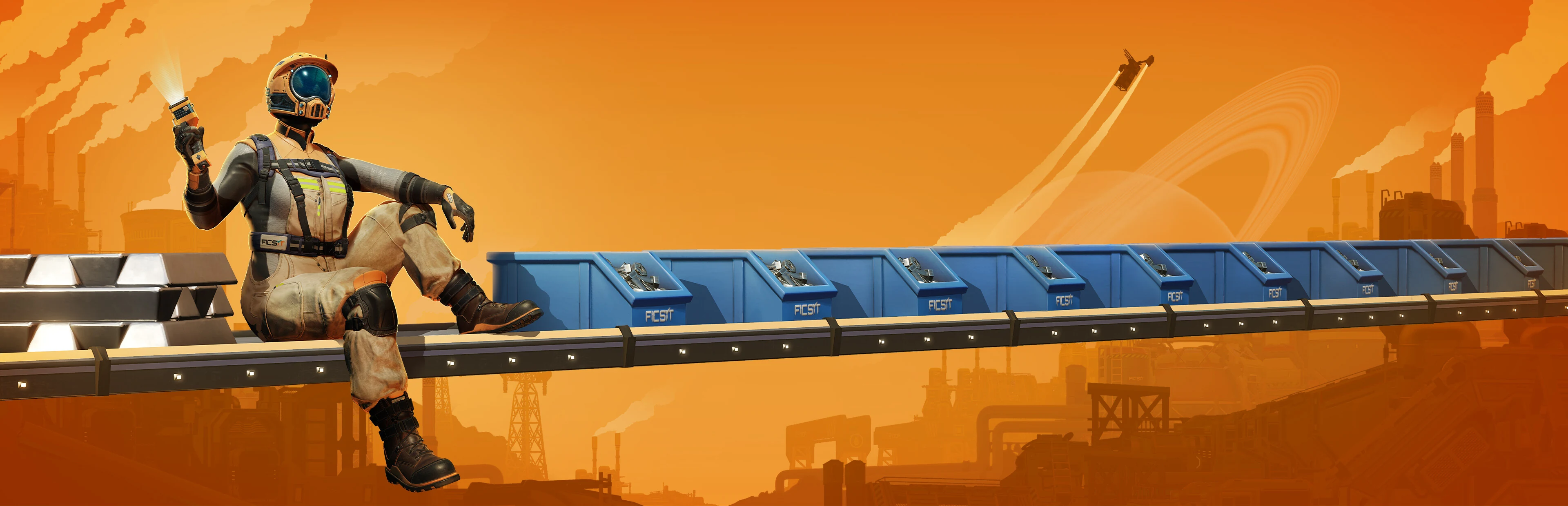
You are a FICSIT pioneer dropped onto a 30 square kilometre map on the planet Massage-2(AB)b with a build gun and a quota. The loop is first-person factory building: scan and mine the resource nodes, turn ore into ingots, ingots into parts, and parts into the next tier of machines that make the next tier of parts.
Everything in between is the actual game. Conveyor belts move solids, pipes move fluids, and getting the two to meet the right machine at the right rate is the puzzle. Power is part of that layout: machines need a connection, generators need fuel to burn, and a factory that outgrows its grid stops dead until you build more of it. As the factory grows you stop walking and start riding: factory carts for short hops, trucks and trains for the long ones, jump pads and hypertubes to get around a building that is now several storeys tall.
It is also built to be shared. The game supports online co-op with cross-platform multiplayer, so a friend on PlayStation can build in the same save as a friend on PC, and the world settings belong to the save rather than to one player.
Logistics is the difficulty curve
There's combat, in the sense that the local wildlife would like a word, and there's safety gear for when it does. But combat is not where the game spends its difficulty. The harder problems are layout and rates: a merged line that can't carry the combined rate, a manifold that hasn't finished filling, a machine whose output has nowhere left to go.
Satisfactory tells you the numbers you need to find them. A Mk.1 belt carries 60 items a minute and a Mk.2 carries 120, so two steady 60-item lines merging into one output need belts rated for at least 120 on every shared segment, including the short connectors between machines. One Mk.1 piece left in the route caps the whole thing at 60. Get it right and the fix for a bottleneck is usually to find the segment that is still undersized rather than to rebuild the factory, with one exception worth remembering: a faster belt never helps a consumer that only takes 60 a minute.
Manifolds have their own rhythm. A row of splitters feeding the same trunk fills the earlier machines first and only spreads to the rest once those inputs back up, so the last machine in the row looks starved for a while before it settles. That warm-up is normal and not a fault. A machine that starves permanently usually means the total supply is short or a segment of the main belt is too slow.
The other half of the discipline is deciding where surplus goes. A full container is not a failure, it is what a buffer is for, as long as the excess has somewhere to go. Put a Smart Splitter on the feed, send one output to storage and set another to Overflow into a powered AWESOME Sink, and the line keeps running at full rate while the container stays full. A container that fills up with no sink or consumer behind it is the actual dead end.
What the 1.2 update changed
Update 1.2 was the first Satisfactory update to launch on PC, PlayStation 5 and Xbox Series S|X at the same time, and it is the first major update the game has had since 1.1 a year earlier.
The headline for anyone with a factory already running is vehicle routing. Vehicle paths are now placed from the Transport tab like railway, and the vehicles themselves are placed on top of the path, so a truck route is drawn rather than driven and then recorded. Paths can be built straight, split per vehicle type and recoloured, and the vehicle menu lists the stations and routes a given vehicle can reach. Existing recorded routes keep working, so an older factory doesn't need to be rebuilt around the change.
Weather came back properly as well. Rain returns with wetness on buildings and the pioneer's suit, wind and fog, several rain densities and thunder, and it is occluded by your buildables rather than falling through the roof. A new World settings tab carries weather presets along with toggles for the visor effect and thunder and a fog density slider, so a player who finds storms irritating can turn the weather down.
The rest of the update is the kind of work a builder notices: an engine upgrade to Unreal Engine 5.6.1, dynamic swapping between gamepad and keyboard when you touch either input, most controller bindings now rebindable, fluid stations and fluid trucks for moving liquids over long distances, and a pause menu that actually pauses the simulation in single-player.
The versions and the settings
Satisfactory is on Windows through Steam and Epic, on PlayStation 5 and Xbox Series S|X, and it has been Steam Deck Verified since early 2026. The console release landed in late 2025 and the 1.2 update shipped to all of those platforms at once. The only paid add-on listed on Steam is the soundtrack.
The settings screen is where difficulty actually lives, and it helps to know which menu you are in. The old Advanced Game Settings menu is now called Creative Mode, and it does what it always did: it opens up free building and turns achievements off for that save. The separate Game Modes menu appears only when you create a new game and leaves achievements alone, and it holds the cost multipliers for Space Elevator deliverables, recipe parts and power consumption along with resource node randomisation and a shareable world seed. Once a setting there is active you cannot turn it off again for that save, and it carries into multiplayer sessions, so read the screen rather than clicking through.
Should you play it
Yes, if the idea of making a thing that runs without you is appealing. The progression gives you a target, the build gun gives you the freedom, and the moment a line you designed runs clean is the payoff the whole game is arranged around. Cross-platform co-op lets players on different supported platforms work on the same factory together.
Where it lands depends on what you enjoy. If you need a story to carry you, the framing is a FICSIT quota rather than a campaign, and progression runs through tiers, milestones and Space Elevator deliverables. If you want combat to feel consequential, the wildlife will interrupt you but it is not the point. If you like systems, rate planning and the specific satisfaction of finding the bottleneck nobody told you about, that is what the game is.
The tradeoffs sit in the settings and the layout rather than in a difficulty menu. You can make resource nodes rich or impure, cut or multiply the cost of everything you deliver, and build in Creative Mode at the price of achievements. Read the save and achievement restrictions before enabling those options.
Go deeper with V4mp
- Developer
- Coffee Stain Studios
- Genre
- Factory building
Explore Satisfactory further
Explore the wiki for detailed reference pages on the game's world, systems, items and locations.