
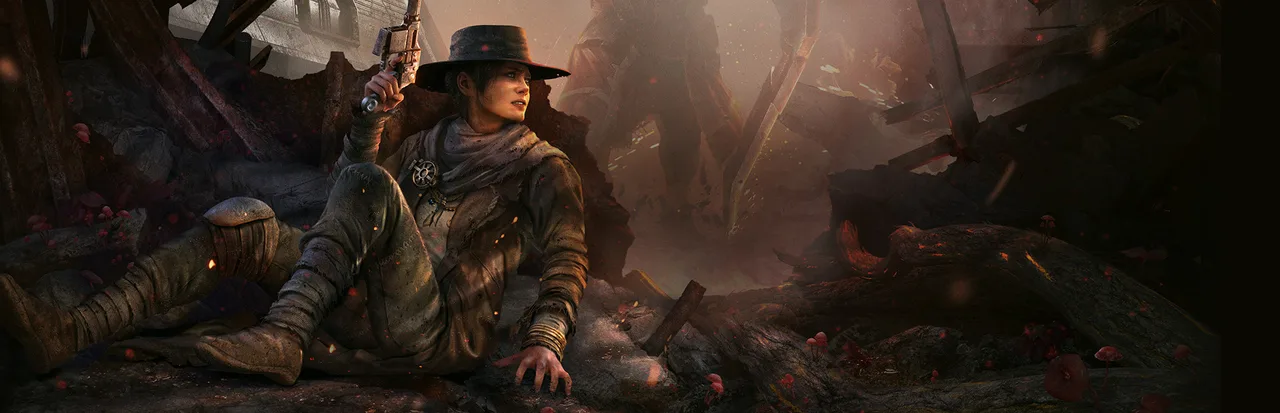
About Remnant: From the Ashes
Gunfire Games built Remnant: From the Ashes on top of the Dark Souls vocabulary, then handed you guns. It arrived on PlayStation 4, Xbox One and PC on 20 August 2019, and this review covers the base game plus both of its expansions, Swamps of Corsus and Subject 2923. It is the game that came before Remnant II: same studio, older build, and a different set of systems underneath the shooting.
A shooter with a soulslike skeleton
You carry two guns and a melee weapon, dodge on a stamina bar, and rest at crystals that bring every ordinary enemy in the area back. Those checkpoints refill your ammo and your Dragon Heart charges, and the Dragon Heart is the healing item you build a fight around: it restores health, and it is the same button that picks a downed teammate back up. It starts limited and gets better once you save the Root Mother, who upgrades it for you.
Gear gets stronger by feeding it materials, not by spending points in a skill tree. Weapons and armour both upgrade with iron and scrap, and a fully upgraded gun hits for three times what it did on the day you found it. Traits sit alongside that as the character half of the build: there are fifty of them, each capped at level twenty, and once one is unlocked it stays switched on permanently. You earn trait points by levelling up, one every fifteen-hundred experience, and by finding Tomes of Knowledge, which sit in the world behind a small blue pillar of light and hand over a point each. If you want your points back, you get the Orb of Undoing from the campaign's final boss, and after that you can buy more from Reggie in Ward 13.
One thing worth saying plainly, because the sequel muddies it: this is not Remnant II. There are no archetypes to run two of at once here, no mutators and no prisms. Your character is your traits plus whatever gear you are carrying, and that is the whole puzzle.
You pick a starting class, not a career
Character creation asks one real question: Scrapper, Ex-Cultist or Hunter. The Scrapper starts in heavy armour with a shotgun and a hammer and is built to win fights at arm's length. The Ex-Cultist gets a coach gun and a healing mod, which makes the early game far more forgiving and makes them the natural pick for keeping a team alive. The Hunter gets a hunting rifle and a mod that marks enemies through walls, and is the choice if you want to delete things from a distance before they notice you.
That choice sets your opening weapons, your first armour set and its bonus, and your starting trait. It does not lock you into anything. Every trait can be earned by any character, and the starting gear of all three classes is sold by the vendors back in Ward 13, so a Scrapper who wants to end up a long-range build is only a few hours behind. Remnant II later grew a full archetype system out of this idea; here it is a starting loadout and nothing more.
Hand-built worlds, shuffled between runs
There are four realms to travel through. Earth is a rusted, half-flooded city over run by the Root. Rhom is a dead desert world of a fallen empire, all bone-white ruins and buried tombs. Corsus is a primordial ice planet cracked open by geothermal heat, which leaves sweltering jungle in the middle of the freeze. Yaesha is green and alive, home to the Pan and their immortal priesthood. Ward 13 is the hub you keep returning to, with Rigs selling and upgrading weapons and armour, McCabe crafting weapons and mods, Ace selling materials, Reggie selling consumables, the Root Mother upgrading your Dragon Heart and Whispers selling armour skins. The Labyrinth is the impossible tower that connects the realms and the place you pick your next world from.
Dungeons, events, enemy spawns and the boss waiting at the end of each realm are drawn from a pool, so what you actually walk through changes between runs even though the sequence of worlds does not. That is the mechanic the whole game is built around, and it is why Adventure Mode is the best thing it did after launch: it lets you re-roll a single realm on its own, without touching your campaign, so when you want one specific boss or one specific drop you can go and look instead of replaying the story. What you find in there is yours to keep, though quest key items stay tied to the campaign that earned them. New Game Plus here is the same idea with a bigger scope: you can re-roll the campaign or an adventure at any time, at a difficulty you choose on the spot, and every weapon, trait and material carries over apart from those campaign quest items.
The catch is that two dials are running at once. The difficulty you pick sets the enemy health and damage multipliers, and on top of that the area scales with your Gear Score independently of that setting. Re-rolling an area you already cleared gets harder as your gear improves, not easier, so an upgrade run is not a victory lap.
Every boss is a blueprint
Bosses drop materials, and McCabe turns those materials into boss weapons and mods. Kill Singe and you walk away with a Blazing Heart that becomes the Spitfire; break Shade and Shatter apart and you get a Black Tear that becomes the Veil of the Black Tear. Several bosses even change what they give you depending on how you finish them, so the same fight can be worth running twice. The upgrade rules are worth knowing before you spend anything: ordinary weapons cap at +20, boss weapons cap at +10, all of them eat iron and scrap the whole way up, boss weapons also want Lumenite Crystals that mostly come off bosses and elites, and the last step of any upgrade wants a single Simulacrum.
Armour is a set of three pieces, head, body and legs, and each set carries a bonus that grows as you wear more of it. Weight matters, because that is what sets your encumbrance and therefore how your dodge behaves, which is why the heavier sets are a real trade rather than a straight upgrade. Around that sit the trinkets: two rings and an amulet, doing the fine-tuning that turns a collection of good items into a build.
Weapon mods are the active half of your kit. A standard gun takes one mod, so you can be carrying two at once across your hand gun and your long gun, and each mod charges up as you land hits before you spend it on a heal, a shield, a burst of damage or a mark. Unique boss weapons arrive with their own mod that cannot be moved, and swapping a mod on anything else empties its charge, which is the game quietly telling you that the checkpoint crystal is where you reshuffle your loadout.
Difficulty, Hardcore and Survival
There are four difficulties, and they do one thing: they change enemy health, enemy damage and the experience you earn. Normal is the baseline. Hard lifts ordinary enemy health by half and their damage by about two thirds. Nightmare more than doubles their health and pushes damage past triple. Apocalypse goes further still, and is the setting for people who have already decided they like being punished. The loot table does not change with difficulty, with one exception: Glowing Fragments only come off bosses once you are on Hard or above, and the harder the setting the more of them you get.
Hardcore is a separate promise, not another difficulty setting. You make a new character, mark it Hardcore, and death ends that save for good. It has its own list of rewards, most of them rings, and the interesting wrinkle is that everything it hands you is account bound, so a Hardcore run that ends badly still leaves your normal characters better off. In multiplayer you only go down if a teammate is still standing to revive you, and it is only when the whole team is on the floor that the run is over.
Survival is the third mode and the most different thing in the package. It is a roguelike: you start in the Labyrinth with a pistol and some scrap, buy what you can from the pillars, teleport into a random location, kill the boss and come back with more scrap before the timer levels the enemies up again. It runs on its own difficulty ladder from Normal up to Apocalypse, and the Glowing Fragments you pull out of it buy armour skins rather than power. It is also the mode most likely to teach you a boss, because it makes you fight with the gear the run gives you instead of the gear you ground out.
The two expansions
Swamps of Corsus arrived on 28 April 2020 and it is the stranger of the two. It adds Survival Mode, a separate Corsus biome for Adventure Mode, and armour skins bought from Whispers with Glowing Fragments. The same stretch of updates also rebuilt the game's own Corsus campaign for free, folding new dungeons, enemies, bosses and rewards into a realm that had been thin.
Subject 2923 followed on 20 August 2020 as the final expansion, and it is the one that closes the story. It adds a second campaign, not a side area, sending you to an abandoned military base called Ward Prime on Earth and to Reisum, a frozen world of mountains and tundra ruled by the Urikki. Reisum's monsters, dungeons and bosses were also added to the Adventure and Survival rotations, so the expansion feeds the modes you already like as well as the new story. Both packs need the base game, Subject 2923 does not need Swamps of Corsus, and the Complete Edition bundles all three parts together.
Co-op changes the maths
You can bring up to two friends, so three survivors in total, and the game makes you pay for the company. More players means enemies with more health, more damage and more of them on the field at once. Two things soften that. Loot drops are instanced rather than contested, so whatever one player picks up the whole party receives too: weapons, armour, rings, trinkets and crafting resources all arrive for everyone. Ammo is the exception, and it stays with whoever grabs it. And resting needs everyone standing at the crystal, which is the same action that puts downed allies back on their feet, so a team that stays near a checkpoint can absorb a lot of mistakes.
The support tools are built for this. Several mods and traits exist mainly to help the people standing next to you, from healing pools to shared marking, and they are far less useful alone. Cross-play is where it gets narrower than the three-player party suggests. There are two pairs that work and no third one joining them: the Xbox console version plays with the Windows version sold through the Microsoft Store, including the Game Pass PC copy, and the Steam and Epic versions play with each other. Solo is completely viable if that is how you want to play, and leaning on the Ex-Cultist's healing or a summoned pet is the closest thing to an easier setting in a fight.
Should you play it
Yes, if you want a shooter that asks you to plan instead of react. The loop that runs through all of it, find the boss, learn its moves, take its parts, build the thing that answers it, is genuinely satisfying, and Adventure Mode turns that loop into something you can farm deliberately. The co-op is easy to drop into, and the amount of gear hidden behind re-rolls means there is always a reason to go back through a world you thought you were done with.
Skip it if you want a tight, hand-authored campaign. The realms are assembled from parts rather than authored as places, and you will feel that as repetition if the reroll is not the part that appeals to you. Skip it as well if you are coming from Remnant II expecting the same toolkit: no dual archetypes, no mutators, no prisms, and a considerably rougher edge on almost everything.
Reception landed the way the design predicts. On Steam the storefront summary reads Very Positive across roughly 57,000 reviews.
Three things before you buy
Check which version you are buying. The Complete Edition includes the base game and both expansions, while Swamps of Corsus and Subject 2923 are also sold separately, and both of them require the base game. Subject 2923 is the story expansion if you only want one, and Swamps of Corsus is the one to buy if Survival Mode is what sold you on the game.
Plan your upgrades before you spend iron. Ordinary weapons go to +20 and boss weapons stop at +10, Lumenite Crystals are the bottleneck for boss gear and Simulacrum is the last step on anything, so a weapon you upgrade on a whim is one you will have to refarm for.
Know your platform. The game came to PC, PlayStation 4 and Xbox One first, and it has since reached Nintendo Switch as well. Cross-play only covers two groups: Xbox consoles with the Windows version sold through the Microsoft Store and Game Pass PC, and Steam with Epic. PlayStation sits outside both, so settle where your group is buying before anyone buys.
Go deeper with V4mp
- Developer
- Gunfire Games
- Genre
- Action RPG shooter
Explore Remnant: From the Ashes further
Explore the wiki for detailed reference pages on the game's world, systems, items and locations.