
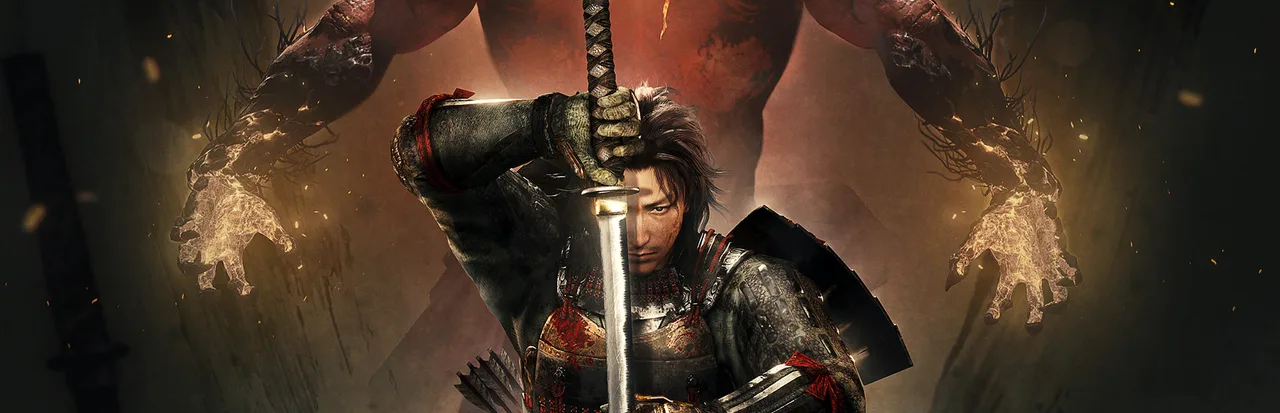
About Nioh 2
Developed by Team NINJA and Kou Shibusawa and published by Koei Tecmo, Nioh 2 came to PlayStation 4 in March 2020 and reached PS5 and PC as The Complete Edition on 5 February 2021. This review covers the Complete Edition, so all three expansions - The Tengu's Disciple, Darkness in the Capital and The First Samurai - are in scope.
You are the yokai this time
Nioh 2 is a prequel, set in a Sengoku-era Japan already crawling with yokai, and the first real decision it makes is one the original never offered: you build the protagonist. Face, gender, build and starting weapon are yours to choose, and the character you end up with is not a visitor to the supernatural. They are a Shiftling, born of a yokai mother and a human father, which means the abilities another game would treat as a late unlock are the premise here.
That single change resets the series. The first Nioh was a story about an outsider collecting power; Nioh 2 is a story about someone who already has it and has to live with what it costs them. The monsters you fight are also what you are, and the combat vocabulary - Guardian Spirits, Yokai Shift, the Dark Realm - is built on top of that idea rather than bolted onto it. Set against 1555 Japan, with the familiar names of the era moving through the campaign, it also carries more story than a prequel usually bothers with.
The red aura is an invitation
Every yokai has a move that reads as cheating the first time you see it: a charging attack flagged in red, an attack that ignores the rhythm you had just learned. Burst Counter is the answer, and it is the best thing Nioh 2 does. Instead of rolling clear and waiting your turn, you step into the attack and turn it back.
That inversion is what separates Nioh 2 from a game that is merely difficult. The scariest animation on screen becomes the moment you are hunting for. Learning a boss here is less about memorising a longer dodge than about picking out the handful of seconds where the game is openly offering you the fight - and then being brave enough to take them twice in a row.
Soul Cores turn the bestiary into a toolbox
Kill a yokai and it may leave a Soul Core behind. Take the core to a shrine, purify it, and you can use that creature's own ability yourself. It is one sentence, and it changes everything underneath: monsters stop being obstacles and start being equipment, and a new region becomes a shopping trip as much as a challenge.
The consequence is two progression ladders running at once, feeding the same fight. One is the human one: the slow build of a character who gets stronger the ordinary way, through the skills and special abilities the game hands out as you progress. The other is the yokai one, where your options come off the corpses of the things that killed you. That layering is why Nioh 2 still holds up years later: there is always one more answer to try, and the answer is usually something you took off a monster.
The Dark Realm makes the floor an opponent
The other new idea is the Dark Realm. Certain enemies drag the arena into a territory of their own making, and the fight changes shape: ground you were happy to stand on stops being neutral, and the encounter tightens around you. It is the cleanest statement of what Nioh 2 is about - you are fighting something that rewrites the room - and it stays tense across a long campaign, which is not something arena modifiers usually manage.
Where it asks too much
Nioh 2 is the densest of the three games, and that density is the price of everything above it. Guardian Spirits, Yokai Shift, Soul Cores, the weapon skills you unlock and the special abilities that come with progress are all live at once, layered over the equipment and loot that this genre always drags behind it. Each system is individually readable. Together they ask you to hold a spreadsheet in your head while something with too many arms swings at it.
The Complete Edition sharpens both ends of that. All three expansions are here, and together they send the story back through the Heian period, which is where the base game's own questions actually get answered rather than extended sideways. This edition is also simply the sensible way to buy the game: one purchase, instead of a base game and three add-ons bought separately.
None of this is unreadable, and the game documents itself better than its reputation suggests. But if you bounced off the first Nioh because the menu felt like homework, Nioh 2 will not rescue you. It doubles down on exactly that.
The pulse
Nioh 2 landed well and has stayed there. Critics put it in the mid-eighties, and on the Complete Edition almost every reviewer who filed recommended it. On PC, more than nine in ten of the ten-thousand-plus English-language user reviews are positive. It also took the 2021 Steam Award for Best Game You Suck At, which is a fairer summary of the pitch than most marketing copy manages.
The numbers held. Over two million copies by April 2021, two and a half million by February 2022, and a series past eight million by the middle of 2025 - and that is before the third game arrived in February 2026.
The other thing worth knowing now is that Nioh 2 is finished. The most recent entry in its own update history is patch 1.28.8, from December 2022. There is no seasonal reset and no live-service treadmill: what you install is the finished thing. With a sequel on the shelf, that makes Nioh 2 a genuine choice rather than a queue.
Should you play it
Yes, and this is the one to start with even though it is the second. The Complete Edition is a finished game with all of its expansions included, a combat system nothing else in its own series has bettered, and a premise that finally gives the yokai half of the title something to do. If the counter clicks, Nioh 2 will hold you for a hundred hours.
Skip it if what you want is a small vocabulary and pure execution. Nioh 2 respects your patience more than your evening: the systems are deep enough to swallow one on their own, and this is a game that wants to be learned rather than simply finished. That is the whole review in one line - Nioh 2 is the series at its most generous and its most demanding at the same moment.
And if you came the other way, from the third game backwards, this is where the lineage gets explained. Everything the later games do with counters and borrowed power starts here, and it starts with you being the monster.
Go deeper with V4mp
- Developer
- Team NINJA
- Genre
- Samurai action RPG
Explore Nioh 2 further
Explore the wiki for detailed reference pages on the game's world, systems, items and locations.