
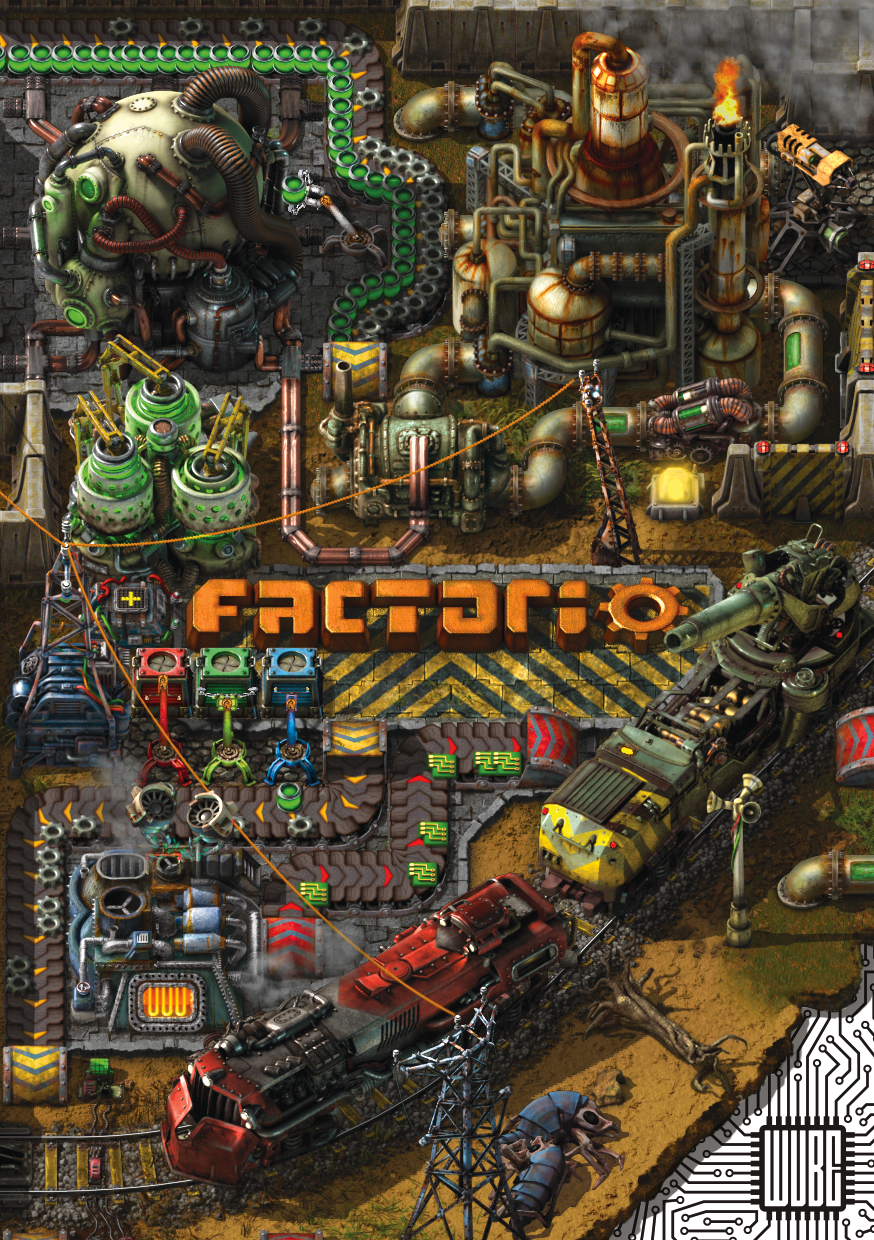
About Factorio
One copy of the base game gets you the whole loop on a map that is very large rather than endless. Space Age is an expansion that requires that copy, adds four planets and space platforms, and rewrites the pacing of a run if you start with it enabled.
What the base game already is
You crash on a planet and work outward from a stone furnace. Mining drills feed belts, belts feed assembling machines, power comes from an offshore pump, a boiler and steam engines, and every finished product becomes an ingredient for something more complicated. The loop holds because it never lies to you: a starved assembler has a visible cause, and finding it is the game.
The 2.0 update that shipped alongside Space Age belongs to the base game rather than the expansion, and it brought broad changes to production, quality-of-life and performance. Buying only Factorio still gets you that technology tree and those changes. The map is finite but very large — a maximum of two million tiles on each side — so a long-running save is not going to run out of room. The base game runs on Windows, macOS and Linux, and it supports cooperative play, LAN co-op and cross-platform multiplayer between those versions. There is also a console release, and the expansion's own purchase page lists the supported platforms for anyone checking their machine first.
What Space Age adds, and what it costs you
Space Age continues the run after rockets, and it ships as a set of four mods: Space Age itself, Quality, Elevated Rails and Recycler. Those mods are packaged so you can enable some without the others: Recycler and Elevated Rails are dependencies of Space Age but can be switched on separately, and Quality is recommended rather than required. Space Age adds four planets you travel to with space platforms, each with its own resource problem, and it moves the victory condition from launching a rocket to building a platform that can reach the solar system edge. The scale is deliberate: new science packs, new buildings, new intermediate products and two new enemy types, with planet-specific mechanics that each break a habit the starting planet taught you.
Quality is the one worth understanding before you start. It introduces higher tiers for items, structures and equipment, created by chance through quality modules, and it is the game's answer to growing upward instead of outward. It is recommended rather than required, and the two highest tiers need technology from two of the later planets. Elevated Rails adds a second layer of track that lets you build intersections and cross terrain and oceans. Recycler turns items back into ingredients at a loss, which is the exchange rate you accept when a factory produces the wrong thing by the thousand.
The honest cost is time. Space Age changes progression and pacing enough that Wube's own advice is to start a fresh save with it enabled rather than adding it to a finished base-game factory, and that advice applies to a first run too. The two modes are really two different campaigns, and a player who bounces off the expansion's opening may still enjoy the base game more.
Space Age availability, plainly
The expansion requires ownership of the base game and is sold directly by Wube, with Steam and Humble listed as the partner storefronts. Buying from Wube upgrades your account on the site, which is what unlocks the direct downloads, and that same account can then redeem a free Steam key — so buying straight from the developer is not a lock-in either. The expansion page lists system requirements as well, and its recommended specification is a clear step up from the minimum.
One platform exception is worth knowing before you buy. Space Age is not available on the original Nintendo Switch release of the game, for space and memory reasons; the Nintendo Switch 2 edition is where the expansion lives, and that edition is out now. Nothing here touches the PC versions, where the expansion is business as usual.
How it plays once you are inside
The pleasure is diagnostic rather than dramatic. A transport belt moves fifteen items a second across two lanes, so each lane carries half of that, and a full lane beside an empty one is not a full belt. Inserters take from behind and drop in front, priorities hide in splitter settings, and a single furnace produces plates at a slower rate than most new players assume. Once you can read a stalled line, the game turns into a series of small, satisfying repairs.
Combat is the other half of the promise. Biters that find themselves in a polluted area try to reach whatever is producing it, and spawners absorb that pollution to muster attack waves, which pushes you to automate defences and walls rather than treat them as a separate game mode. Space Age's platforms then carry that same pressure into orbit, where a platform that cannot handle what meets it is a design problem rather than a bad roll.
Should you play it
Yes. If you are new, buy the base game and play the free 2.0 content first, because the opening hours teach the same skills either way and the base run is the cheaper way to find out whether belts and ratios are your idea of a good evening. If you already know the loop and want more of it, Space Age is a genuine second campaign with new logistics, new hazards and a much larger victory condition.
Two practical notes. Start a new save for Space Age instead of extending an old factory, and check the platform list before you buy, because the expansion is not available on every version of the game. Both are much cheaper to get right on the first evening than to correct a hundred hours later.
Go deeper with V4mp
- Developer
- Wube Software
- Genre
- Factory building
Explore Factorio further
Explore the wiki for detailed reference pages on the game's world, systems, items and locations.