
Fix a Starved Belt Line: Lanes, Inserters and Throughput
On this page
When an assembler repeatedly runs out of plates, follow the missing item upstream before rebuilding the line. The factory may need more smelting, a second usable lane, a correctly placed inserter, or one overlooked belt upgrade. Each problem leaves a different pattern of moving and backed-up items.
Read capacity per lane
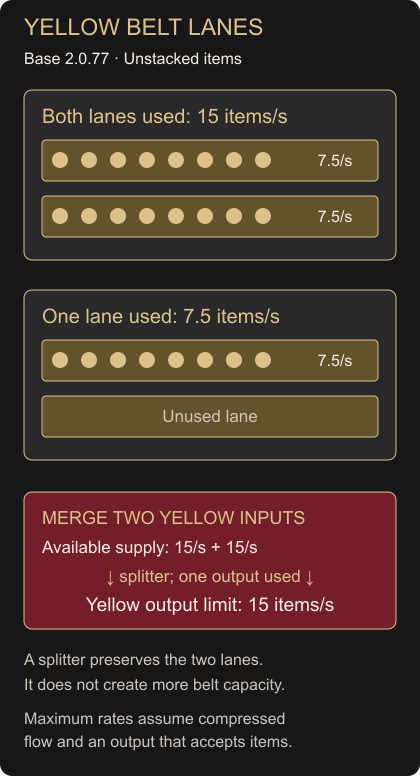
Every belt has two lanes. A full yellow belt carries 15 items per game-second across both lanes, with a limit of 7.5 on each. A full lane beside an empty lane does not provide the full 15-item capacity.
| Belt tier | Both lanes combined | One lane |
|---|---|---|
| Yellow transport belt | 15 items/s | 7.5 items/s |
| Red fast belt | 30 items/s | 15 items/s |
| Blue express belt | 45 items/s | 22.5 items/s |
These are maximum rates for compressed, unstacked items with enough supply and somewhere to go. Sparse production achieves less. Belts themselves use no electricity, although their electric inserters and connected machines do. Belt transport system.
Place the transfer before expanding
Basic yellow belts are available without research. One iron plate plus one gear makes two belt items. Run the belt through the inserter’s pickup tile; a belt ending beside a furnace does not put items inside it automatically. Transport belt.
A standard inserter picks up behind itself and drops in front. It can collect from either belt lane. When a straight belt runs beside an output inserter, the inserter drops onto the far lane. Watch the first few items to check both the arm direction and the lane receiving them. Several arms on the same side can keep filling one lane while leaving the other unused. Inserters.
Side-loading another belt also feeds one receiving lane. Use this deliberately to put ore on one lane and coal on the other for a furnace row. Keep each lane’s intended ingredient clear; randomly mixing several items on one lane makes a shortage harder to trace. Belt lanes.
Use splitters for the right job
With no filter or priority, a splitter divides input evenly between outputs that can accept it. One full yellow input can therefore supply two outputs averaging 7.5 items per second each. If one output backs up, the other can take the available flow up to its capacity. Combining two full yellow inputs into one yellow output still leaves a 15-item-per-second output limit. Splitter.
A splitter preserves left and right lanes; putting one into an uneven line does not automatically balance its lanes. Check its settings too: output priority favours one branch, while a filter directs the chosen item to one output and other items to the other. An unexpected setting can explain why a downstream machine gets nothing. Splitter mechanics.
For crossings, research Logistics for underground belts and splitters at the default cost of 20 red packs. Yellow underground belts bridge four intervening tiles and carry the same total 15 items per second as yellow surface belts. A yellow underground pair or splitter remains a restriction even when the visible surface belt has been upgraded. Technology requirements, underground belt.
Match production to the belt
For ordinary iron, copper, coal or stone, a normal electric drill without bonuses produces 0.5 item per second. Thirty drills therefore have capacity for 15 ore per second. Their outputs still need access to both lanes; loading everything onto one yellow lane caps delivery at 7.5. Electric mining drill.
A normal stone furnace produces iron or copper plates at 0.3125 per second. That makes 24 furnaces a one-lane capacity target and 48 a full-yellow-belt target, assuming continuous ore and fuel, enough transfer and powered electric equipment. These calculations do not apply unchanged to uranium, steel or modded recipes. Stone furnace.
Check a stalled line in order
- Open the first starved machine. Identify the missing ingredient, or check whether its output is already full.
- Follow that ingredient’s lane upstream. A sparse feed from the producers suggests missing production; a queue before a narrow section suggests restricted transport.
- Inspect underground tiers, splitter settings and whether both lanes are useful.
- Check inserter direction, filters and power. Inserters slow under low power and stop filling a machine when its required input buffer is sufficient. Inserter behaviour.
A backed-up belt supplying satisfied machines is normal. Expand the confirmed shortage, then recheck the same machine. For the next production block, use red and green science; for electrical trouble, revisit first steam power.