
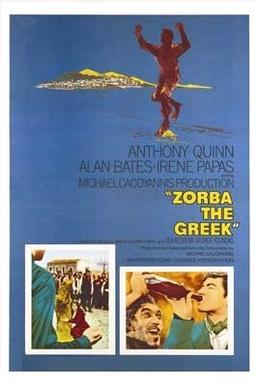
Behind the film
- Year
- 1964
- Director
- Michael Cacoyannis
- Writers
- Michael Cacoyannis
- Runtime
- 2h 22m
- Genres
- Drama, Musical
- Production
- 20th Century Studios
- Country
- Greece, United States, United Kingdom
- Cast
- Anthony Quinn, Alan Bates, Irene Papas, Lila Kedrova
About the film
Contains story spoilers.
Michael Cacoyannis’s 1964 film begins with Basil, a young English writer of Greek ancestry, waiting to leave for Crete. He has inherited a lignite mine from his father and wants to see whether it can be put back to work. At the port he meets Alexis Zorba, an older labourer who talks his way into the journey and soon becomes his partner on the project. Basil is restrained and bookish; Zorba trusts appetite, instinct and action. Their differences are clear before they reach the island, but neither man can simply become the other. The mine gives them a practical reason to stay together while the film tests what each thinks a useful life should look like.
Crete appears as a lived-in community, with people who have known one another for years, gossip that travels quickly and customs that shape who is welcome. Basil and Zorba rent rooms from Madame Hortense, a French woman who runs a small hotel and remembers a younger life spent around naval officers. Zorba begins courting her with a confidence that looks comic from the outside, but she takes the attention seriously. When she becomes ill, Zorba stays beside her; as she lies dying, villagers crowd the hotel, waiting for her death so they can seize her belongings; they rush in as she dies and empty her room. Basil, meanwhile, is drawn to a widow who keeps apart from the local men. Their separate relationships place both visitors inside a community whose rules they do not fully understand.
Zorba’s confidence does not make him a simple philosopher dispensing easy answers. He can be generous, impulsive, self-involved and rough with other people, sometimes in the same scene. He eats, works, flirts, argues and dances with his whole body, while Basil tends to watch, interpret and postpone. Their friendship gives Basil a way to act before he has a complete explanation for what he is doing. That change is gradual: Basil still keeps his distance when the village’s choices become frightening, and Zorba cannot make him brave by insisting that he should be. At the same time, Zorba is not untouched by grief or disappointment. When events turn against him, his energy does not erase the pain; it gives him a way to keep moving through it. Anthony Quinn’s performance makes that tension visible in his face and gait as much as in his speeches.
Madame Hortense’s courtship and Basil’s attraction to the widow unfold beside the mine story, but they do not provide the same kind of escape. Hortense wants Zorba to promise her a future, and he is happy to indulge the hope while keeping his freedom. The widow is treated as a threat by men who believe her independence has humiliated them. Basil’s hesitation leaves her exposed to the village’s anger, which grows into lethal violence. The film is direct about the cruelty she faces, and the contrast matters: Zorba’s confidence often wins him room to move, while a woman living alone has little protection from a community determined to police her choices.
The old mine collapses, leaving the men with a problem beyond finding more ore: they need sound timber to shore up its workings. Zorba makes a deal for wood from a nearby monastery’s forest, then designs a wire system to carry the cut logs down the mountain to the mine. Basil gives him money to buy the cable and supplies at the port of Chania, but Zorba spends much of it on a night out and returns with the materials after wasting time. The scheme is a timber transport line, not the mine itself. Its opening becomes a public event, with food, wine and the villagers gathered to watch. When the logs race down too fast and smash the structure, the mine project is finished for good.
Cacoyannis keeps the film close to the people and places that shape those failures. It was filmed on Crete, and its black-and-white photography by Walter Lassally gives the coastline, village streets and hillsides a strong physical presence. The score by Mikis Theodorakis sits alongside the sounds of work, conversation and music rather than turning every scene into a grand statement. The story comes from Nikos Kazantzakis’s novel, but the film trims its long literary reflections into encounters that can change direction quickly: a meal becomes a negotiation, a dance becomes an answer, and a public gathering can reveal how little control an outsider has over local judgment.
After the timber line collapses and the widow is killed, Basil is left shaken by the losses around him. Zorba does not pretend that the disaster can be made sensible or that a dance will bring anyone back. On the beach, Basil asks Zorba to teach him to dance. Basil has spent much of the story holding himself back until he can think everything through; now he makes the request himself and begins to move. The closing dance is not a neat solution: the money is gone, the mine is ruined, Hortense has died and the widow has been murdered. Basil has learned to respond to life as it arrives, and the two men laugh and dance amid the wreckage of their plans.