
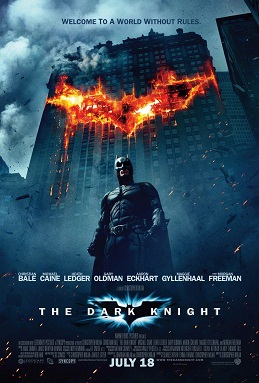
Behind the film
- Year
- 2008
- Director
- Christopher Nolan
- Writers
- Jonathan Nolan, Christopher Nolan, Bob Kane
- Runtime
- 2h 33m
- Genres
- Action, Neo-noir, Crime thriller, Crime
- Production
- Warner Bros. Entertainment, DC Comics, Legendary Pictures
- Country
- United States, United Kingdom
- Cast
- Christian Bale, Michael Caine, Heath Ledger, Gary Oldman, Aaron Eckhart
About the film
Contains story spoilers.
The Dark Knight puts Batman in the awkward position of wanting someone else to succeed him. Harvey Dent can stand in daylight, prosecute criminals and give Gotham a public face for its recovery. Bruce Wayne's mask makes him effective, but it also makes him a poor foundation for a healthy city. Dent appears to offer a future in which people can trust institutions instead of waiting for an armed stranger to arrive.
That hope gives the film a different tension from a straightforward struggle between Batman and the Joker. Dent, Gordon and Batman are trying to build something together, with very different ideas about what the work permits. Their compromises begin before the worst violence. The city is full of people making arrangements with corruption because the clean alternative looks impractical. Once the Joker starts applying pressure, those arrangements become openings he can exploit.
The campaign against Gotham's organised crime gives these questions an immediate setting. Gordon's police work, Dent's prosecutions and Batman's interventions overlap, but none of the three can command the whole system. Criminal money can cross borders, people inside public institutions can be bought, and removing one powerful figure does not guarantee that the network collapses. The Joker enters a situation already shaped by those weaknesses and convinces criminals that his disruptive methods might solve their Batman problem. Bruce has a private reason to hope Dent succeeds too. A Gotham that no longer needs Batman might leave room for a life with Rachel. She has her own relationship with Dent and her own judgment of Bruce's ability to stop wearing the mask. The film makes his imagined future vulnerable before it destroys it. Money, equipment and physical preparation give Bruce considerable control, but they cannot secure the personal life he has attached to his public mission. Gotham needs arrests and public trust at the same time. A spectacular intervention can deliver the first while making the second harder to hold onto.
Heath Ledger makes the Joker unpredictable through small changes in pace. He drifts through a sentence, pauses, then snaps into an ugly threat or a joke. His smeared makeup gives him the appearance of someone who has already abandoned ordinary social rules. The changing stories about his scars offer explanations and immediately make explanations unreliable. Understanding his past will not provide Batman with a useful plan for controlling him.
The interrogation scene is the clearest collision between their methods. Batman can hurt him, yet force cannot guarantee the answer he needs or undo a decision already made elsewhere. The Joker wants to turn that frustration into evidence that everyone eventually abandons their principles. His ferry experiment extends the argument to strangers. Passengers and prisoners are invited to decide that survival excuses murder. Their refusal gives Gotham a moment of moral strength that neither its villain nor its protector can manufacture for it.
Christopher Nolan stages Gotham through broad streets, glass towers and recognisable civic spaces. The city feels like somewhere people work, rather than a sealed world designed around one superhero. That makes the truck chase and hospital destruction feel like attacks on a functioning place. The scale is thrilling, but the cutting repeatedly returns to people whose plans have just collapsed. Action changes the political and emotional situation instead of merely clearing a path to the next confrontation.
Lucius Fox gives Batman's methods a firm point of resistance. The citywide surveillance system might help locate the Joker, but usefulness is not enough to justify giving one person access to everyone else. The display offers Batman information while erasing the privacy of people who never agreed to become part of his operation. This makes the technological spectacle uncomfortable. Equipment that seems to establish Batman as a responsible counterweight to the Joker can extend his power past a boundary even a close ally rejects. Fox gives him a condition rather than unconditional loyalty, so protecting Gotham has to include a limit on the protector. The scene sits within a film that repeatedly asks who gets to decide what an emergency permits. Batman's strength can stop an immediate threat, but its legitimacy cannot come solely from his confidence that he means well. The people beside him need room to challenge what he is doing.
Dent's transformation is the worst damage. Rachel's death breaks the connection between his public mission and the life he hoped it would protect. His coin becomes a way to make revenge look like impartial judgment. Batman's final decision to accept blame for Dent's killings protects the city's belief in its fallen prosecutor, while leaving that belief attached to a lie. The ending therefore carries a real contradiction: Batman gives up his reputation to preserve hope, but Gotham's recovery now depends on concealing what happened. The Joker has been stopped. The problems he exposed remain inside the solution chosen by the men who survived him.