
Behind the film
- Year
- 2019
- Director
- Ruben Fleischer
- Writers
- Rhett Reese, Paul Wernick, David Callaham
- Runtime
- 1h 33m
- Genres
- Zombie comedy, Zombie, Post-apocalyptic, Horror
- Production
- Columbia Pictures
- Country
- United States
- Cast
- Woody Harrelson, Jesse Eisenberg, Emma Stone, Abigail Breslin, Zoey Deutch, Rosario Dawson, Bill Murray, Avan Jogia
About the film
Contains story spoilers, including the ending.
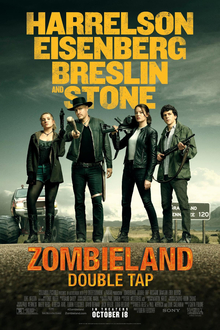
Zombieland: Double Tap reunites four survivors whose greatest source of comfort can also be their greatest irritation. Woody Harrelson, Jesse Eisenberg, Emma Stone and Abigail Breslin return as Tallahassee, Columbus, Wichita and Little Rock in the 2019 sequel. The group has stayed together long enough to become a family, with all the arguments and competing needs that entails. Its travels now stretch from the White House into a country where the zombies have changed too. Different varieties require more than the habits that previously kept the group alive. New human survivors offer friendship, romance and further reasons to argue. The apocalypse remains a place for comic violence, but the immediate trouble concerns people who want different things from the same household.
Columbus proposes to Wichita, while Little Rock grows tired of Tallahassee treating her as a child. The sisters leave, then Wichita returns after Little Rock runs off with Berkeley. Columbus's new companion Madison makes the reunion awkward. Their search takes them to Nevada's Elvis-themed hotel and finally Babylon, a community that destroys incoming weapons. Fireworks attract a horde, and the attempt to burn it with fuel fails to stop enough zombies. Nevada arrives in a monster truck, but the survivors still have to reach a tower. Tallahassee lures the attackers over its edge and hangs from a hook; Little Rock saves him with a hidden pistol. Wichita accepts the proposal, Nevada joins Tallahassee, and Little Rock leaves Berkeley. The family returns to the road with Nevada, while Madison stays behind. Columbus finally recognises home in the people travelling beside him.
The decade between films became a reason for the family's problems. Writers Rhett Reese and Paul Wernick had begun considering a sequel almost immediately, but drafts written around a younger Little Rock stopped fitting as Abigail Breslin grew up. Her desire to leave home supplied a different story. The search for her brings Tallahassee's protective behaviour into conflict with her wish to have a relationship of her own. Reese described later writing as an opportunity to consider what elapsed time meant for the survivors, the zombies and the decaying world. Wernick put the family at the centre of the film, with the undead providing the danger around its familiar disagreements. The sequel asks the group to change its relationships as well as its tactics.
Director Ruben Fleischer gave that passage of time a visible home in the White House. He imagined survivors furnishing it with objects taken from other places, including museum art and oversized roadside-style decoration. Overgrown vegetation makes the building feel abandoned by everyone except its current occupants. Elsewhere, the Hound Dog hotel turns Tallahassee's love of Elvis into a place where he can meet someone who shares it. Fleischer said Woody Harrelson's own enthusiasm helped spark that strand of the story. The opening's slow-motion action used a high-speed camera to put the returning cast inside the zombie mayhem. Rather than introducing the outbreak through separate victims, as the first film had done, the sequel brings its familiar fighters into that elaborate opening display.
The hotel fight that appears to unfold without a cut was assembled from seven shots. Fleischer credited cinematographer Chung-hoon Chung and the stunt team with planning a camera route through the action. The performers and doubles could exchange places within the sequence, allowing a more demanding move to pass into the next piece of acting without an obvious interruption. Fleischer assembled the pieces as they were filmed so the cast could see how the whole passage was working. The White House conversation used a different kind of extended movement, inspired by the walking conversations of The West Wing. One follows an argument through a home; the other follows a fight through a hotel. Both give the actors room to keep their timing connected while the camera moves between them.
Earlier versions of the sequel had treated zombie killing itself as something Tallahassee had grown bored with. Fleischer recalled a draft in which more powerful zombies revived his enthusiasm by giving him a fresh challenge. Other ideas changed size as they developed. Tallahassee originally had a single competitive counterpart before the filmmakers added a matching rival for Columbus. Albuquerque and Flagstaff therefore turn the group's personalities into an encounter with distorted versions of themselves. Eisenberg said the writing's emotional treatment of the characters mattered to him even inside a broad comedy. The finished film can move from grotesque action to a family quarrel because the characters still have personal wants that extend beyond the next kill. The threat gives those wants a deadline rather than replacing them.
The credits return to the beginning of the outbreak for a separate Bill Murray joke. Playing a version of himself, Murray is promoting an imaginary third Garfield film when the press event becomes a zombie attack. The scene grew from his improvised admission of regret about Garfield in the first movie. Reese explained that the writers would not have assumed he wanted to mock his own career; once Murray supplied the joke, they could build on it. Fleischer initially expected actors to play the journalists, then used real entertainment interviewers, including Al Roker. Their familiar professional setting becomes the site of another messy fight. The sequence leaves the central family's journey intact and gives Murray a new encounter with the apocalypse before the events that brought him into their lives.