
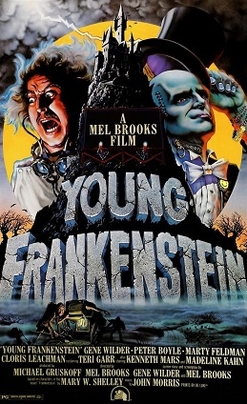
Behind the film
- Year
- 1974
- Director
- Mel Brooks
- Writers
- Mel Brooks, Gene Wilder
- Genres
- Comedy horror, Horror, Science fiction, Parody
- Production
- 20th Century Studios
- Country
- United States
- Cast
- Marty Feldman, Peter Boyle, Teri Garr, Madeline Kahn, Cloris Leachman, Kenneth Mars, Richard Haydn, Gene Hackman
About the film
Contains story spoilers.
Frederick Frankenstein is a respected American medical lecturer who would rather discuss the nervous system than his notorious family. He insists that the name is pronounced “Fronkensteen,” a small act of distance from his grandfather Victor and the experiments that made him infamous. That boundary fails when a legal notice tells Frederick he has inherited the family estate in Transylvania. On arriving at the station, he meets Igor, the grandson of his grandfather’s assistant, and Inga, who is to help him at the castle. The housekeeper, Frau Blücher, knows far more about the old laboratory than Frederick expects. Behind a hidden passage, he finds Victor’s notes and equipment, and his scientific curiosity begins to outrun the careful identity he built in America. The joke is not simply that he repeats the old story: Frederick initially believes he can visit its machinery without becoming part of its history.
The film gives that turn a gothic frame. It is shot in black and white, with old-fashioned titles and transitions, and the laboratory fills the castle with levers, coils and electrical apparatus. Brooks and Wilder built a comedy that treats these conventions seriously enough for the jokes to land against them. Frederick and Igor obtain the body of an executed criminal, then try to find a suitable brain. Igor is sent to steal the brain of Hans Delbrück, a celebrated scientist, but breaks it and substitutes one marked “Abnormal.” Frederick does not know what has been put into the skull. The creature wakes during the storm and nearly strangles his maker. The fear is real inside the scene, even as the wrong brain, the assistant’s confidence and the overbuilt machinery keep turning the horror setup into physical comedy.
Frederick’s experiment also draws the attention of the village. Inspector Kemp, whose artificial arm and eye make him a comic echo of earlier Frankenstein films, wants reassurance that the doctor will not create another monster. But the creature is already loose, and Frau Blücher has helped it escape. She reveals her former relationship with Victor and understands how to soothe the being with violin music. Sparks from a switch frighten it into fleeing the castle and wandering the countryside. One encounter reworks the old image of a creature meeting a child; another sends it to a blind hermit who welcomes a stranger into his cottage. The hermit’s kindness cannot overcome the practical mishaps of their meeting. The creature is burned, frightened and alone again, a succession of slapstick accidents that still leaves him with the film’s clearest desire: to be treated as a person rather than hunted as a spectacle.
Frederick eventually finds the creature and changes his approach. Instead of treating him as a failed experiment to be restrained, he praises him and promises to help him succeed. He introduces the creature to a gathered audience as a being capable of following commands, then stages their duet to “Puttin’ on the Ritz” in white tie and tails. The polished performance briefly turns the laboratory’s threat into a theatrical partnership. A stage light explodes, however, and the creature panics when the audience laughs and throws vegetables. The crowd sees a monster again; the creature experiences another public rejection and is chained up. That turn gives the dance its purpose in the plot: Frederick’s confidence in controlling the experiment is exposed as another performance, one that collapses as soon as the creature becomes unpredictable.
Frederick’s fiancée Elizabeth arrives just as the situation unravels. The creature escapes captivity and takes her with him; what begins as an abduction becomes an unexpected romance, while Frederick and Inga’s relationship has already moved beyond the professional. The village mobilizes against the creature, and Frederick and Igor lure him back with music before the mob can destroy him. Frederick then tries to repair the damage of his experiment by transferring some of his own stabilizing intellect to the creature. When the villagers break into the laboratory, the creature can reason with them, and Kemp gives him a warm reception. The ending lets the two couples form around the identities they have chosen: Frederick marries Inga, while Elizabeth stays with the creature. The doctor’s final growl suggests the exchange also changed him, leaving the boundary between creator and creation pointedly unsettled.
The comic rhythm depends on how carefully the film holds its old horror surface in place. Wilder’s Frederick can switch from measured professor to panic-struck descendant; Feldman’s Igor keeps interrupting that control with a shifting hump and blunt confidence; and Boyle gives the creature a mixture of menace and awkward openness. The supporting cast turns castle and village into a world of familiar genre types whose reactions still drive events. Brooks and Wilder’s affection for the 1930s Frankenstein films is visible in the monochrome photography, the dramatic laboratory and the familiar escapes, while the absurdity comes from how bodies, props and people misfire. Songs, pratfalls and recurring bits such as the horses’ response to Frau Blücher sit beside genuine suspense. The story keeps returning to the question of what happens after creation: whether the being will be feared, guided, or welcomed.