
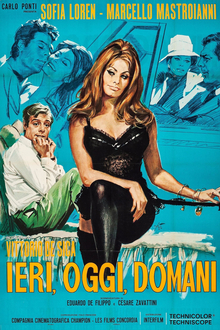
Behind the film
- Year
- 1963
- Director
- Vittorio De Sica
- Writers
- Eduardo De Filippo, Cesare Zavattini, Billa Billa, Isabella Quarantotti
- Runtime
- 1h 58m
- Genres
- Comedy
- Country
- Italy, France
- Cast
- Sophia Loren, Marcello Mastroianni, Aldo Giuffrè
About the film
Contains story spoilers.
Yesterday, Today and Tomorrow begins in Naples with Adelina, who supports her unemployed husband Carmine by selling contraband cigarettes. An unpaid fine threatens the family's possessions and then Adelina herself with imprisonment. A lawyer explains the protection given to pregnant women and mothers in the months after childbirth, so she sets out to remain pregnant. The plan works for years, until Carmine is exhausted and cannot continue. Adelina considers turning to their friend Pasquale but changes her mind. She eventually goes to prison, where the neighbourhood's effort to collect money and seek a pardon brings her home. The joke stretches a desperate household solution across an increasingly crowded family.
The Milan episode replaces the crowded household with a wealthy industrialist's Rolls-Royce. His wife Anna takes her lover Renzo into the countryside while her husband is away. She complains about a marriage dominated by money and work, then proposes leaving with Renzo. When she lets him drive, his attempt to avoid a boy selling flowers ends in a collision with a tractor. Anna's anger over the damaged car abruptly ends her romantic mood. She accepts a lift and leaves Renzo behind. His discarded bouquet completes their failed outing. A minor accident exposes the fragile relationship beneath Anna's talk of escaping her affluent life.
In Rome, Mara works as a sex worker from an apartment near Piazza Navona, with Augusto among her regular clients. Across the way, a religious grandmother is hosting her grandson Umberto, a seminarian who falls for Mara without knowing her occupation. His threat to abandon his vocation brings his distressed grandmother to Mara for help. Mara persuades him to return to his studies. She has promised to abstain from sex for a week if he does so, which leaves Augusto frustrated when their time together finally arrives. Her striptease ends without the intimacy he expects. The woman condemned by her neighbour has become the person who restores the grandson's commitment.
The film's three-city form grew out of a less settled writing process than the finished sequence suggests. Cesare Zavattini initially described a project provisionally called Tre donne, with three sketches for Loren directed by De Sica. His surviving correspondence and diaries record uncertainty about the Milan story and disagreements with producer Carlo Ponti over the shape of the film. The eventual division of work left Zavattini responsible for Mara's original story and involved in adapting Alberto Moravia's Troppo ricca for Anna with Billa Billa, the pen name of Marialisa Zanuso. Mara itself survives in a subject and three screenplay variants. The archive's comparison identifies the last version as closest to the completed film. That history distinguishes an idea developed through successive scripts from the final performances and situations viewers recognise. Zavattini's dissatisfaction also complicates any picture of the anthology as an effortless reunion of established collaborators: he felt pushed aside in a project whose original conception he regarded as his own. The contrast between Ponti's decisions and Zavattini's ambitions belongs to the film's writing history, alongside the deliberate movement among Naples, Milan and Rome.
A discarded proposal shows how differently the Milan episode might have developed. Zavattini had written Cocaina, about a newly married couple who try cocaine and become ill, forcing them to call their parents. De Sica wanted to use the idea and discussed it in a July 1963 interview, but said the American coproducers working with Ponti would not accept the subject. He argued that the comic failure of the experiment could puncture the drug's supposed glamour. That proposal never became Anna. Zavattini's idea instead resurfaced in the later anthology Controsesso as Cocaina di domenica, directed by Franco Rossi and performed by Nino Manfredi and Anna Maria Ferrero. It therefore belongs to the route by which the production reached its released selection of stories, rather than to the plot of Yesterday, Today and Tomorrow. The surviving account makes clear that choosing three cities did not mean their episodes were fixed from the start: a possible Milan story could be rejected, replaced and eventually used with another director and cast.
Loren remembered the completed film through the pleasure of performing with De Sica and Mastroianni. In a later interview, she linked her ease with De Sica to their shared Neapolitan background and singled out the striptease as an especially enjoyable moment on set. Mastroianni's increasingly vocal response as she removed clothing had the crew laughing. Her memory places the humour in an exchange between performers, with his reaction forming part of the scene's attraction. The familiar image of Loren dancing depends on the spectator inside the scene as well as on the dance itself; Augusto's enthusiasm gives her gestures a comic answer. Across the three episodes, Giuseppe Rotunno supplies the cinematography, Adriana Novelli the editing and Armando Trovajoli the music. De Sica's direction and the returning leads keep the anthology together as the characters, cities and circumstances change.