
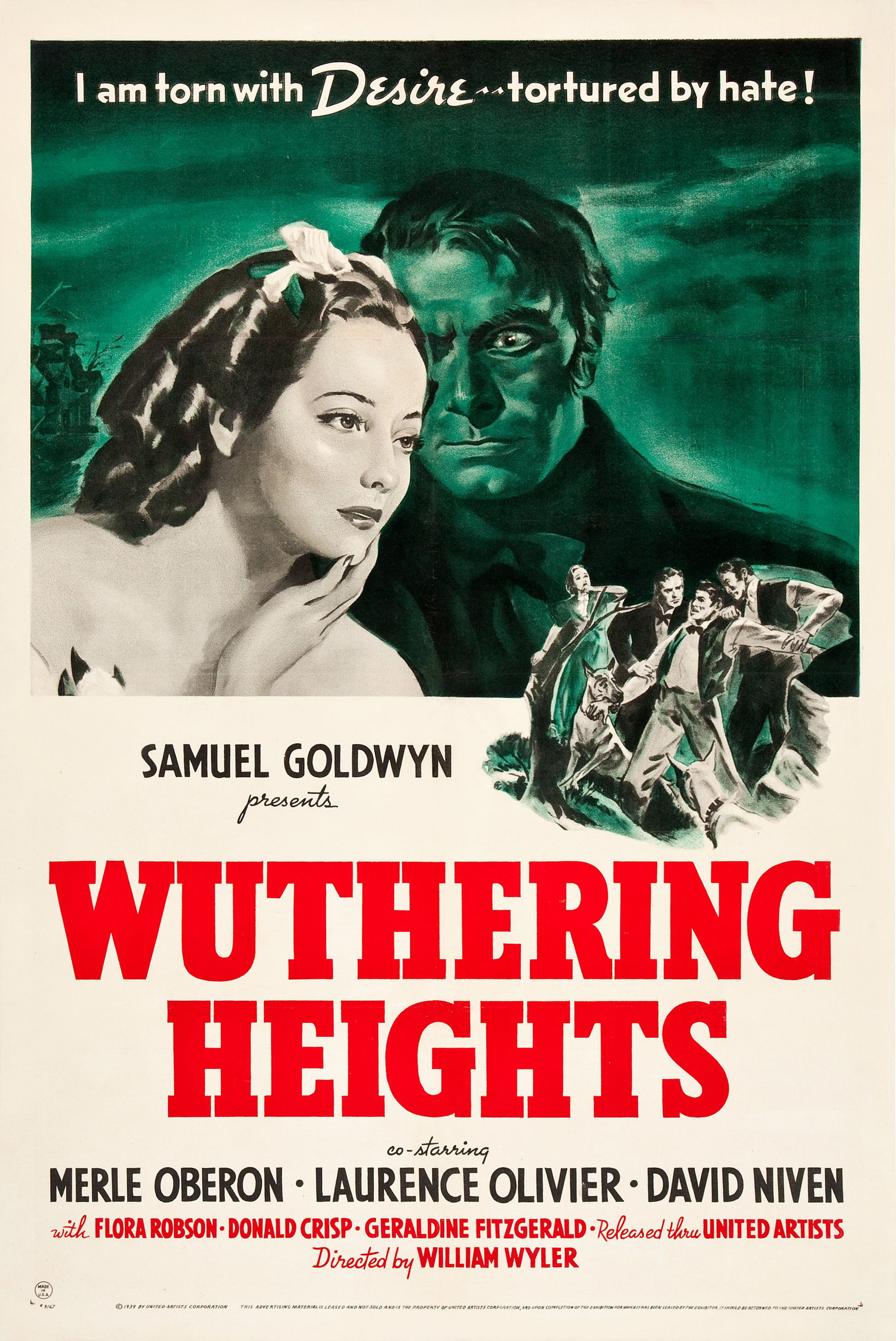
Behind the film
- Year
- 1939
- Director
- William Wyler
- Writers
- Ben Hecht, John Huston, Charles MacArthur
- Runtime
- 1h 39m
- Genres
- Drama, Romance
- Production
- Samuel Goldwyn Productions
- Country
- United States
- Cast
- Merle Oberon, Laurence Olivier, David Niven, Geraldine Fitzgerald, Flora Robson, Donald Crisp, Leo G. Carroll, Cecil Kellaway
About the film
Contains story spoilers.
On a snowy night in Yorkshire, Lockwood arrives at Wuthering Heights, the home of the withdrawn Heathcliff. During the night he hears a woman's voice calling “Cathy” and feels a cold hand at the window. Heathcliff rushes outside into the storm, and Lockwood asks housekeeper Ellen Dean to explain the name. Ellen takes him back forty years, to the time when Mr. Earnshaw brought home an orphaned boy and gave him the name Heathcliff. His daughter Cathy takes to the newcomer, but her brother Hindley resents him from the start and throws a stone at him.
Cathy and Heathcliff make a world for themselves at Peniston Crag, pretending to rule a castle on the moor. After Mr. Earnshaw dies, Hindley inherits the house and makes Heathcliff a stableboy. One night the pair look into a ball at the Linton home, where guard dogs injure Cathy. The Lintons nurse her but reject Heathcliff. Cathy urges him to leave and return with enough money to win their respect. The household that shelters her offers the comforts and position that her childhood companion cannot provide.
When Cathy later tells Ellen that Edgar Linton has proposed, Heathcliff hears her say that marrying him would lower her standing. He leaves before hearing her declaration of love for him. Cathy runs after him, collapses on the moor and is found by Edgar. She recovers from pneumonia and marries Edgar, while Heathcliff disappears. The missed part of her confession turns a difference in circumstances into a separation neither can take back. Edgar’s affection and his family’s wealth give Cathy a secure future, but they do not end her bond with Heathcliff.
Heathcliff returns wealthy and buys Wuthering Heights by paying Hindley’s debts. His new standing does not bring the reunion he wanted: Cathy rejects him, and he marries Edgar’s sister Isabella. Isabella becomes the target of his resentment toward Cathy, trapped in a marriage whose outward respectability conceals cruelty. When Cathy falls gravely ill, she sends for Isabella, who refuses to visit. Heathcliff hears the news and rushes to Cathy despite Isabella’s objections. His revenge has injured people around them without freeing him from the attachment that first drove him away.
As Edgar gathers heather outside, Cathy confesses her love for Heathcliff. He carries her to the window for a last look at the moors before she dies in his arms, then begs her spirit to haunt him. Ellen’s account ends, and Dr. Kenneth arrives with news that he saw Heathcliff outside with a woman, only to find him dead when he approached. The closing image reunites Cathy and Heathcliff as spirits walking toward their childhood refuge. Lockwood’s night at the house has opened onto a history that continues beyond either lover’s death.
William Wyler's version uses Ellen's account as a frame: Lockwood's encounter with Heathcliff gives the past the feel of a mystery being retold, and the opening ghostly touch sets the moors between ordinary life and the supernatural. The camera often places the lovers against wide, empty slopes, then brings them into the confined rooms of Wuthering Heights and the Linton home. The 1939 film turns the novel's first generation into a contained tragedy and leaves the later generation out of its story.
The contrast between the two houses shapes how Cathy and Heathcliff imagine a life together. Wuthering Heights is tied to Hindley's authority and to the labour Heathcliff is forced to do; the Lintons' estate offers Cathy safety, attention and social standing. Her choice of Edgar is not simply a rejection of Heathcliff, and his return with money cannot undo the years that changed them. The film nevertheless steers their bond toward romantic destiny: the scene of their reunion after death gives the story a clear, ghostly resolution. That ending was added at producer Samuel Goldwyn's insistence after Wyler resisted a supernatural coda.
The production's own artificial moors add to the film's enclosed, theatrical feeling. The hills near Los Angeles were dressed with purple sawdust and imported heather, while Gregg Toland's black-and-white photography won the film its Academy Award. Merle Oberon, Laurence Olivier and David Niven play the triangle at the centre of the household: Cathy moves between the wild intimacy of her childhood with Heathcliff and the security offered by Edgar, while Isabella becomes caught in Heathcliff's attempt to punish Cathy. The film keeps its focus on these adult relationships and on the first generation, rather than carrying Brontë's story into the next family's lives. Wyler’s demands also pushed Olivier away from the habits of stage performance. Repeated takes frustrated the actor, who eventually acknowledged that the director had something to teach him about working for the camera. Their argument over how to play a scene became part of a longer collaboration: Olivier later wanted Wyler to direct Henry V, and they worked together again on Carrie. The moorland romance was therefore made through a combination of fabricated landscapes, controlled photography and performances repeatedly tested for their effect on film.