
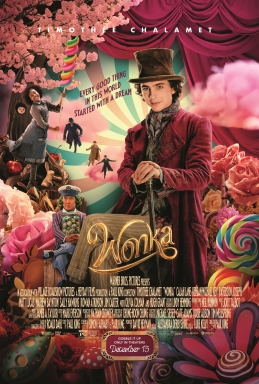
Behind the film
- Year
- 2023
- Director
- Paul King
- Writers
- Simon Farnaby, Paul King
- Runtime
- 1h 56m
- Genres
- Comedy, Musical, Adventure, Speculative fiction
- Production
- Heyday Films, Warner Bros. Entertainment
- Country
- United States, United Kingdom, Canada
- Cast
- Timothée Chalamet, Gustave Die, Murray McArthur, Paul G. Raymond, Bertie Caplan, Isy Suttie, Kobna Holdbrook-Smith, Tom Davis
About the film
Contains story spoilers.
Wonka arrives in a city where chocolate is a business controlled by three wealthy rivals and a police chief happy to accept their bribes. His ambition is to share the wonder of his own sweets, but the system is arranged to keep newcomers out. Mrs. Scrubitt's boarding house becomes another trap: the contract she persuades him to sign turns lodging into forced work in her laundry. His fellow workers, including Noodle, become allies in the effort to sell chocolate and escape their debts. Lofty, an Oompa-Loompa, presents a different problem. Wonka took cocoa beans from Loompaland, and Lofty has followed him to demand repayment in chocolate. Even when Wonka's inventions win customers, the cartel can exploit its money and influence to drive him away. His success depends on overcoming that network, as well as making something people want to buy.
The cartel sabotages Wonka's shop and offers to clear the workers' debts if he leaves. Noodle remains captive, and Wonka escapes an explosive boat to return for her. They seek the account book that can expose the bribes. Slugworth reveals that Noodle is his niece: he gave her to Scrubitt and told her mother Dorothy that she had died. He locks Noodle and Wonka in liquid chocolate, but Lofty rescues them. They expose the cartel and release its chocolate reserve into the fountain; the rivals float away after eating hoverchocs, and the police chief is arrested. Wonka reunites Noodle with Dorothy, then buys a castle for his factory, with Lofty heading the tasting department. The resolution gives Noodle the family stolen from her and gives Wonka a place to continue his inventions.
Paul King and Simon Farnaby built this prequel around Wonka before he becomes the mysterious factory owner from Roald Dahl's story. King has described the young chocolatier as hopeful, poor and new to the city, with a childlike outlook that leaves him unprepared for business rivals and predatory contracts. That choice gives the story a different starting point from the familiar Wonka: the character is not yet withholding secrets from children, but trying to make a life and find a place for his inventions. King connected this early version to Charlie Chaplin's innocent outsider and to the generous spirit he saw beneath the older character's eccentric exterior.
The city was designed as a blended, storybook Europe rather than a precise map of one country. Nathan Crowley and his team mixed architectural references from several European regions, then built a large town square, the Galéries Gourmet, the cathedral and Scrubitt's laundry across Leavesden sets and a backlot. Crowley said the scale of the square had to work for the camera so audiences could read the action, while Wonka's own chocolate shop used a separate stage and visual details drawn from his childhood memories with his mother. Those design choices connect the city to the characters: the cartel's shops communicate wealth and order, while Wonka's imagined shop is warmer and more personal. Crowley began the shop with a curved chocolate tree, surrounded by edible flowers and a walkway. The barge and waves recalled the canal-boat childhood he imagined for Wonka. A rotating tree gave the musical number physical movement. Crowley valued constructing and adjusting real sets with the director, treating the process as sculpture rather than simply reproducing a finished illustration.
The musical approach connects the film to the 1971 adaptation, which expresses Wonka's hopes through song. King and Farnaby marked possible song moments in their drafts; Neil Hannon then replaced their initial lyrics with his own work. The production notes describe the placement, length and ownership of the songs as decisions that continued to develop as the film came together. Composer Joby Talbot also arranged the songs so they could emerge from the score naturally. He reused Hannon's melodies as character motifs, helping the spoken and sung scenes belong to the same musical world. Choirs, bells, brass and folk instruments supplied its varied sound, while daily dance and music rehearsals ran alongside the main unit's filming.
Costume design gives the city's factions a visible identity. Lindy Hemming worked with Crowley week by week so the clothes and sets shared a palette, using color to make the cartel members recognizable without dressing them as a theatrical lineup. Her team drew and made the principal costumes, adding embroidery and treated fabrics to give the garments a past. Wonka's coat and hat were imagined as things he might have gathered while traveling, with each piece carrying a small story. Hemming also considered the crowd part of the image, selecting and moving background performers so each frame held a varied mix of colors and characters. The costumes help make the world feel lived in even as it stays heightened and fantastical. That detail work lets the designs register as part of the characters' histories, not just decoration for a musical number.