
Behind the film
- Year
- 2017
- Director
- Stephen Chbosky
- Writers
- Steven Conrad, Jack Thorne, Stephen Chbosky
- Genres
- Drama
- Production
- Starz Entertainment, Mandeville Films, Participant
- Country
- United States
- Cast
- Julia Roberts, Owen Wilson, Jacob Tremblay, Mandy Patinkin, Crystal Lowe, Sônia Braga, Izabela Vidovic, Ali Liebert
About the film
Contains story spoilers, including the ending.
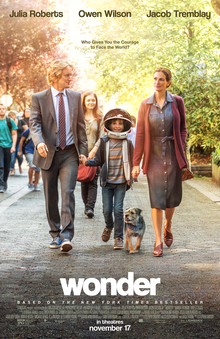
Wonder follows Auggie Pullman's first year at Beecher Prep after being homeschooled. Jacob Tremblay plays the boy, with Julia Roberts and Owen Wilson as his parents, Isabel and Nate. Stephen Chbosky directs the 2017 adaptation of R.J. Palacio's novel. Auggie's facial difference attracts stares and bullying, but he becomes friends with Jack Will and Summer. At Halloween, a costume lets him overhear Jack joining in hurtful talk about him. Their friendship breaks before Jack apologises and they reconcile. Auggie's sister Via also feels overlooked and finds a new place in her school's theatre group. Later, classmates defend Auggie and Jack from older boys during a retreat. At the year-end ceremony, Auggie receives a medal. The school year closes with public recognition for a child who began it worried about being seen.
Palacio described the film's expanded attention to Isabel and Nate as a change from the novel's child-centred perspectives. The book lets readers know the parents through what their children observe, while the adaptation gives the adults scenes without them. Chbosky wanted room for the mother's experience of the first day of school as well as the son's. Isabel returning to an empty house is part of the same separation that Auggie experiences in a busy classroom. The director also consulted Palacio about details outside the novel, from the family's belongings to Isabel's dissertation. She could supply possibilities without determining every final choice. Chbosky described practical makeup as essential to his approach to Auggie. He wanted Tremblay's own voice, mouth and eyes to carry the performance, with digital work limited to small adjustments. The character's feelings needed to remain the young actor's work through the physical transformation.
Chbosky and cinematographer Don Burgess discussed giving the different characters their own visual treatment. Working with children, makeup and a dog made time on set particularly limited, so three cameras often ran together. Chbosky kept rehearsal light after an initial read-through, asking the children to know their lines while leaving room for spontaneous behaviour. The boys' burping contest was one of the moments he kept. Auggie's space fantasies required a different approach to movement. Burgess experimented with shutter speeds, and the filmmakers used slow motion to give the astronaut's joyful skip a weightless quality. A trampoline helped produce the opening image. Chbosky described the goal as a child's version of floating in space rather than a technically exact recreation. That approach lets Auggie's interest in astronauts become a way of inhabiting the school corridor, carrying his private imagination into a setting where he initially feels exposed.
Makeup designer Arjen Tuiten had to fit Auggie's appearance around Tremblay's working day. He explained that a conventional application lasting several hours would leave too little time to film. The team designed the pieces to assemble more quickly and brought the process down to about seventy-five minutes, including hair, teeth and lenses. Silicone pieces covered the neck, chin and cheeks, while an underlying structure helped change the appearance of the eyes and ears. Tremblay's growth during production meant that spare teeth and flexible construction were necessary. Tuiten also met the actor and his parents before committing to the approach, concerned with how a child would respond to wearing the materials repeatedly.
Production designer Kalina Ivanov made the Pullman house feel occupied rather than perfectly arranged. Auggie's bedroom carries a night-sky mural, while Via's has a daytime sky with clouds. The designs suggest their illustrator mother's response to two different children. Auggie's hospital bracelets were arranged on a corkboard after an earlier growth-chart idea proved less suitable for the camera. Beecher Prep drew on the Brooklyn school attended by Palacio's children. Green chalkboards in wooden frames and personal notes helped give Mr Browne's classroom warmth, with decoration changing across the school year. The science fair used projects collected from local schools, while the art department made Auggie and Jack's camera obscura. Costume designer Monique Prudhomme also followed changes in the children. Auggie wears fewer hoodies as he becomes more comfortable. Via's clothes change as she starts high school and grows closer to Justin. The family and school environments carry those changes through objects and clothing.
Tremblay's preparation included letters from children with facial differences. He and his parents approached families through Toronto's Hospital for Sick Children and gathered the replies in a binder. He recalled reading some of those letters before the more serious scenes. The prosthetics also helped him enter the role, giving him a physical experience different from his own appearance between filming days. Auggie's love of Star Wars was easier for him to share. Tremblay described recognising the performer inside Chewbacca's costume when the character appeared for one of Auggie's imagined encounters.
Wilson described Chbosky as calm and encouraging under the demands of a shoot with children and extensive makeup. He found the director's manner consistent with the film's concern for kindness. Wilson also spoke about approaching acting through the habits of a writer, thinking of possible lines or changes to a scene and offering them to the director. Roberts's attention to the shoes Isabel might wear made him reflect on the different ways performers prepare. Within a story about parents learning how much space to give their children, those approaches build the adults through both conversation and ordinary personal details.