
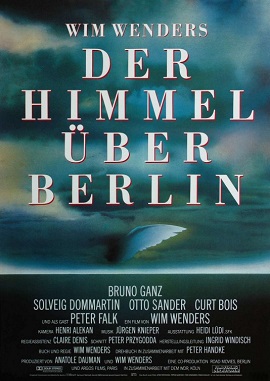
Behind the film
- Year
- 1987
- Director
- Wim Wenders
- Writers
- Wim Wenders, Peter Handke, Richard Reitinger
- Runtime
- 2h 8m
- Genres
- Fantasy, Drama
- Production
- Westdeutscher Rundfunk, Argos Films
- Country
- France, Germany
- Cast
- Bruno Ganz, Solveig Dommartin, Otto Sander, Curt Bois, Peter Falk, Hans-Martin Stier, Annelinde Gerstl, Beatrice Manowski
About the film
Contains story spoilers.
Wings of Desire follows Damiel and Cassiel, guardian angels who move unseen through West Berlin. They hear the thoughts of people on buses, in apartments, in the library and on the street, but cannot enter their lives as ordinary companions. Their work is to listen, remember and sometimes ease a person’s loneliness with a quiet presence. Children can see them; adults generally cannot. The angels’ long view makes human troubles seem fleeting, yet the film’s attention stays close to individual worries: a woman travelling to give birth, a man wrestling with betrayal, and strangers who find themselves alone inside a crowded city.
Damiel is less content with this role than Cassiel. The two have watched Berlin for centuries, and the Wall makes their position as observers especially visible: they can pass through barriers that divide people, but they do not belong to either side of the city’s daily life. Cassiel follows an elderly storyteller, Homer, who searches the empty ground of Potsdamer Platz for the city he remembers. The place has been transformed by war and division, leaving the old man with a blank landscape and a wall marked by graffiti. His search gives the angels’ wandering a human scale, connecting the city’s damaged history with one person’s effort to remember it.
Damiel’s attention turns to Marion, a trapeze artist performing with the Circus Alekan. She lives alone in a caravan and faces the end of the circus, which has lost the place it occupied in the city. Her aerial work depends on balance, risk and the possibility of falling, all physical experiences that are closed to Damiel. After the circus closes, Marion moves through Berlin on her own, dancing and trying to imagine a life beyond the performance. Damiel can hear her thoughts but cannot answer them. What draws him is not just her beauty: she is a working person whose body is exposed to gravity and danger, while he has spent eternity unable to touch anything.
A film crew arriving to make a movie about Berlin’s Nazi past introduces Peter Falk, playing a version of himself. The angels recognize him as someone who was once one of them and chose mortality. He now deals with practical things: he eats, smokes, feels the cold and talks with people. When Damiel encounters him, Falk senses that an angel is nearby and speaks to him about the pleasures of being alive. His presence gives Damiel a model for the change he is considering, but not a promise that life will be easy. Mortality means pain, hunger and uncertainty as well as touch, taste and the possibility of a relationship with Marion. The film uses this encounter to contrast long familiarity with Berlin against a newly acquired sense of place: Falk can describe ordinary pleasures because he has already crossed from watching to participating. Damiel must decide whether that trade is worth losing the safety of being untouched.
The shift in point of view is part of the story. The angels’ world is filmed in textured monochrome, while human experience brings colour into the frame. The camera often glides above Berlin or follows the angels from a distance; after Damiel becomes human, the movement settles nearer the street and the physical world. Wim Wenders said he and cinematographer Henri Alekan connected black and white with the angels’ lack of touch and colour, and he wanted colour to arrive as a new sensation. The city is not simply a backdrop: its no-man’s-land spaces and the Wall shape what the characters can see and where they can go.
Damiel finally gives up immortality. His first sensations are plain and immediate: he bleeds, sees colour, tastes food and drinks coffee. He also has to find his way through the city without the angels’ freedom of movement. Cassiel remains on the other side of that choice. When he listens to a young man preparing to jump from a building, Cassiel cannot prevent the death and is left shaken by his helplessness. Falk reaches out to him as he once did to Damiel, but Cassiel does not follow. The two friends now face different kinds of limitation: one has entered human time, while the other continues to witness lives he cannot control.
Damiel and Marion eventually meet at a concert by Nick Cave and the Bad Seeds. She speaks about wanting a serious love that can make her feel complete, while he is learning what it means to be a person among other people. The film ends with their relationship beginning rather than with a settled account of their future. Its closing movement gives Damiel what he chose mortality for: a chance to be present with Marion, with all the uncertainty that comes with that choice. Berlin’s divided spaces, the people’s unspoken thoughts and the change from monochrome to colour have all prepared the same question: what can be gained by stepping out of the role of observer?