
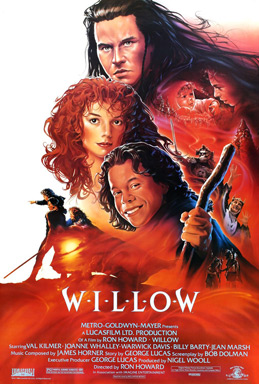
Behind the film
- Year
- 1988
- Director
- Ron Howard
- Writers
- Bob Dolman, George Lucas
- Runtime
- 2h 6m
- Genres
- Fantasy, Sword and sorcery
- Production
- Lucasfilm, Imagine Entertainment
- Country
- United Kingdom, United States
- Cast
- Warwick Davis, Val Kilmer, Joanne Whalley, Jean Marsh, Billy Barty, Patricia Hayes, Gavan O'Herlihy, Kevin Pollak
About the film
Contains story spoilers, including the ending.
Willow Ufgood is a farmer, a father and an aspiring magician when a baby enters his family's life. In Ron Howard's 1988 fantasy, the child is Elora Danan, whose survival threatens Queen Bavmorda's rule. The Nelwyn village's High Aldwin sends Willow to place her with the Daikini, the taller people beyond their community. What begins as an attempt to remove danger from home becomes a responsibility he cannot simply hand away. He releases the imprisoned swordsman Madmartigan in exchange for taking the baby, only to discover that completing an errand does not necessarily mean keeping a child safe.
Warwick Davis plays Willow opposite Val Kilmer's Madmartigan, whose fighting ability initially comes with little interest in helping anyone else. Their partnership gives the journey two different kinds of competence: Willow cares about the child, while Madmartigan knows how to survive a violent world. Fin Raziel, an enchantress trapped in an animal's body, adds another reversal of appearances and power. Bavmorda's daughter Sorsha begins on the queen's side but joins the travelers as her attachment to Madmartigan grows. These companions are gathered through encounters and changes of allegiance rather than assembled as an ideal company from the outset. Willow's desire to become a magician consequently develops alongside a more immediate test of character. Protecting Elora requires him to persist among warriors and sorcerers whose abilities seem far greater than his own.
The Nelwyn settlement gives Willow obligations before the adventure begins. His farm and family are things he can lose, and Burglekutt's threat that unpaid debts could send him into the mines places ordinary economic pressure beneath the fantasy. Meegosh, his loyal companion, is a miner from the Copper Hills. The distinction matters because Willow's closest friendship crosses the local hierarchy that Burglekutt is keen to enforce. Leaving the valley therefore means leaving a recognizable working community, with debts, occupations and people who depend on him.
Howard developed the film with George Lucas and screenwriter Bob Dolman after reconnecting with Lucas during the effects work on Cocoon. At a dinner during screenplay development, Joseph Campbell listened to the story and discussed the myths it drew upon. The collaboration placed Howard inside a world that Lucas had long wanted to make, with Howard translating that vision into performances and scenes. Howard later described the experience as an unusually demanding education in filmmaking. Lucas gave him final cut and room to contribute, although Howard felt a strong responsibility toward the originator's story. That tension between freedom and responsibility helps explain the scale of the undertaking: the director was handling a newly invented fantasy environment while also trying to make its emotional relationships intelligible. Willow's family and his concern for Elora provide concrete motives within that larger mythology. Howard's account also places the transformation experiment inside that collaboration: Dennis Muren proposed tests whose computer methods initially puzzled the director.
The journey's horses, battles and stunts required extensive physical staging alongside the visual effects. Howard recalled coordinating as many as three production units, with Joe Johnston and Micky Moore directing other units. The locations ranged from Wales and New Zealand to London soundstages and the redwood forest in Marin. A long schedule and the number of effects shots made this a much larger logistical exercise than a succession of actors performing against a single backdrop. Howard said that completing Willow changed how he approached later challenges: he still felt anxiety and excitement, but no longer the same fear of making a movie. The finished adventure depends on that coordination between landscapes, performers, action units and effects work.
Fin Raziel's restoration makes Willow's uncertain spellcasting visible through a chain of animal forms. Industrial Light & Magic combined puppet work with digital image processing to turn the goat through other creatures and finally into the human sorceress. Dennis Muren saw a possibility in manipulating two-dimensional pictures and their outlines, while puppets supplied controlled movements for the transitions. Model maker Jean Bolte helped build those creatures, and programmer Doug Smythe developed software when a suitable commercial package did not exist. Fur and feathers were particularly awkward surfaces to blend. The scene's changing bodies consequently came from cooperation between the model shop and a small computer graphics department, rather than a complete replacement of physical effects.
At Nockmaar, Bavmorda turns the attacking army into pigs, but Willow protects himself and finally restores Raziel. She reverses the spell, allowing the assault to continue. In the ritual chamber, the queen defeats the experienced sorceress and her own daughter. Willow instead uses sleight of hand to make Elora appear to vanish. Bavmorda's furious response accidentally completes the ritual with herself beside the altar, banishing her. Elora stays with Madmartigan and Sorsha at restored Tir Asleen. Raziel gives Willow a spellbook, and he returns to his family. His victory leaves him with knowledge to develop, alongside the resourcefulness he already possessed.