
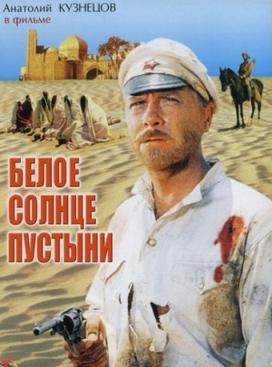
Behind the film
- Year
- 1969
- Director
- Vladimir Motyl
- Writers
- Valentin Ezhov, Rustam Ibrahimbeyov, Mark Zakharov
- Genres
- War, Ostern, Tragicomedy, Romance
- Production
- Lenfilm, Mosfilm
- Country
- Soviet Union
- Cast
- Spartak Mishulin, Pavel Luspekayev, Anatoly Kuznetsov, Nikolay Godovikov, Raisa Kurkina, Kakhi Kavsadze, Musa Dudayev, Nikolay Badyev
About the film
Contains story spoilers, including the ending.
White Sun of the Desert places a soldier's journey home inside a Soviet variation on the western. Vladimir Motyl's 1970 adventure stars Anatoly Kuznetsov as Sukhov, Spartak Mishulin as Said, Kakhi Kavsadze as Abdullah and Pavel Luspekayev as Vereshchagin. The desert, armed pursuers and isolated settlement supply familiar western ingredients, transplanted to Central Asia. Mosfilm describes this genre as the Eastern. Its noble defender has more people to protect than he can comfortably manage, while the landscape leaves him far from reinforcements. Comedy belongs to this world too, alongside the danger. Isaak Schwartz and Bulat Okudzhava wrote the film's song, and its characters have memorable concerns beyond defeating Abdullah. Sukhov's simple wish to get home keeps the adventure attached to a life elsewhere.
Sukhov first rescues Said, who has been buried up to his neck by Djavdet. Red Army commander Rakhimov then leaves him with Abdullah's nine surviving wives and young soldier Petrukha. Abdullah intends to escape by sea and has already killed two women. In Pejent, Sukhov repairs a Lewis gun and mines the barge Tver. His attempt to hold Abdullah prisoner fails: Abdullah escapes and kills Gulchatay and Petrukha. Sukhov leads the women through a tunnel into an oil tank, where Abdullah's men besiege them. Said returns to help, repaying his debt. Vereshchagin finally joins the fight after learning of Petrukha's death, but takes the mined barge and dies in the explosion. Wounded Sukhov calls Abdullah round rather than shooting him in the back, then kills him and Mahmud. The women return to Rakhimov's protection. Sukhov offers to help Said against Djavdet, but Said insists on settling that matter himself. Sukhov walks on toward home.
That ending makes Sukhov's competence painfully incomplete. He saves the women, yet his own preparation kills an ally. Motyl explained that Vereshchagin's death had existed in the screenplay in another form, earlier in the action; the finished chain of events made the soldier's good intentions more costly. Petrukha and Gulchatay also die, so the victory cannot restore the small community that briefly formed around the rescue. For Motyl, this was an adventure about helping strangers without expecting payment or gratitude. He introduced Katerina Matveyevna, the wife waiting at home, to give Sukhov something definite to lose by staying. The remembered woman and the distant Russian countryside pull against every new obligation in the desert. Sukhov has already served as a soldier and wants to leave, but the women need him now. His attachment to home makes that decision harder than a hero's automatic appetite for another fight.
Cinematographer Eduard Rozovsky gave the desert its apparent emptiness through practical choices. He described selecting the direction of the dunes so that Sukhov's footprints cut diagonally across an expanse without a visible beginning or end. To make a mirage, he placed hot coals in front of the camera: the rising heated air distorted the view. The oil tank presented the opposite problem, with characters enclosed in a place that should contain no light. Rozovsky recalled joking about photographing their skeletons with X-rays, a measure of the difficulty rather than the method used. He also described a deliberate contrast in movement. Sukhov, Vereshchagin and Petrukha move slowly, while Abdullah's fighters move sharply and nervously. The difference puts the two groups at odds before a weapon is fired. Space, heat and the pace of bodies help turn the same terrain into a weary journey for one man and a field of attack for another.
The rescue also depends on an unequal arrangement between the people on screen. Abdullah threatens the women, and Sukhov becomes their protector and guide. They remain largely dependent on men's decisions, including the decision to free them. An East European Film Bulletin essay reads this as a paternalistic picture of Soviet power in Central Asia: the Russian soldier appears necessary because the local world is presented as cruel or unable to protect its vulnerable people. That reading concerns how the adventure distributes authority. The film's use of bandit villains should not be mistaken for a neutral account of the historical Basmachi movement. Said complicates the rescue's direction by returning on his own terms, but the women's safety still rests chiefly with Sukhov. His personal generosity and the larger political assumptions of his heroic role occupy the same story.
The images of home give the film another visual vocabulary beside guns and sand. A SlavVaria study connects its compositions with early twentieth-century painting, including works by Mikhail Larionov, Martiros Saryan, Boris Kustodiev and Konstantin Korovin. Its comparisons place Sukhov's resting body beside Larionov's soldier, the waiting women beside Saryan's grouped figures, and Vereshchagin with his wife beside Kustodiev's merchant couple. The study also relates Sukhov's imagined domestic world to Korovin's rural imagery. These are readings of visual affinities, rather than a claim that each image was copied from a painting. They help describe the distance between Sukhov's inward life and the immediate emergency. The film can pause over a body, a household or a dream even while the pursuit continues. Its Eastern setting contains both an armed adventure and the stubborn picture of an ordinary life to which Sukhov hopes to return.