
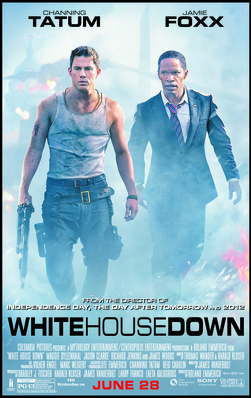
Behind the film
- Year
- 2013
- Director
- Roland Emmerich
- Writers
- James Vanderbilt
- Runtime
- 2h 11m
- Genres
- Action, Thriller, Drama, Political thriller
- Production
- Centropolis Entertainment
- Country
- United States
- Cast
- Channing Tatum, Jamie Foxx, Maggie Gyllenhaal, James Woods, Jason Clarke, Garcelle Beauvais, Richard Jenkins, Lance Reddick
About the film
Contains story spoilers.
John Cale arrives at the White House hoping to change two things at once: his career and the way his daughter sees him. A former soldier now working as a Capitol Police officer, he wants a job in the Secret Service. His interviewer, Carol Finnerty, remembers him from college and sees too little evidence that he has become dependable. Emily, meanwhile, is an enthusiastic follower of politics who gets to interview President James Sawyer during their tour. Cale has not told her that his application has failed. Before he can resolve that smaller embarrassment, the visit becomes a hostage crisis, with father and daughter separated inside a building suddenly controlled by armed men.
A bombing at the Capitol creates the diversion for Emil Stenz and his team to seize the White House. The attack also has an accomplice already beside the president: retiring protection chief Martin Walker. Instead of leading Sawyer to safety, Walker turns the emergency bunker into a trap. Cale intercepts the attack and escapes with Sawyer, leaving the pair to improvise their way through the residence. The hidden tunnels offer no easy exit, and a desperate flight in the presidential limousine ends in the swimming pool. Outside, officials mistake the crash for Sawyer's death and put the vice president in charge.
Walker wants to launch nuclear missiles against Iran, where his son died during a failed covert operation. Computer specialist Skip Tyler helps him reach the command system, while Emily becomes leverage against the president. The crisis spreads beyond the building when Air Force One is destroyed and Speaker Eli Raphelson assumes the presidency. He orders the White House bombed. Cale kills Walker before the nuclear launch, and Emily carries the presidential flag onto the lawn to stop the incoming airstrike. Sawyer survives a gunshot because his pocket watch stops the bullet; the apparent rescue then exposes Raphelson as an accomplice in the conspiracy.
The political dispute underneath the siege concerns Sawyer's proposed withdrawal of American forces from the Middle East. In the film's invented Washington, peace threatens people who benefit from continuing conflict, and the danger comes from domestic conspirators with access to the institutions they attack. That gives Sawyer and Cale different jobs within the same emergency. One must protect a foreign-policy initiative and the authority of his office; the other is trying to reach a child held a few rooms away. Finnerty works from outside, resisting responses that could kill the hostages. The expanding military response keeps colliding with the immediate needs of the people trapped inside.
The White House itself was reconstructed for the Montreal shoot, with Roland Emmerich favoring stages over locations because the story compresses its events into a few hours. Controlled light could keep that afternoon consistent through complicated action scenes. The research drew on public tours and access to people familiar with the building, although secret spaces and the presidential car still required invention from available references. Emmerich also described one deliberate visual departure: replacing many carpets with shiny floors. Working with cinematographer Anna Foerster, he used wide lenses to keep more of the rooms visible around the actors. The action therefore has to occupy a substantial, furnished space rather than disappear into isolated close-ups. Foerster and Emmerich also carried over experiments from Anonymous, building ceilings into the sets and finding ways to light from outside them with mirrors rather than filling the rooms with visible equipment.
Its mixture of peril and comedy was deliberate. Emmerich identified Die Hard as a model for combining suspense with a damaged father's attempt at redemption, while Lethal Weapon informed the interaction between Cale and Sawyer. Their unequal positions make the partnership unusual: the officer can handle a fight, but the president knows his own house. Emmerich also returned to the humor in Independence Day when thinking about how to release tension between threats. Some jokes emerged during filming rather than arriving fully formed in the screenplay. Foxx's protest about his basketball shoes was one such improvisation, giving the presidential figure an everyday irritation in the middle of the violence.
The destruction extends far beyond what could be built on a stage. Image Engine supplied nearly a hundred visual-effects shots for the takeover and its aftermath, combining filmed actors with reconstructed grounds, aircraft and Washington surroundings. The team maintained both pristine and damaged versions of the White House so that destruction could accumulate across the sequence. Trees were a surprisingly large part of the work: the digital environment contained more than eight hundred, requiring detail and lighting that would hold up around the south lawn. Some wide shots also contained crowds numbering in the thousands, assembled from varied clothing, movement and character assets. Those details give the emergency a visible public edge, with reporters, civilians and security forces gathering beyond the rooms where Cale is fighting to bring Emily home.