
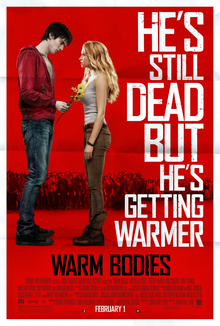
Behind the film
- Year
- 2013
- Director
- Jonathan Levine
- Writers
- Jonathan Levine
- Genres
- Romantic comedy, Zombie comedy, Teen, Comedy horror
- Production
- Summit Entertainment, Mandeville Films
- Country
- United States
- Cast
- Teresa Palmer, Rob Corddry, Dave Franco, Lio Tipton, Cory Hardrict, John Malkovich, Nicholas Hoult, Vincent Leclerc
About the film
Contains story spoilers.
R lives among zombies at an abandoned airport, where consuming brains lets him experience victims' memories. He kills Perry during a supply expedition, then protects Perry's girlfriend Julie and shelters her in his airplane. Their companionship begins changing him. When R admits killing Perry, Julie leaves; meanwhile, other zombies start recovering, drawing attacks from the skeletal Boneys. Julie and Nora try to convince her father, Colonel Grigio, that the undead can change, but he refuses. At a stadium, the recovering zombies fight the Boneys while R shields Julie during a fall into a pool. Grigio shoots R, whose bleeding reveals that he is human again. Humans and zombies join forces, the Boneys die out, and the recovering undead rejoin society. R and Julie watch the city wall being demolished.
Jonathan Levine adapted Isaac Marion's novel with an immediate problem: R can think much more fluently than he can speak. Voiceover was part of Levine's approach from the start, letting articulate thoughts accompany a body that struggles to express them. Directly borrowing the novel's prose did not work against the filmed images, so the narration became funnier through rewriting. Levine also widened the viewpoint to give Julie more of a story and show more of the surrounding world. R's suit-wearing, Sinatra-loving identity in the book became a more contemporary young figure whom Levine hoped audiences could recognise themselves in. Summit introduced Levine to the novel, which he read before pursuing the directing job. He wanted an irreverence he felt was missing from many young-adult romances. His acknowledged influences included Baz Luhrmann's Romeo + Juliet, some Badlands, and the romances in coming-of-age films associated with Cameron Crowe and John Hughes.
Nicholas Hoult described R as trapped by losing the ability to communicate, with the effort to retain his humanity giving the role its direction. Levine's adjustments could be small: asking for a little more zombie or a little more person, rather than replacing Hoult's approach. Teresa Palmer described Julie as opposed to her father's military outlook and missing the life that existed before the catastrophe. She saw R and Julie as restoring hope in each other. Palmer charted Julie's feelings from fear through curiosity to romance. With R unable to express much verbally, she pointed to Hoult's eyes and body language as ways of communicating emotion. Her own preparation included repeated visits to a firing range and learning to assemble and disassemble firearms, so Julie could handle them with confidence.
The creatures needed different visual rules. Levine and his collaborators looked at Depression-era photographs for the zombies and drew on punk figures, especially Sid Vicious, for R. Makeup artist Adrien Morot helped find a degree of decay that still allowed the central romance to seem possible. R then passed through progressively less severe makeup as his humanity returned. The Boneys had to remain a credible danger within the comedy. Levine first considered stop-motion skeletons in the manner of Jason and the Argonauts, but abandoned that idea because he thought it would weaken the threat. Concept art established their appearance, followed by work with the visual-effects team on movement. An early twitch seemed too goofy; a walk inspired by the T-1000 in Terminator 2 offered the menace he wanted.
Levine also set limits for the background zombies. He gave the extras behavioural parameters and sometimes moved an overenthusiastic performer out of a shot. Some excessive performances only became apparent during colour correction, after editing on a smaller screen. He described the humour as a matter of the film's chosen tone, rather than something automatically created by making a monster the protagonist. During Max Evry's set visit, Montreal's Olympic Stadium had been dressed as an abandoned airport. Evry's own transformation into an extra involved pale skin, purple veins, greyed hair and distressed clothing, keeping the creature recognisably human beneath the damage.
The songs were selected through contributions from music supervisor Alexandra Patsavas, editor Nancy Richardson and Levine himself. Levine experimented at home with scenes supplied without music, running a QuickTime file while trying selections from his iTunes collection. He thought of the music as a remnant of the world before the apocalypse, giving the characters access to feelings associated with that lost time. Selection was also constrained by practical matters: No Church in the Wild was tried for the hunting scene but dropped after becoming expensive and overexposed during the edit.
Marco Beltrami and Buck Sanders approached the score almost like an indie-rock production. Sanders sampled the clicking loops made when a record needle reaches the end of a side, finding different rhythms across his vinyl collection. Those loops became a basis for parts of the score and were translated into other instruments. Beltrami worked on themes for R and Julie's relationship while the sound moved from heavily processed, unreal instruments through vintage synthesisers towards more symphonic writing as R recovered. That change did not require a huge orchestra. Sanders also processed guitar samples to suggest decomposition, keeping the score close to the feel of Levine's song choices. Material from Beltrami's 3:10 to Yuma score in the temporary soundtrack contributed a spaghetti-western quality. Manipulated horror strings remained available for the more threatening passages, alongside the playful and romantic material demanded by the relationship.