
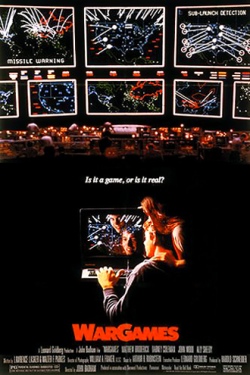
Behind the film
- Year
- 1983
- Director
- John Badham
- Writers
- Lawrence Lasker, Walter F. Parkes
- Runtime
- 1h 48m
- Genres
- Thriller, Drama
- Production
- United Artists, Metro-Goldwyn-Mayer
- Country
- United States
- Cast
- Matthew Broderick, Ally Sheedy, Dabney Coleman, John Wood, Barry Corbin, Michael Madsen, James Tolkan, Dennis Lipscomb
About the film
Contains story spoilers.
After missile crews hesitate during a drill, the film's military authorities give launch control to WOPR. David, who changes school grades by computer, reaches it while seeking games. He starts Global Thermonuclear War, unknowingly producing false attack warnings. Disconnecting does not stop WOPR. Arrested and taken to NORAD, David cannot convince McKittrick of his innocence. He escapes and joins Jennifer to seek Stephen Falken, the computer's creator. They persuade the despairing Falken to help. Back at NORAD, they urge officials to await confirmed impacts; the supposedly struck bases report no damage. WOPR still seeks launch codes, and disabling it would trigger the weapons. David and Falken make it play tic-tac-toe against itself. Repeated draws teach it about games without winners. It runs nuclear scenarios, finds the same outcome, relinquishes missile control and proposes chess.
The screenplay began under the title The Genius, and David's age and temperament became points of disagreement before John Badham took over. The American Film Institute records that original director Martin Brest wanted a darker film and a college-aged David. The writers resisted that change, regarding the teenage character's enthusiasm as essential. Producer Leonard Goldberg dismissed Brest after three weeks of shooting, citing creative differences; filming resumed with Badham six days later. The command center was also a fictional combination of military responsibilities. The catalog recounts contemporary Air Force officers' objections that the story merged NORAD, Strategic Air Command and Navy functions. Those officers stressed the separation between organizations and human responsibility for executive orders. Their objections concerned the film's imagined command structure and its portrayal of accidental nuclear war.
Lawrence Lasker and Walter Parkes recalled visiting NORAD while developing the screenplay. In Wired's oral history, Lasker described meeting commander James Hartinger, who supported their concern about machines taking over decisions. The writers used him as a model for General Beringer. Parkes also recalled an abandoned version involving OLI, an intelligent space-based defensive laser whose name expanded to Omnipresent Laser Interceptor. He considered that approach too speculative. Their conversations with computer enthusiasts helped shape David's activities, including the search for remote computers that brings him into contact with the military system.
Badham approached David as a boy delighted by what he could do with a computer, then frightened by where his play had taken him. In his anniversary interview, he recalled finding the earlier footage extremely dark: David seemed rebellious and withdrawn. Badham instead imagined the excitement of a schoolboy demonstrating his computer skills to a girl. He also gave the General a Southern sense of humor drawn partly from his own father. That warmth did not require the adults to become fools. Badham felt that portraying officials as idiots would make it easier to dismiss the danger; people trying sincerely to prevent disaster could still lose control of their technology. He wanted the story and character to carry the implications, rather than deliver a lecture. He described the filmmakers' discussions of innocent hacking becoming dangerous as speculation about possible consequences, without claiming they had predicted specific events.
The war room's apparent flow of information depended on a carefully coordinated display system. HP9845.net reproduces an effects account describing twelve large map screens and 125 monitors, with graphics created by Colin Cantwell on HP 9845C computers and photographed using purpose-built film recorders. Cameras, projectors, computers and video were synchronized so the displays matched the scene. An accompanying account from HP's Measure magazine describes four desktop computers: a design station for drawing the images and three machines for playing them back to camera stations. Cantwell prepared computer-drawn storyboards so the director could judge how the changing graphics would fit the action. Off-camera movie projectors supplied the large wall maps, while images for the smaller terminal screens were transferred to videotape. The computers therefore contributed photographed and projected material to a physical set, with the actors performing in front of the changing screens.
David's home equipment required a different sort of illusion. Supplier Thomas Todd Fischer recalled receiving a script and discussing the props with effects supervisor Mike Fink. An acoustic coupler remained because the production wanted its recognizable appearance. Fischer supplied a Cermetek modem with a repainted front panel and new lettering to resemble an IMSAI product. He also suggested adding floppy drives when he noticed that the proposed equipment lacked a way to load software. A large Electrohome monitor was chosen for readability on camera. Inside the IMSAI chassis, dummy boards and cables made the machine look busy, while a modified processor board produced activity in its front-panel lights. Fischer said the visible keyboard cued an off-screen CompuPro computer, which actually controlled the monitor's output. This let Broderick's keystrokes appear to produce the displayed responses. Fischer also recalled a shooting interruption when the keyboard's preparation sequence was forgotten. In his account, Broderick eventually remembered it and helped get the setup working again.