
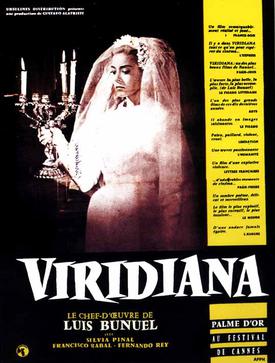
Behind the film
- Year
- 1961
- Director
- Luis Buñuel
- Writers
- Luis Buñuel, Benito Pérez Galdós, Julio Alejandro
- Genres
- Comedy drama
- Country
- Mexico, Spain
- Cast
- Silvia Pinal, Francisco Rabal, Fernando Rey, Margarita Lozano, Lola Gaos, José Calvo, José Manuel Martín, Victoria Zinny
About the film
Contains story spoilers.
Luis Buñuel's Viridiana follows a young woman who hopes to become a nun, then finds herself trying to establish a home for people living outside respectable society. Silvia Pinal plays Viridiana, whose visit to her uncle becomes the beginning of a life away from the convent. Fernando Rey plays Don Jaime. Don Jaime has paid for her education and lives in a mansion with his servant Ramona. His niece resembles the wife who died on their wedding night. He persuades her to put on the bridal clothes, drugs her coffee and carries her to bed. He stops himself from raping her, then tells her in the morning that he has done so. Although he admits the lie, Viridiana leaves. Police bring her back after Don Jaime hangs himself. His will divides the estate between her and his son Jorge.
Viridiana houses beggars in outbuildings and leads them in prayer. Jorge arrives with his girlfriend Lucía, starts renovating the property and begins a relationship with Ramona. Lucía leaves. While the owners are away, the beggars enter the mansion and hold a feast. The returning Jorge and Viridiana are caught by two men; Jorge is tied up and one man begins to rape Viridiana. Jorge offers the other money to kill the attacker. Ramona summons the police. Later, Viridiana joins Jorge and Ramona at cards in his room. Producer Pere Portabella describes this final gathering as a sexual arrangement involving all three characters. The apparently ordinary card game was, in his recollection, a way of answering official concern about what might happen when Viridiana entered her cousin's room alone.
The beggars' feast brings the film's religious imagery into the dining room. They arrange themselves along one side of the table in a pose resembling Leonardo's Last Supper. A recording of Handel's Hallelujah Chorus accompanies the disorder, and a man dances in the dead wife's corset and veil. Michael Wood's Criterion essay describes a cut that jumps from women admiring a tablecloth to the drunken aftermath of dinner. He also draws attention to Jorge buying a dog to free it from being tethered to a moving cart, while another dog passes behind him in the same predicament. Wood reads these moments alongside the small crucifix that opens into a knife. His account resists treating Viridiana's charitable project as simply foolish: the wish to relieve suffering survives even when its results are painfully limited. He sees the film's two halves as the uncle's frustrated desire and the novice's attempt to help the poor, with guilt and forgiveness running through her response to his death.
Francisco Rabal recalled bringing Silvia Pinal and her husband Gustavo Alatriste to meet Buñuel at Madrid's Hotel Fénix. They had another project in mind, which the director later rejected in favour of Viridiana. Rabal remembered Alatriste providing the money when UNINCI could not, and paying both him and Fernando Rey. Juan Antonio Bardem's account describes receiving a screenplay signed by Buñuel and Julio Alejandro, then taking it through the censorship process. He remembered Buñuel wanting assurances before committing to work in Spain. Bardem also recalled two screenings of the completed picture, one for the censors and another for the Spanish producers' organisation. For the former, he said, two shots were removed: the crucifix opening as a knife and Lola Gaos's character taking the group photograph. He remembered giving an evasive answer about the banquet music, even though Handel had already been chosen. The film then went to Paris for sound mixing at Billancourt.
Producer Pere Portabella remembered the project beginning with conversations about bringing Buñuel back to Spain. A letter from Mexico offered a screenplay then called La belleza del cuerpo. Portabella described meeting Bardem's circle and bringing together groups that had previously been distant from one another. His account credits Films 59 and UNINCI with the production. He also remembered the sound mix in Paris and a print becoming ready only two days before the end of the Cannes festival. At Cannes, Portabella recalled persuading the Spanish film official Muñoz Fontán to accept the prize. The official initially thought the honour belonged to the filmmakers, then agreed and ordered champagne. Portabella's memory of that celebration sits beside his account of the official reaction back in Spain, where the film's international success offered no protection from the authorities.
Pinal remembered Alatriste's generosity toward Buñuel in an interview with El País. Rather than refusing expensive requests, she said, he wrote cheques for more money than the director asked for. She also recalled carrying copies of Viridiana into Mexico in her suitcase, telling a customs officer that they were home movies despite her nervousness. Getting the film shown was another difficulty: in her account, Salvador Novo helped them find a cinema willing to screen it. Viridiana competed at Cannes in 1961 and shared the Palme d'Or. Buñuel directed and co-wrote the screenplay with Julio Alejandro; José Aguayo was the cinematographer. Franco's government banned the film in Spain, while the Vatican condemned it as blasphemous. Bardem recalled the film eventually opening in Spanish cinemas in 1977.