
Behind the film
- Year
- 1992
- Director
- David Lynch
- Writers
- Robert Engels, David Lynch
- Genres
- Psychological horror, Mystery, Drama, Crime
- Production
- Ciby 2000, New Line Cinema
- Country
- United States, France
- Cast
- Sheryl Lee, Moira Kelly, David Bowie, Chris Isaak, Harry Dean Stanton, Ray Wise, Kyle MacLachlan, Mädchen Amick
About the film
Contains story spoilers, including the ending.
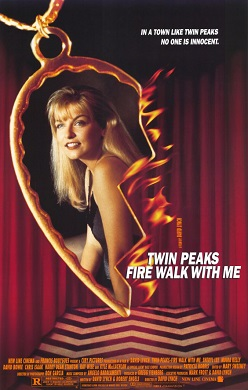
Twin Peaks: Fire Walk with Me returns to Laura Palmer before her death, after the television series had made her murder the centre of its investigation. David Lynch directs the 1992 feature and shares the screenplay credit with Robert Engels. Sheryl Lee plays Laura, Ray Wise plays her father Leland, and Kyle MacLachlan returns as FBI investigator Dale Cooper in a reduced role. The project followed the cancellation of the original series, with MacLachlan eventually agreeing to a limited period of filming. Production began in Washington state in 1991, including work at a recreational vehicle site in Snoqualmie used as the Fat Trout Trailer Park. Ron Garcia photographed the film, Mary Sweeney edited it and Patricia Norris designed the production. Its Cannes premiere and American release brought a hostile early reception, particularly toward its treatment of Laura and its distance from the television show's humour.
The opening investigation concerns Teresa Banks, whose body is found in Deer Meadow. Agents Chester Desmond and Sam Stanley encounter unhelpful residents and hostile police. A ring missing from Teresa's possessions becomes a clue, but Desmond disappears after finding it. At FBI headquarters, the missing Phillip Jeffries briefly returns with an account of mysterious spirits before vanishing again. A year later, Laura is trying to conceal her cocaine use and the sexual abuse she has suffered. Her diary has been disturbed, and the terrifying figure she knows as BOB increasingly reveals her father's face. The final journey takes Laura and Ronette Pulaski to an abandoned train car. BOB intends to possess Laura; she puts on Teresa's ring, and Leland/BOB kills her. The earlier murder and investigation lead into a second young woman's struggle with the same danger.
Laura's section stays close to what she feels as recognition becomes harder to avoid. In the Roadhouse, Julee Cruise sings while Laura sits with tears on her face. Her outward role as the homecoming queen offers little protection from what happens at home. Close views of Lee's terrified expression keep the revelations attached to Laura rather than treating them simply as clues for a detective. Her conversations with Donna and James also reveal the distance between the person they think they know and the life she cannot explain to them. The film continues beyond the murder. Laura appears in the Red Room with Cooper beside her, and an angel comes into view. She cries and smiles in response. The image offers a change from the violence of the train car, but it does not reverse her death or provide a detailed account of the place she has entered. Its spiritual meaning remains open to interpretation.
The change in viewpoint also changes the place of the murder mystery. Laura is alive for most of the feature, able to be generous, secretive, frightened and angry within the same story. The ring gives her a means of resisting BOB's attempt to possess her, even though she cannot escape being killed. In her retrospective for WIRED, Julie Muncy reads this resistance as a correction to the familiar image of Laura as a beautiful dead girl. That reading places the abuse survivor's actions at the centre of the tragedy.
At the Cannes press conference, Lynch described wanting to return to the world before the series began and show events that had previously only been discussed. Asked whether he was attacking the American dream, he brought the answer back to Teresa Banks and Laura's last seven days. He also resisted reducing the film to a single message about drugs. His responses stressed the contrasts and feelings within a film, and the opportunity to enter experiences that would be dangerous in ordinary life. Angelo Badalamenti described the score in terms of darkness rather than straightforward horror, with power suggested through that darkness. Lynch's remarks about casting were similarly practical: he pictured a role's voice and appearance, then talked with prospective performers rather than requiring them to act out scenes. He singled out Lee's commitment to Laura, explaining how an actress initially hired to play a dead girl had become the performer he wanted for this much larger part.
Lee's work also depended on accepting moments that could not be explained through ordinary cause and effect. In Criterion's account of her interview about the film, she describes Lynch guiding her to surrender to situations that defied conventional logic. His direction used few words, but those words had force. That approach gave the performer something to follow within the dreamlike scenes without requiring each image to become a spoken explanation. Laura's distress remains present even when the events around her exceed what she can understand.
Garcia had already photographed the television pilot before returning for the feature. In American Cinematographer, he described Lynch arriving with a clear idea while remaining receptive to unexpected things on set. Obstacles did not automatically require forcing the original arrangement; something noticed at the edge of the director's attention could become part of the scene. Garcia's recollections also distinguish that openness from a demand to make everything stranger. During the earlier pilot, Lynch had rejected some orange-filtered transitional footage as excessive. The cinematographer's account describes a collaboration in which unusual images still required choices about restraint, timing and what belonged within the director's conception.