
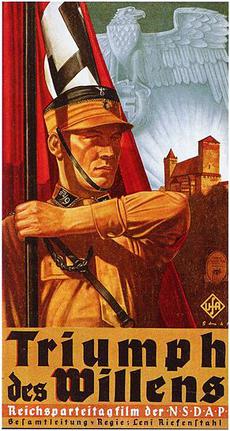
Behind the film
- Year
- 1935
- Director
- Leni Riefenstahl
- Writers
- Leni Riefenstahl, Walter Ruttmann
- Runtime
- 1h 54m
- Genres
- Documentary, Propaganda
- Country
- German Reich
About the film
Contains story spoilers.
Triumph of the Will is a film about the 1934 Nazi Party Congress in Nuremberg, made under the direction of Leni Riefenstahl and released in 1935. It has no fictional hero or conventional plot. Instead, it shapes several days of rallies into a political spectacle that presents Adolf Hitler as the centre of German public life and the Nazi Party as a unified national movement. The film was commissioned and supported by the Nazi regime, and it is a propaganda work glorifying Hitler and National Socialism. Its polished images should be read in that context: the camera is not a neutral witness, and the people gathered in the frame are not simply evidence of spontaneous public feeling. The production had dedicated camera towers, bridges and tracks, so the rally ground itself became part of the apparatus for shaping what the audience would see.
The opening establishes the film’s method before any speech begins. Text cards describe Germany’s recent history through the regime’s own myth of rebirth, then an airplane appears above the clouds and descends toward Nuremberg. The editing joins Hitler’s arrival to views of the city and its crowds, although the marching shown in the streets had not yet begun when the plane landed. This rearrangement creates the impression that the city and its people are already moving toward the leader. When Hitler emerges from the aircraft, the film cuts among the cheering crowd, raised Nazi salutes and the motorcade. Classical music swells over the images, giving his arrival the shape of a ceremonial revelation rather than an ordinary political visit. The time cards also define the story the film wants viewers to accept: the First World War, Germany’s suffering and the regime’s claimed “rebirth” are compressed into a straight path toward Hitler’s arrival. The opening edits turn that political claim into a visual experience.
After the arrival, the film shifts between intimate scenes of the rally grounds and large choreographed gatherings. It shows party members and visitors in camps, young men at breakfast, people washing and talking, and boys playing in the streets. Such scenes provide a quieter interval between the mass displays, but they also fold everyday activity into the film’s claim that the party reaches across German society. The people appear as parts of one orderly community, with little space for disagreement or anyone harmed by the regime. That impression is carefully made: the camera selects celebratory moments and makes Nuremberg itself, with its old buildings and banners, seem to welcome the new political order. High and low camera positions alter how bodies and buildings appear, while moving shots glide past banners and assembled crowds. These choices make the rally look larger and more coherent than an unplanned observer could capture, placing the viewer inside the regime’s preferred image of itself.
The speeches and formations build the film’s central picture of unity. Rudolf Hess opens the congress, followed by a montage of other Nazi leaders speaking about party loyalty, national recovery and common purpose. The film then moves to the Reich Labour Service rally, where young men hold spades and call out the German regions from which they came. Their tools evoke public work, while their rows and drills give the gathering a military character. Later, a night parade of the SA uses torchlight, flags and shadow to turn the march into a ritual. These sequences make separate groups—the party leadership, labour corps and paramilitary formations—appear to belong to one disciplined body organized around Hitler.
The Hitler Youth rally and the review of the armed forces extend that image into the future. Hitler speaks to young people as the generation expected to build the country’s next chapter; the montage presents their enthusiasm as a natural extension of the older party faithful. The military review briefly introduces cavalry and modern vehicles, then the film returns to mass political gatherings. At the memorial ceremony, Hitler, Heinrich Himmler and SA leader Viktor Lutze cross an open avenue between rows of uniformed men to lay wreaths for those killed in the First World War. The film connects mourning with the party’s present show of discipline, turning a memorial ritual into another demonstration of political unity.
The final rally gathers the film’s major images into a closing argument. Hitler addresses a vast crowd from a high platform while flags and standards frame him above the assembled party members. Rudolf Hess then declares the congress closed with a slogan that fuses Hitler, the party and Germany into one identity. The crowd sings the Horst-Wessel-Lied as the camera frames a giant swastika banner; it fades to silhouetted Nazi Party columns marching in formation. That final image keeps the film’s political claim in view, turning the assembled bodies into a single continuing movement. This is not a neutral record of the rally: Riefenstahl and the regime planned camera positions and staged portions of the event, and editing reshapes the order and scale of what viewers see. The result is a crafted political image of unanimity that conceals the coercion, exclusion and violence of Nazi rule.