
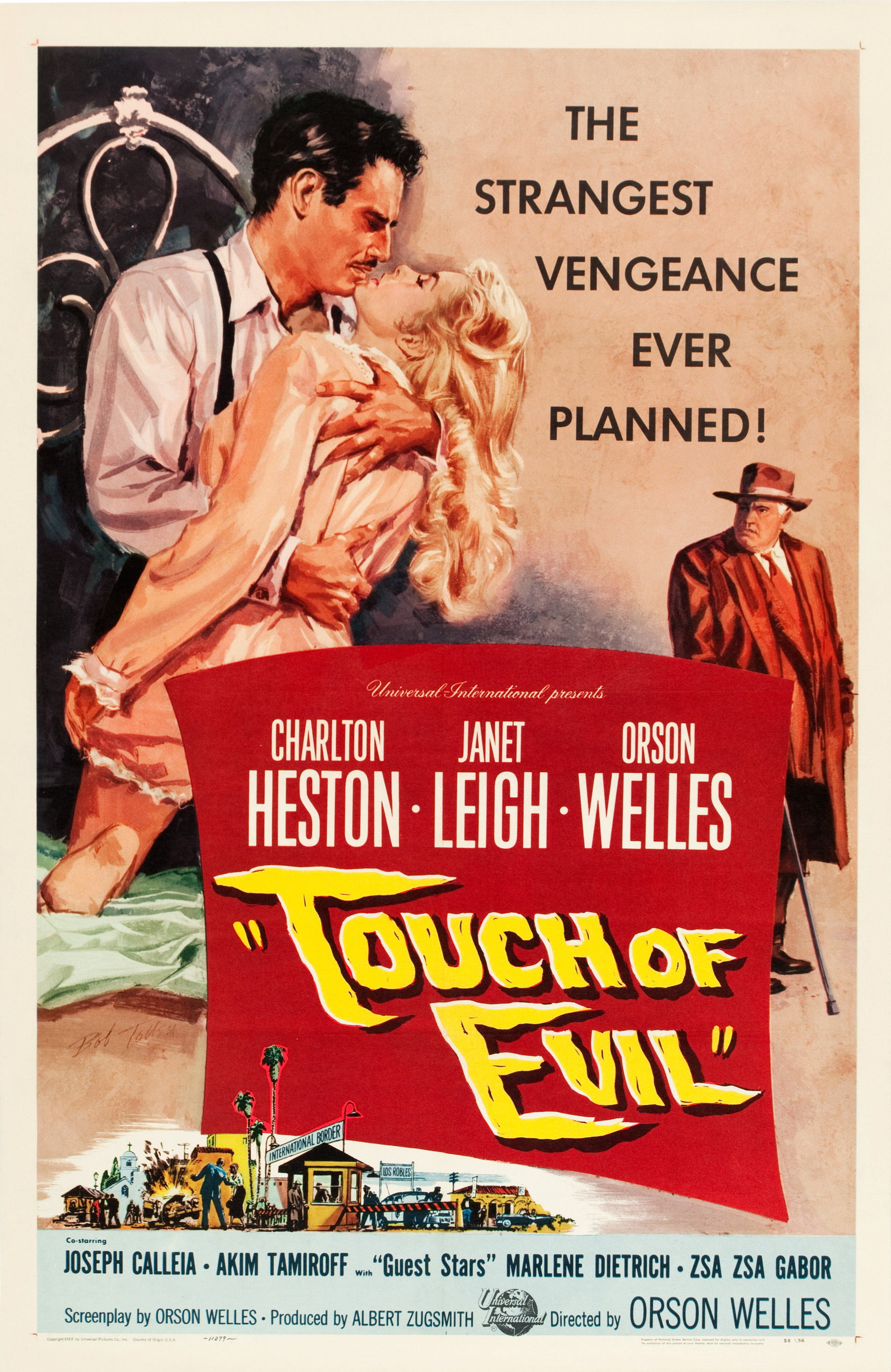
Behind the film
- Year
- 1958
- Director
- Orson Welles
- Writers
- Orson Welles
- Genres
- Crime, Drama, Film noir
- Production
- Universal Pictures
- Country
- United States
- Cast
- Charlton Heston, Janet Leigh, Orson Welles, Joseph Calleia, Akim Tamiroff, Marlene Dietrich
About the film
Contains story spoilers, including the ending.
Touch of Evil puts a Mexican investigator opposite an American detective whose reputation protects his corruption. Orson Welles directs the 1958 film and plays Hank Quinlan, with Charlton Heston as Mike Vargas and Janet Leigh as Susan, Mike's new wife. Their honeymoon takes them through a border town where a car bombing brings Mike into Quinlan's territory. The investigation soon threatens the couple as well as the detective's authority.
In Los Robles, Mike challenges dynamite supposedly found in suspect Sanchez's shoe box: he has already seen the box empty. Quinlan and crime boss Joe Grandi join forces against him. Grandi's gang terrorises Susan at an isolated motel, drugs her and moves her to a hotel. Quinlan kills Grandi there, leaving Susan to face accusations of murder and drug use. Mike searches old cases for evidence of Quinlan's methods. Pete Menzies, the captain's loyal partner, finally turns against him after finding his cane at the murder scene. Wearing a microphone, Menzies draws Quinlan into a conversation while Mike records nearby. Quinlan hears the recording and shoots Menzies. He prepares to kill Mike and blame him for the shooting, but the dying Menzies shoots Quinlan. Susan is released and leaves with Mike. Sanchez, meanwhile, confesses to the original bombing. His guilt does not undo the planted evidence or Quinlan's other crimes. Menzies has helped expose the man he once defended, at the cost of his own life. Marlene Dietrich's Tana arrives beside the canal where Quinlan lies dead, leaving the final words about him to someone who knew him before his collapse.
Welles adapted the story from Badge of Evil, written by Robert A. Wade and H. Billy Miller under the name Whit Masterson. He changed the central couple's nationalities, making the investigator Mexican and his wife American. That choice brings anti-Mexican prejudice into the encounters between Mike and the officials whose case he questions. Quinlan has a talent for identifying suspects, but treats his conviction of their guilt as permission to manufacture proof. His partner's devotion makes that abuse possible until the evidence reaches someone Menzies can no longer excuse.
Russell Metty's photography gives Los Robles long streets and dark corners in which several actions can remain visible together. Welles and art directors Alexander Golitzen and Robert Clatworthy used Venice, California, for the border town. Crews scattered rubbish through its streets and moved it with wind machines; shooting those streets at night required extensive lighting. The opening follows the bomb into a car, rises above the street, then returns to the level of Mike and Susan walking towards the border. The car passes in and out of their route until the explosion interrupts their kiss. Another long take works inside Sanchez's apartment. Heston recalled rehearsing at night before Welles and Metty arranged a shot that moved between rooms as walls were pulled aside. Several actors had to keep the interrogation moving through a take lasting almost five minutes. The lighting changes at Tana's establishment: softer shadows and diffused light give Quinlan a place apart from the harder night scenes outside. The town can hold his memories as well as the investigation that will destroy his position.
The film's editing history produced versions with different arrangements of those scenes. Universal took over post-production, and additional material was directed by Harry Keller. The longer print found in the 1970s was a preview version containing footage Welles had not directed. In 1998, producer Rick Schmidlin worked with editor Walter Murch and consultant Jonathan Rosenbaum on a reconstruction guided by Welles's notes. That later version revisits decisions made for the 1958 release; it is a reconstruction from surviving material rather than a newly discovered finished cut by Welles.
Welles's 1957 memo argues for keeping Mike's investigation and Susan's encounters with Grandi active alongside each other. He wanted the early Grandi scene divided by a return to the explosion, rather than joined into one continuous passage. Grandi was meant to take a threatening tone without entirely succeeding: Susan's response should let the audience see how frightened he is himself. Welles also described the music spilling into the street from competing establishments, each trying to attract tourists. His attention extended to the rough sound of cheap loudspeakers. These were specific requests about the couple's separation and the town they moved through, written after he had seen the studio's edit.
Murch described the practical work behind the 1998 opening in his Fresh Air interview. The team found an image element without the titles that had covered the travelling shot. They also recovered the original effects track, bringing back footsteps, crowds, goats and cars previously obscured by the title music. For the music heard from businesses along the route, Murch took pieces from elsewhere in the film and assembled them around the moving camera. Removing Mancini's opening title cue therefore involved rebuilding the street's changing sound, rather than simply leaving the shot quiet. As the car and newlyweds travel through the town, different noises can pass across their route. This account concerns the reconstruction's opening, whose sound and credits differ from those in the original theatrical release.