
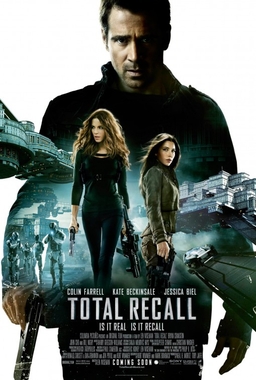
Behind the film
- Year
- 2012
- Director
- Len Wiseman
- Writers
- Kurt Wimmer, Mark Bomback
- Runtime
- 1h 58m
- Genres
- Action, Thriller, Science fiction, Dystopian
- Production
- Original Film
- Country
- United States
- Cast
- Colin Farrell, Kate Beckinsale, Jessica Biel, Bryan Cranston, John Cho, Bill Nighy, Steve Byers, Bokeem Woodbine
About the film
Contains story spoilers.
This 2012 version of Total Recall moves Philip K. Dick’s memory premise to a damaged Earth. Chemical warfare has left only two habitable regions: the United Federation of Britain, where political power and wealth are concentrated, and the Colony, a crowded Australian territory whose workers commute to Britain through the Fall, an elevator that tunnels through the planet. Douglas Quaid lives in the Colony and spends his days on an assembly line building police robots alongside his friend Harry. The city’s stacked housing, multilingual streets and movement between unequal regions give the story a different geography from the 1990 film, which sends its characters to Mars.
Quaid’s nights are less ordinary. He keeps dreaming of escaping a fortified site with a woman he cannot identify, and he is increasingly dissatisfied with his work and home life with Lori. Harry warns him away from Rekall, a company that sells artificial memories, but Quaid goes anyway and chooses a spy adventure. During the procedure, technician McClane notices that Quaid’s brain already contains memories of a real operative. Before they can work out what that means, armed police storm the facility. Quaid’s instincts take over; he fights his way out, leaving him with the question of whether the violence came from a planted fantasy or a life he has forgotten.
At home, Quaid tells Lori what happened. She turns on him and tries to kill him, revealing that she is an intelligence agent assigned to watch him and that their marriage is an implanted memory only weeks old. He escapes and follows a message left by a former colleague to a safe-deposit box. Inside is a recording of himself directing him to an apartment in the Federation. Lori receives an order from Chancellor Cohaagen to bring Quaid in alive, but ignores it and sends her team after him. The flight across the city turns into a running fight through stairwells, apartments and transit routes, while the woman from his dreams, Melina, helps him evade Lori’s pursuit.
In the Federation, Quaid finds the apartment linked to the recording and finds a hidden recording explaining that he used to be Carl Hauser, one of Cohaagen’s agents. Hauser was sent to infiltrate the Resistance but defected after falling in love with Melina. He discovered that Cohaagen planned to send an army of robotic police to the Colony, using the Fall to move the troops and clear space for Federation residents. Cohaagen captured Hauser and replaced his memories with the Quaid identity. That account of his past still leaves Quaid dependent on messages and people whose reliability he cannot establish. He and Melina must reach Matthias, the Resistance leader, who may be able to retrieve the code that disables the robots.
The pair cross a city where police drones and surveillance make every street a possible trap. Quaid is pursued by Lori, whose familiarity with his assumed life makes her more dangerous than a faceless squad, and Melina is also trying to reach the underground network she once shared with Hauser. When they find Matthias, he begins searching Quaid’s memory for the kill code. Cohaagen raids the Resistance base and reveals that the kill code was a fabrication designed to lead him to Matthias. He kills the Resistance leader and captures Melina. His plan is to restore Hauser’s old identity and use him to finish the infiltration. Former colleague Hammond frees Quaid, dying during the escape, and Quaid heads for the Fall before Cohaagen’s robot force can be deployed.
Cohaagen loads the Fall with troops for an invasion of the Colony. Quaid boards the transport and plants timed explosives while searching for Melina. He reaches her as the elevator arrives, and the two fight Cohaagen and his soldiers before the charges detonate. They jump clear as the Fall drops back through the Earth and explodes underground, destroying the invasion force and killing Cohaagen. The final moments briefly return the story to its memory question: Quaid wakes in an ambulance with Melina beside him, but notices a detail that exposes her as Lori wearing a holographic disguise. He kills her, finds the real Melina, and sees news reports announcing the Colony’s independence.
The memory question runs through that escape: a bored worker has bought the prospect of being a secret agent, and the life he finds afterwards resembles his chosen fantasy. Before the finale, Harry even offers him a way to end it, insisting that shooting Melina would wake him from the Rekall experience. Quaid refuses that explanation. The theatrical ending resolves the invasion and the immediate danger from Lori; the director’s cut adds a more explicit final doubt, when Quaid notices that his Rekall mark is missing. That extra image belongs to the alternate version rather than the theatrical ending described here.
Len Wiseman described the film as a grounded fantasy, with real settings and characters inside a technologically altered future. He said the crew built six hover-cars on racing chassis and filmed them at speed, then extended the setting with effects. For the Fall, they built large sets and rotated performers to stage changing gravity. These practical pieces give the digital cityscapes a physical anchor as the chase moves through rooftops, transit stations and the elevator interior. Paul Cameron’s cinematography and Patrick Tatopoulos’s production design put the two unequal regions around those physical stunts, making the commute itself part of the action.