
Behind the film
- Year
- 1995
- Director
- Agnieszka Holland
- Writers
- Christopher Hampton
- Genres
- Biographical, Drama, Lgbtq-related
- Country
- France, United Kingdom, Belgium, United States, Italy
- Cast
- Leonardo DiCaprio, David Thewlis, Romane Bohringer, Dominique Blanc
About the film
Contains story spoilers, including the ending.
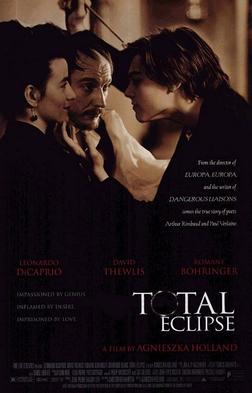
Total Eclipse places Arthur Rimbaud inside a household already bound by marriage, money and expectations of respectable behaviour. In 1871, Paul Verlaine invites the teenage poet to stay with him and his pregnant wife Mathilde in Paris. Rimbaud disrupts the family and the literary company around Verlaine, who becomes drawn to his visitor and eventually abandons Mathilde. Leonardo DiCaprio plays Rimbaud, David Thewlis plays Verlaine, and Romane Bohringer plays Mathilde. Directed by Agnieszka Holland, the 1995 drama adapts Christopher Hampton's play about the French poets. Their lives supply its characters and events, shaped into scenes and conversations for the film.
The departure from Paris does not give the poets a settled life together. Verlaine remains caught between returning to Mathilde and following Rimbaud, while Rimbaud becomes impatient with his indecision. In Brussels, the argument turns on where they will go next and whether they will continue together at all. Rimbaud wants to leave; Verlaine pleads with him to stay, then produces a pistol and shoots him. His attempts to prevent a separation have made their situation irreparable. The court sentences Verlaine to two years in prison. When they meet after his release, his conversion to Christianity gives their conversation another point of conflict. Verlaine wants Rimbaud to find a purpose through faith and continue writing. Rimbaud says he has stopped. Their disagreement reaches beyond the earlier quarrel over departure: the work that first drew Verlaine towards him no longer offers a shared future.
A later conversation with Rimbaud's sister Isabelle frames these memories. She wants Verlaine to surrender the dead poet's remaining work, leaving a censored version of her brother behind. Rimbaud has travelled to Abyssinia, lived by trade and returned to France because of illness; he dies after an operation fails to stop the cancer. Isabelle presents his final religious reconciliation as grounds for deciding what should survive him. Verlaine appears to agree, then tears up her card after she leaves. His vision of the young Rimbaud returns the film to a figure who cannot answer Isabelle's demands himself. The closing mountain landscape belongs to that vision, rather than a reunion between the living poets. Verlaine remembers happiness alongside the cruelty and separation already shown. Keeping the poems becomes a decision about Rimbaud's memory after the relationship and the man are gone.
Hampton's interest in the pair began when he encountered Rimbaud's poetry as a sixteen-year-old studying French. He started researching their story at Oxford and wrote the play when he was twenty-one. Looking back, he described himself as being between the ages of his two subjects. His first fascination was with Rimbaud's desire to break apart the world and rebuild it. Research also brought him closer to Verlaine's persistence as a writer. Hampton contrasted Rimbaud's brief, extraordinary commitment to poetry with Verlaine's determination to keep working throughout his life. That distinction gives the later disagreement about abandoning literature a particular weight. Verlaine can survive humiliation and still think of himself as a poet; Rimbaud's decision to stop challenges the purpose Verlaine has continued to find in writing.
Turning the play into a screenplay meant returning to its structure. Hampton said that cinema required him to imagine the story again from the beginning and change as much as possible, so it would not continue to feel like a stage production. He credited Holland with being direct about what she liked, disliked and wanted to do. The historical subjects remained central to his account of the writing. He described an ambition to stay close to their biographies, first establishing events and then giving the material dramatic shape. That is the writer's account of his method; the finished film still tells the story through performed encounters and a selected sequence of incidents. Its treatment of Rimbaud and Verlaine follows Hampton's long interest in artists as subjects whose working lives and private choices could sustain a drama.
Holland connected Total Eclipse to the existential questions of her own generation. In an interview, she described recognising her younger self in Rimbaud's wish to shake the world and risk its destruction. Verlaine reflected an older perspective: someone who wanted to go further but also feared losing comfort. She called him a despairing conformist. Her identification with both figures makes the conflict more personal than a simple opposition between an adventurous youth and a cautious adult. The wish to escape an established life coexists with fear of what that escape will cost. Holland described directing the film as looking back at her youth from where she stood later.
The French setting also raised a practical question for Hampton: the film was made in English. He later said he wished it had been made in French and would have liked to remake it that way. He linked the language choice to producers' desire for a wider audience. Holland, reflecting on casting, praised DiCaprio's ability to communicate Rimbaud's complexity and the poets' connection through their work. Her account places their shared literary interests alongside the personal bond that becomes so destructive. The performances carry that connection through arguments about how to live and whether to keep writing.