
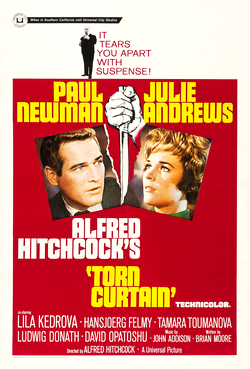
Behind the film
- Year
- 1966
- Director
- Alfred Hitchcock, Willis Hall, Keith Waterhouse
- Writers
- Brian Moore
- Genres
- Spy, Political thriller, Thriller
- Production
- Universal Pictures
- Country
- United States
- Cast
- Paul Newman, Julie Andrews, Lila Kedrova, Tamara Toumanova, Wolfgang Kieling, Ludwig Donath, Günter Strack, David Opatoshu
About the film
Contains story spoilers.
Alfred Hitchcock’s 1966 thriller stars Paul Newman as Michael Armstrong and Julie Andrews as Sarah Sherman, his assistant and fiancée. At a physicists’ congress in Copenhagen, Armstrong suddenly appears to abandon his country for East Germany. Sarah follows him, confronting a decision that threatens their shared future as well as his career. His welcome from the authorities gives him access to Professor Gustav Lindt, whose research concerns antimissile defense. Armstrong’s plan is to take that knowledge back to the United States. He must convince his hosts that he has genuinely changed sides while keeping Sarah from giving the game away.
Armstrong’s contact with the underground escape network brings him to a farm, followed by his minder Hermann Gromek. Gromek recognizes the deception and tries to call the police. Armstrong and the farmer’s wife kill him after a prolonged struggle, then conceal his body and motorcycle. A taxi driver has seen enough to endanger their cover. In Leipzig, Sarah refuses to answer questions about the American Gamma Five program, despite having agreed to stay in East Germany. Armstrong finally tells her why he has come. He provokes Lindt into correcting deliberately faulty mathematics, extracting the equations he needs. A public announcement alerts Lindt to the trick, and the couple flee with Dr. Koska’s help.
The underground moves them toward East Berlin on an unscheduled bus. A countess helps them evade police, and their escape plan eventually leads to a ballet troupe bound for Sweden. The lead ballerina recognizes them at the theatre and alerts the police. Armstrong shouts fire, using the fleeing crowd to get away. Hidden in costume hampers, the couple travel aboard a freighter. At the Swedish dock, the ballerina directs guards toward two baskets and they open fire. An accomplice has drawn attention to decoys; Armstrong and Sarah escape the shooting and swim to safety.
The murder at the farm gives Armstrong’s mission a cost that a scientific formula cannot explain away. Hitchcock wanted the struggle to show how difficult killing a person could be, and to confront his ordinary protagonist with what espionage actually required. His interest in the story began with the defection of British spies Guy Burgess and Donald Maclean, particularly the question of how Maclean’s wife had responded. That concern became Sarah’s bewilderment over the man she expected to marry. The screenplay was credited to novelist Brian Moore, with further work by Keith Waterhouse and Willis Hall before filming. Universal wanted Newman and Andrews, and her limited availability helped push the picture into production. The studio’s musical expectations also affected the finished film. Hitchcock asked Bernard Herrmann for a more popular style of score, but Herrmann delivered an orchestral approach that led to their break. John Addison supplied the replacement music. The uncomfortable farmhouse killing remained central to Hitchcock’s account of the film: Armstrong has crossed a border that also changes what he is willing to do to another person.
For the photography, Hitchcock wanted to reduce the polished appearance he associated with Hollywood color films. He and cinematographer John Warren began with the ordinary light in an office: soft, reflected illumination, without harsh black shadows or an obvious direct beam. Warren used reflected light and softened any direct lighting to fit that approach. Gray gauze in front of the lens further reduced the strength of the colors. Hitchcock also coordinated the palette with the clothes and sets, restricting East Germany to gray and beige with occasional red. He brought Hein Heckroth in to coordinate production design because the setting called for someone familiar with Germany. One hotel-room sequence made the collaboration particularly visible. Hitchcock described playing it entirely in long shot, with a faint yellow shaft of evening sunlight against the room’s heavy brown surroundings. The warmth had to work within the dark setting, rather than brighten everything indiscriminately. Light, costume and furniture were planned together so that the camera would receive the subdued image he wanted.
Discussing the film at Harvard, Hitchcock described further practical limits on that lighting. He said the illumination was reduced to a quarter of the usual level, and that only the two leads wore makeup. Soft light could then preserve the texture of the other performers’ skin. A white sheet measuring twenty feet by twenty feet stood at the end of a set; lamps aimed at it sent their light back into the room. Direct light on faces was diffused to match. Exteriors were diffused too. His concern extended to the walls: a designer could age plaster carefully, only for excessive lighting to destroy its texture. These choices kept the physical surfaces visible without the bright rim around each performer that he disliked. Hitchcock claimed responsibility for the change from the look of his earlier films, treating the restrained color and light as deliberate decisions for this particular journey into East Germany.