
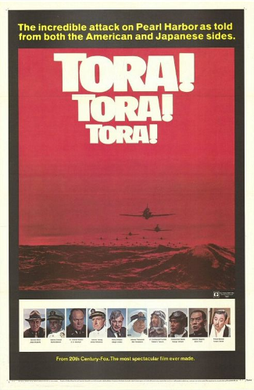
Behind the film
- Year
- 1970
- Director
- Richard Fleischer, Kinji Fukasaku, Toshio Masuda
- Writers
- Akira Kurosawa, Hideo Oguni
- Runtime
- 2h 25m
- Genres
- War
- Production
- 20th Century Studios
- Country
- United States, Japan
- Cast
- Joseph Cotten, Jason Robards, Martin Balsam, James Whitmore, E. G. Marshall, Keith Andes, Neville Brand, Norman Alden
About the film
Contains story spoilers.
The story begins in September 1940 and moves between Tokyo, Washington and Pearl Harbor as Japan’s leaders weigh a war they know may be difficult to win. Admiral Isoroku Yamamoto commands the Combined Fleet, has studied in the United States and understands its industrial reach. He accepts a strike as his duty, but the film presents it as a gamble. Minoru Genda develops the operation; Mitsuo Fuchida leads the first wave. The Japanese scenes show disagreement inside the government and navy: some leaders favour expansion and alliance with Germany, while others see the danger of provoking America.
In Washington, Colonel Rufus Bratton and Lieutenant Commander Alwin Kramer read intercepted Japanese messages. Their clues arrive in pieces: naval activity, diplomatic traffic, and instructions to destroy the embassy code machines after a final set of messages. They suspect a surprise attack and try to raise the alarm, but the information passes through offices where each official sees only part of the picture. At Pearl Harbor, Admiral Husband Kimmel and General Walter Short take precautions, yet those measures reflect fears of sabotage and uncertainty about where a threat might come from. The tension comes from the gap between what viewers can assemble and what any one officer can act upon.
As Tokyo’s diplomats continue negotiations, the strike force crosses the Pacific. Bratton presses his superiors to treat the coded traffic as an immediate warning. General George Marshall orders a warning to Hawaii, but communications fail to deliver it with the urgency the situation demands. On Oahu, radar operators see a formation; Lieutenant Kermit Tyler assumes the aircraft are expected American bombers. A report of a Japanese submarine near the harbour also fails to prompt a timely broader warning. The film places these failures beside Japanese preparations, showing how assumptions combine into a blind spot rather than tracing the disaster to one mistake.
At dawn on December 7, 1941, Fuchida’s aircraft reach the island and the Japanese signal confirms surprise. The film’s measured pace gives way to practical emergencies: aircraft are caught on the ground, ships are struck in the harbour, and sailors try to escape burning vessels and oil-covered water. The action remains tied to earlier decisions, including the choice to cluster planes on airfields to protect them from sabotage. Rather than following one hero through the assault, the film returns to crews and officers across the base, letting the scale of the raid emerge through separate stations and ships.
After the raid, the film turns to what Japan did not hit. The American aircraft carriers are absent from Pearl Harbor, and Admiral Nagumo declines a further wave, fearing for his fleet. The final diplomatic message reaches Secretary of State Cordell Hull only after the attack is underway, deepening the rupture between the two governments. These decisions give the ending a different measure of the raid’s success: surprise is achieved, but the fleet has missed a major target and the United States is pulled into war. The story stops as that larger conflict begins.
The production was conceived as two interwoven perspectives, with American and Japanese units working in the languages and film traditions of their settings. Richard Fleischer directed the American material; Kinji Fukasaku and Toshio Masuda took over the Japanese sequences after Akira Kurosawa was replaced early in the shoot. Japanese and American meetings become parallel spaces where decisions are made from incomplete knowledge. The separate crews’ material is cross-cut into one chain of events, giving the two sets of command rooms and political offices room to develop before the attack. That structure reflects a film planned as a joint production rather than a single viewpoint imposed on the story.
The scale comes from preparation as much as from the attack. The studio’s 1970 souvenir account describes years spent gathering aircraft, ships, vehicles, locations and period equipment, then staging aerial and ground photography in Hawaii. Full-sized vessels and aircraft helped reproduce the machines seen in the raid. A North American T-6 served as a stand-in for Japanese Zero fighters. The film uses physical sets, miniatures and practical effects to turn operational detail into movement, while much of its earlier running time stays with briefings, messages and command decisions. Its cast is spread across an ensemble rather than centred on one lead. The title refers to the Japanese signal for achieved surprise, not simply to “tiger.”
The film’s paired viewpoints can suggest a neutral report, but they remain a chosen frame for a historical drama. Most of its attention stays with military and diplomatic leaders as they interpret warnings and act on partial information; the attack’s wider human and political consequences extend beyond that endpoint. Yamamoto’s final warning about awakening a sleeping giant was written for the film rather than preserved as an authentic quotation. It gives his misgivings a memorable voice, but should not be mistaken for evidence of what he said.