
Behind the film
- Year
- 2018
- Director
- Roar Uthaug
- Writers
- Geneva Robertson-Dworet
- Runtime
- 1h 58m
- Genres
- Adventure, Action
- Production
- Warner Bros. Entertainment, Metro-Goldwyn-Mayer, Square Enix
- Country
- United States, United Kingdom
- Cast
- Alicia Vikander, Walton Goggins, Daniel Wu, Dominic West, Kristin Scott Thomas, Hannah John-Kamen, Antonio Aakeel, Derek Jacobi
About the film
Contains story spoilers, including the ending.
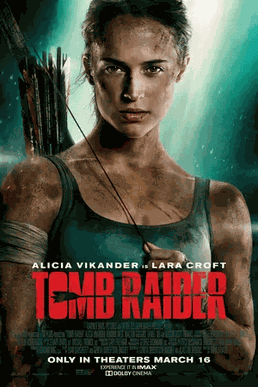
Tomb Raider begins with a Lara Croft who has kept her family name at a distance. Alicia Vikander plays the young adventurer in Roar Uthaug's 2018 film, which introduces her as an East London bicycle courier struggling to pay her way. Richard Croft disappeared seven years earlier, and his daughter has resisted the family legacy because accepting his absence would mean accepting his death. Uthaug described her as vulnerable and imperfect, with the physical ability to survive dangerous situations but no settled idea of who she should become. Her investigation grows out of that unfinished relationship. Dominic West plays Richard, whose archaeological mission has taken him away from his child, while Daniel Wu's Lu Ren is a Hong Kong boat captain with more behind his apparently carefree manner than Lara initially understands. Walton Goggins plays Mathias Vogel, the expedition leader who considers himself justified in pursuing his mission.
Lara's search takes her to Yamatai, where Vogel uses prisoners to excavate Himiko's tomb for Trinity. She escapes the camp and finds Richard alive, hiding on the island to keep the tomb closed. Their reunion puts them on opposite sides of the same question: Lara wants her father back, while he fears what following his research will unleash. The supposed supernatural power proves to be a contagious pathogen carried by Himiko's remains. After Richard becomes infected, he destroys the tomb and dies inside it. Lara defeats Vogel and escapes with Lu and the surviving prisoners. Back in London, she formally accepts her inheritance, then discovers that Trinity's front company belongs to Croft Holdings. The danger reaches into the business she has inherited, and her father's disappearance no longer looks separate from the people managing his affairs.
Screenwriter Geneva Robertson-Dworet described taking Lara further back in her development than the 2013 game that inspired the adaptation. The game's heroine already has an interest in archaeology; the film's Lara has yet to take that path. Robertson-Dworet joined after several possible versions had been explored and returned to the rebooted game's island setting and action. The broken aircraft sequence was one of the pieces she especially wanted to adapt. Her account also describes a change in tone during development. An earlier version leaned toward an Indiana Jones style of action comedy, with a younger, more openly sassy Lara. Vikander wanted greater weight and realism, prompting extensive dialogue revisions. Robertson-Dworet said the plot remained while much of its verbal character changed. The result was conceived around a heroine affected by what she does, rather than one who can brush off every violent encounter.
Production designer Gary Freeman approached Lara's surroundings as places that needed to feel inhabited before she arrived. Contemporary London and Hong Kong were meant to resemble ordinary cities, while the island excavation needed the working character of an archaeological expedition with a hostile purpose. Freeman watched gameplay videos to understand the situations Lara would face and the visual language of the games. He treated the earlier films as a point of difference, aiming for less overt fantasy and a heroine whose abilities came from persistence and growing experience. Uthaug gave him room to develop the environments while checking that the designs stayed within that approach. Freeman also drew on his experience of Children of Men, where a powerful setting did not depend on conspicuous decoration. The tomb could be dangerous and strange without making Lara's entire world feel detached from everyday life.
Visual effects supervisor Paul Linden built the action around what Vikander and the stunt team could physically perform. The ship sequence used a large vessel mounted on a moving gimbal in South Africa, with water work continuing in tanks at Leavesden. For the river escape, the production used the Lea Valley White Water Centre outside London, then extended the surroundings digitally. The aircraft wing was filmed on a Cape Town backlot rather than putting the performer beside a real waterfall. Lara's subsequent parachute fall required digital doubles for much of the violent journey through the trees. Linden also gathered measurements, lighting references and landscape photography so those separate pieces could occupy the same environment. In the puzzle room, marked tiles and rehearsals helped establish where the cast would move before the floor effects were completed. His stated priority was to make the world resist Lara's actions without making her escape appear conveniently arranged.
Tom Holkenborg built Lara's musical theme around the father she misses. He described carrying that material through her arrival on the island, her struggle to survive and her emergence as an adventurer. The score therefore had to grow with a person whose fights remained human in scale, even when the surrounding landscape was enormous. Holkenborg did not base the music on earlier Tomb Raider scores. He distinguished the concentrated demands of a feature from the long stretches of exploration a player might spend inside a game. Strings and brass recorded in London were electronically altered, sometimes enough to obscure their acoustic origins. A specially commissioned set of Pacific drums supplied the rhythmic foundation, while animal recordings became further sound design instruments. The mixture lets the score draw on live performance and unfamiliar textures at the same time. Holkenborg worked on the music intermittently for roughly five or six months, writing in Los Angeles before recording in London.