
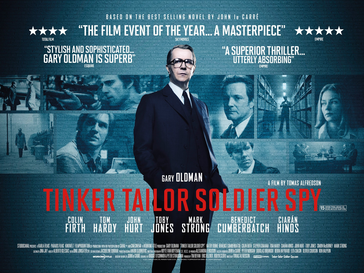
Behind the film
- Year
- 2011
- Director
- Tomas Alfredson
- Writers
- Bridget O'Connor, Peter Straughan, John le Carré
- Runtime
- 2h 7m
- Genres
- Spy, Mystery, Thriller, Drama
- Production
- StudioCanal, Working Title Films, Canal+
- Country
- France, United Kingdom, Germany
- Cast
- Gary Oldman, Colin Firth, Tom Hardy, Mark Strong, Ciarán Hinds, Benedict Cumberbatch, Toby Jones, John Hurt
About the film
Contains story spoilers.
The film begins with a failed mission in Budapest. Control, head of Britain’s intelligence service, the Circus, sends Jim Prideaux to meet a Hungarian general who claims to know the identity of a Soviet mole. Prideaux is shot, and the operation’s failure brings Control and his trusted deputy George Smiley, played by Gary Oldman down with him. After Control’s death, Percy Alleline takes charge. His circle includes Bill Haydon, Roy Bland and Toby Esterhase, the very senior men who now have access to a mysterious Soviet source. The film places this change of power in a shabby office world where prestige and access matter as much as official titles, and where a failed operation can erase a career before anyone has learned what really happened.
Some time later, government official Oliver Lacon asks Smiley to investigate a renewed warning that there is a mole inside the Circus. The warning comes from Ricki Tarr, a field agent who has disappeared after an operation in Istanbul. Tarr tells Smiley that he fell in love with Irina, the wife of a Soviet official, and that she offered to trade the mole’s identity for a safe life in the West. Soon after he reported this possibility, people around her were killed or disappeared, and Tarr was branded a traitor. Smiley asks Peter Guillam to help him search service records, with retired police officer Mendel joining them. The task is not to chase an enemy abroad but to establish which old colleague can still be trusted at home.
Smiley works by testing fragments against one another. He consults Connie Sachs, a former Circus researcher dismissed after noticing that Soviet cultural attaché Alexei Polyakov behaved like a military officer. Her suspicions connect Polyakov to Operation Witchcraft, the source that Alleline and his circle present as a stream of valuable Soviet information. Personnel and financial records show that Control’s people have been pushed aside, while the remaining leaders have gained unusual access to intelligence. Guillam steals the duty log for the night Tarr says he sent his warning, but the relevant pages have been removed. The missing record does not prove who the mole is; it tells Smiley that someone inside the service has tried to erase the same trail Tarr described.
The investigation also revisits the Budapest disaster. Smiley finds Prideaux alive, working as a schoolmaster, and hears what happened after he was shot: the KGB held and tortured him, Irina was killed in front of him, and his interrogators wanted to know how much Control suspected. The names Control gave his suspects come from a children’s rhyme: Tinker, Tailor, Soldier, Poorman and Beggarman. Prideaux’s account makes the old operation more than a prologue, because it shows that the mole’s reach extended to the mission itself. Smiley also learns why Bill Haydon could have arrived so promptly when the emergency was reported: he had been with Smiley’s unfaithful wife Ann and received the message through her. The private wound and the service’s crisis share the same breach of trust.
Smiley then uncovers the purpose of Witchcraft. The intelligence Polyakov supplies is a carefully managed lure rather than the breakthrough Alleline believes it to be; the material is bait meant to make British intelligence offer its American partner valuable information, which the mole can pass to Karla in Moscow. That explanation changes the apparent success of Alleline’s leadership into an elaborate leak. Smiley gets the secret meeting address by pressuring Esterhase, then arranges for Tarr to send a second message through Paris. He expects the mole to warn Polyakov. At the safe house Smiley waits with Guillam, and Haydon appears, confirming the suspicion. In custody, Haydon admits that Karla used his affair with Ann to cloud Smiley’s judgment. Smiley has solved the case, but the confession does not restore the careers, loyalties or relationships already damaged.
Prideaux kills Haydon with a rifle, a sharp ending that the film handles differently from the novel and the 1979 television adaptation. In the film, Smiley returns to the Circus as its chief, while Ann returns home; the final montage moves through these personal and institutional resolutions as Julio Iglesias sings “La Mer.” The story has spent most of its time in offices, apartments and memories, so the payoff comes from a quiet act of recognition and the aftermath of a betrayal rather than a conventional chase. Director Tomas Alfredson and screenwriter Peter Straughan described the challenge as compressing a dense novel without losing its melancholy pace. They lean on glances, objects, files and rooms to let information travel indirectly, keeping the audience inside Smiley’s slow work of noticing what others would rather leave unrecorded.
The film keeps this inquiry tactile and enclosed. Alfredson’s camera drifts past office doors and windows, while cigarettes, glasses and paperwork become things Smiley studies. At the Circus Christmas party, a Lenin-masked Santa and a rendition of the Soviet anthem turn the festivities into an incongruous performance of camaraderie. The scene makes the workplace seem to perform loyalty even as its people wonder who has crossed sides. Alfredson said the film is about loyalty and ideals.