
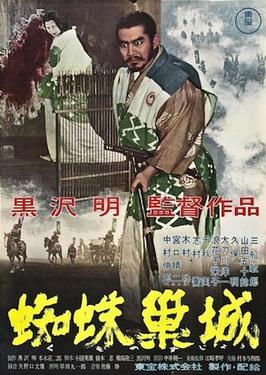
Behind the film
- Year
- 1957
- Director
- Akira Kurosawa
- Writers
- Akira Kurosawa, Shinobu Hashimoto, Hideo Oguni, Ryūzō Kikushima
- Runtime
- 1h 45m
- Genres
- Drama, Samurai cinema
- Production
- Toho
- Country
- Japan
- Cast
- Toshirō Mifune, Isuzu Yamada, Takashi Shimura, Minoru Chiaki, Akira Kubo, Seiji Miyaguchi, Yoshio Inaba, Hiroshi Tachikawa
About the film
Contains story spoilers.
Throne of Blood begins among ruins and fog, then returns to the events that left a castle abandoned. General Taketoki Washizu and his friend Yoshiaki Miki have helped defeat an enemy force and are riding to Spider Web Castle when they lose their way in Spider Web Forest. A spirit predicts that Washizu will take the North Castle and then the greater seat, while Miki will command the First Fort and his son Yoshiteru will eventually rule. Tsuzuki rewards them exactly as foretold. Washizu now has to consider who will inherit the power he has gained.
Tsuzuki visits Washizu’s North Castle with an army, and Asaji argues that her husband must kill him before the lord can learn about the prophecy and treat Washizu as a threat. She drugs the guards’ sake; Washizu enters the forbidden room and kills Tsuzuki with a spear. Asaji then places the weapon in a guard’s hands and calls out that traitors are attacking, helping Washizu turn the murder into an apparent act of defence. Kunimaru, Tsuzuki’s son, and Noriyasu, one of the lord’s advisers, suspect what happened and flee, trying to warn Miki. Miki refuses to believe them. Their escape leaves potential opposition alive while Washizu moves into the throne he was promised.
Washizu has no child, so he decides to adopt Miki’s son Yoshiteru as his heir and plans to announce the choice at a banquet. Asaji reveals that she is pregnant, changing the succession question: the child she carries could inherit, so Washizu reverses his decision and chooses to eliminate both Miki and Yoshiteru. At the banquet, he waits for the two men to arrive, drinks heavily, and sees Miki’s ghost in the empty place set for him. He loses control in front of the guests, slashing at the seat and exposing his fear. After Asaji sends everyone away, an assassin brings Miki’s severed head and reports that Yoshiteru escaped. Washizu kills the messenger in anger, while the son he tried to remove remains a living rival.
The murder does not make Washizu feel secure. His men grow fearful of him, and reports spread that Yoshiteru has joined Kunimaru and Noriyasu, now allied with their former enemy Inui. Then word comes that Asaji’s baby has been born dead. Washizu is shaken by the loss of the heir who had justified his decision to kill Miki and Yoshiteru, while the forces outside his castles are closing in. He rides alone back to Spider Web Forest to ask the spirit what will happen. It tells him he will not lose until the forest itself moves against his castle. Washizu brings this assurance back to his soldiers, trying to restore their morale as the forts come under siege.
By morning, Asaji is in a semi-catatonic state, rubbing her hands as if she cannot remove blood that is no longer there. Washizu leaves her and hurries to the castle yard when his men panic at the sight of the forest advancing. The image has a practical explanation: Noriyasu’s forces have cut trees and branches and carry them as cover while they approach. Yet the tactic works as the spirit’s prophecy in the moment, and Washizu’s troops lose faith in the man who has kept them through murder and fear. When he orders them to hold their positions, they turn their bows on him instead. They accuse him of treason because he himself killed the lord he served.
Washizu tries to command the archers as the arrows begin to strike around him, but he cannot make the men obey. The violence that he kept hidden in the castle now takes over the open courtyard. He is wounded by the arrows of his own troops and dies as the rebel army closes on the gate. Asaji remains behind, still trapped in the repeated act of washing her hands. The ending ties the supernatural warning to a military manoeuvre: the forest really does seem to move, but it is moved by the people Washizu has driven into rebellion. The prediction has not protected him; his decision to trust it has stopped him from recognising the enemy’s approach and his own soldiers’ loss of loyalty.
Kurosawa gives the Shakespeare story a Japanese military setting and a theatrical pattern built from stillness, measured gestures, and sudden movement. Noh-derived music and performance shape the spirit, while Asaji’s controlled posture makes her counsel feel as deliberate as a ritual. The fog hides the road and softens the distance between castle and forest, making Washizu’s world seem closed even when he is moving through open country. Dark walls, broad rooms with low ceilings, and the crowded courtyard change the space around him as his position rises and then collapses. The story stays close to concrete political choices: a drugged guard, an adoption plan, an escaped heir, and an army using cut branches as shields. Each leaves Washizu with fewer loyal people and less room to read what is happening.