
Behind the film
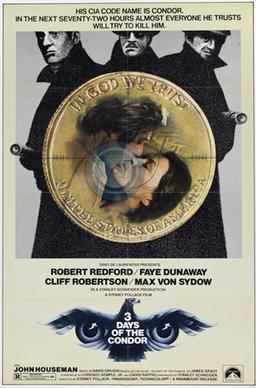
- Year
- 1975
- Director
- Sydney Pollack
- Writers
- Lorenzo Semple Jr., David Rayfiel
- Genres
- Spy, Drama, Crime, Political thriller
- Production
- Paramount Pictures
- Country
- United States
- Cast
- Robert Redford, Faye Dunaway, Cliff Robertson, Max von Sydow, John Houseman, Tina Chen, Addison Powell, Hank Garrett
About the film
Contains story spoilers.
Joe Turner, played by Robert Redford, works at the American Literary Historical Society, a small CIA office in New York. Its researchers read books and other printed material from around the world, looking for ideas or patterns that might matter to intelligence work. Turner notices an oddity in a thriller novel that has appeared in several languages despite poor sales and sends a report to headquarters. The work is quiet and desk-bound, and Turner is a reader rather than a field agent. When he leaves the office to collect lunch, an armed team enters and kills the employees who remain inside.
Turner returns to find his co-workers dead, including Janice, a colleague he has been seeing. He takes a gun from the reception area and calls the New York office, using his code name, Condor. Headquarters tells him to find somewhere secure and wait for instructions. He checks on Heidigger, who was absent from work, and discovers that he has also been killed. The new information makes the attack seem planned around the whole section, not a random assault. Turner contacts the agency again and is directed to meet Wicks, the department chief he has never met, with Sam Barber, a friend he trusts, present as reassurance.
The meeting is a trap. Wicks tries to kill Turner, who wounds him and escapes; Wicks then shoots Barber in the throat. Before Wicks is taken to hospital, he tells officials that Turner shot them both, setting up a false account that makes Turner appear responsible. Turner has no way to know which officials are involved, so even a call for help can expose his position. He meets Kathy Hale, a photographer, and forces her at gunpoint to drive him to her Brooklyn apartment. He holds her there while trying to work out why his section was targeted and what his report might have uncovered. Kathy is frightened and angry, and the film keeps the coercion in their first exchanges visible even as their relationship changes.
As Turner explains what happened, Kathy begins to understand that he may be telling the truth, but his appearance does not make him safe to trust. He draws on skills from an earlier job as a telephone lineman, using his knowledge of phone lines to investigate a call connected to the people pursuing him. The work pulls him out of hiding and into contact with former colleagues and agency offices. The possibility that the CIA itself may be divided into competing operations gives each meeting a second meaning: an official who offers information may be helping him, managing him or trying to locate him.
The danger reaches Kathy’s apartment when a man disguised as a mail carrier comes to kill Turner. Turner kills the attacker and finds material that connects him to the agency, evidence he can use when he challenges his superiors. With Kathy’s help, he abducts Higgins, the deputy director of the New York office, to question him. Higgins tells him Wicks has died after being disconnected from hospital life support. He knows little about the attack at first, but he recognizes Joubert, the tall European gunman Turner has seen before, as a former CIA assassin now working freelance. Higgins later finds that the mail carrier and Joubert had worked together on an earlier operation and reported to Wicks. The connections narrow the search while showing how far the agency’s ordinary channels can be compromised.
The key found on the dead mail carrier leads Turner to Joubert’s registered hotel. Turner uses a telephone-company disguise to tap Joubert’s line and trace a call to Leonard Atwood, a senior CIA operations official in Maryland. Atwood’s house is dark when Turner confronts him, and the questions about the novel and the massacre finally meet. Turner realizes that his inquiry threatened an unauthorized intelligence operation intended to extend American influence in oil-producing countries. Joubert appears behind him and orders him to lower his gun. Instead of killing Turner, Joubert shoots Atwood: the CIA has hired him to eliminate the official, and Atwood’s contract on Turner is cancelled.
Joubert offers Turner freelance work, praising how quickly the researcher has adapted to danger. Turner refuses and returns to New York. In a public street, he tells Higgins that Atwood’s operation was preparing to invade the Middle East for oil. Higgins defends the plan, arguing leaders may use extreme measures when shortages threaten the country. Turner says he has given the story to The New York Times. Higgins asks whether the newspaper will print it, leaving Turner’s survival and the disclosure’s consequences unresolved.
Sydney Pollack keeps much of the story in offices, apartments, streets and telephone conversations, so Turner’s ordinary habits become the tools he has for staying alive. Turner and Kathy move from captor and captive to collaborators, while the power imbalance of his kidnapping remains part of their relationship. The final exchange with Higgins shifts the question from who ordered the killings to whether a newspaper can make the truth matter.