
Behind the film
- Year
- 1988
- Director
- John Carpenter
- Writers
- John Carpenter
- Runtime
- 1h 34m
- Genres
- Action, Science fiction, Action thriller, Dystopian
- Country
- United States
- Cast
- Roddy Piper, Keith David, Meg Foster, Raymond St. Jacques, George Buck Flower, Sy Richardson, Tommy Morrison, Norman Alden
About the film
Contains story spoilers.
Nada comes to Los Angeles for work and finds a construction job. There he befriends Frank, a fellow worker living far from his family. Frank brings him to Justiceville, a camp for people shut out of the city’s promise of work and stability. A street preacher warns that the wealthy are being recruited by a force that controls people without their knowledge. Later, a hacker interrupts a television broadcast with a similar warning. Nada sees some of the camp’s organizers slipping into a church, but does not yet know what they are doing there.
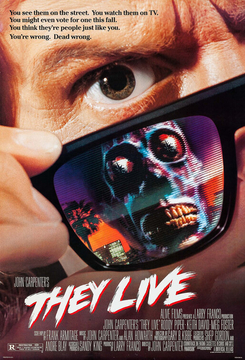
The church hides a meeting of people trying to interrupt the broadcast signal. Before Nada can decide whether to join them, police arrive in riot gear and bulldoze Justiceville. He escapes the raid, returns to the stripped church, and finds a box of sunglasses left in a wall. Through the lenses, the familiar city becomes a different image: advertising gives way to blunt commands such as “OBEY” and “CONSUME,” while prosperous-looking people appear as skull-faced aliens. The glasses also reveal that the creatures use wristwatch devices to communicate and disappear. Nada’s discovery turns his quiet search for a job into an immediate, violent confrontation with the people who control what everyone else sees.
When two alien officers try to arrest him, Nada takes their guns and storms a bank where he sees more aliens. He shoots several and escapes by taking Holly, a television-station employee, hostage. At her home, she rejects his explanation, then knocks him out and sends him through a high window. Nada survives and seeks Frank, who is wary after hearing that he has become a wanted gunman. To make Frank see what he has seen, Nada forces the glasses on him during an extended alley fight. Frank eventually looks, recognizes the disguised aliens, and agrees to go with Nada to the resistance meeting.
The resistance gives the men contact lenses that filter the signal without the painful glasses. They learn that the aliens are using television to mask their appearance and embed commands in everyday media, while offering money and status to humans who cooperate. Holly turns up at the meeting just before police raid it. Nada and Frank escape through a portal activated by an alien wristwatch and emerge inside a vast complex beneath the television network. A former camp resident, now an eager collaborator, mistakes them for new recruits and shows them the hidden transport system and broadcast operation. They find Holly again and force a path toward the roof, where the signal is being transmitted.
On the rooftop, Holly reveals her loyalty to the aliens and shoots Frank. Nada kills her and smashes the transmitter, but police gun him down. As he dies, he raises his middle finger toward the police. The film ends on a cut to a woman having sex with a man who seems human, until she recognizes the creature’s face and screams. The film ends on recognition, not a changed world.
The visual contrast begins with a recognizable city. Nada watches signs and faces without understanding their significance; the lenses then turn storefronts and billboards into evidence. Cinematographer Gary B. Kibbe described a realistic anamorphic approach with low light levels, allowing parts of the frame to fall away while a carefully placed light picks out another detail. For the glasses’ point of view, the filmmakers chose black and white with electronic interference, making the image communicate discomfort as well as information. Effects specialist Jim Danforth combined matte paintings, optical work and stop-motion with the photographed streets. Rather than transporting Nada to a separate fantasy world, the design reveals another layer of the one he already inhabits. The familiar surroundings remain visible even when their meaning has become threatening.
The alley fight makes persuasion a physical ordeal. Carpenter described it as a battle of wills, drawing on John Wayne and Victor McLaglen’s brawl in The Quiet Man. Piper’s wrestling moves helped give it a changing rhythm; the crew rehearsed for weeks and shot it over four days. The film also adapts Ray Nelson’s short story Eight O’Clock in the Morning, expanding a brief tale of awakening from hypnosis into an action story about people excluded from prosperity. Its heroes work with their hands and distrust institutions that have repeatedly failed them. Their resistance grows among the camp’s outcasts, while the aliens offer comfortable lives to human collaborators. That division gives the bank violence, the awkward effort to convince Frank and the television-station assault a common setting: a society where accepting the official picture has material rewards. The final sexual gag brings the same conflict back to an ordinary private encounter, when the loss of the signal makes concealment impossible. Carpenter wrote Frank specifically with Keith David in mind, giving Nada a resistant companion whose eventual cooperation has to be earned.