
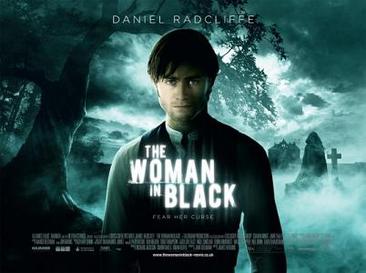
Behind the film
- Year
- 2012
- Director
- James Watkins
- Writers
- Jane Goldman
- Genres
- Horror, Psychological horror fiction, Drama, Thriller
- Production
- Hammer Film Productions, Alliance Films, UK Film Council
- Country
- Canada, United Kingdom, Sweden, Italy
- Cast
- Daniel Radcliffe, Ciarán Hinds, Janet McTeer, Roger Allam, Sophie Stuckey, Liz White, Shaun Dooley, David Burke
About the film
Contains story spoilers, including the ending.
The Woman in Black sends Arthur Kipps from London to a village where an estate assignment brings him into contact with another family's buried grief. Daniel Radcliffe plays Arthur, a father still unable to recover from his wife's death. Eel Marsh House stands apart from Crythin Gifford, reached by a causeway that disappears beneath the tide. Getting there means crossing into a place where the ordinary work of sorting a dead client's affairs becomes a frightening investigation. James Watkins directed Jane Goldman's adaptation of Susan Hill's novel. Watkins wanted the villagers to have individual histories and recognisable fears, rather than simply behaving like ominous strangers in a remote settlement. Their losses matter alongside Arthur's. His separation from his son Joseph gives the journey an urgency that reaches beyond the house and its previous occupants.
Arthur discovers that Jennet Humfrye's son Nathaniel was adopted by her sister Alice Drablow. The boy drowned in the marsh, and Jennet blamed Alice for abandoning him. Jennet's ghost now drives children to their deaths, making other parents suffer for her loss. Arthur's presence at the house is followed by another child's death, and the villagers turn against him. Sam Daily, played by Ciarán Hinds, helps Arthur recover Nathaniel's body. Arthur hopes that reuniting mother and child in burial will end the curse. It does not. At the railway station, Jennet lures Joseph onto the tracks. Arthur rushes to save him, and both are killed by the train. Father and son then see Arthur's wife Stella and leave together. That reunion gives the family an escape through death, while Jennet remains with the ghosts of the village children. Understanding her history has not made her forgive anyone. Arthur finds the person he has been longing for, but his attempt to protect Joseph cannot deliver the living reunion he expected.
Arthur's attraction to the house has a personal reason. Radcliffe explained that proof of a ghost would also promise an afterlife and the possibility of seeing his wife again. He stays partly in search of consolation. The actor described Arthur as cut off from his son and ordinary life by bereavement, while Jennet carries her grief into a lasting desire for revenge. Their encounter brings two responses to loss into direct conflict. Watkins likewise approached the story through parents' fear of losing their children. He wanted the dread to build gradually, with a glimpse at the edge of the image allowing the viewer's imagination to supply what remains hidden. To give Arthur the weight of that grief, Watkins worked with Radcliffe on stillness and restrained energy, even changing how he breathed. Radcliffe met a grief counsellor and read about bereavement. The withdrawn figure moving through the house came from that preparation.
Eel Marsh House was designed to leave room for something to be watching from far behind Arthur. Watkins described long corridors, deep backgrounds and clear perspectives, with the apparition physically present on set. The house therefore gives the eye more than one place to search. A doorway or distant patch of darkness can remain troubling while Arthur occupies the foreground. Watkins wanted control over where the woman stood and how much of her could be seen, rather than relying on a digitally created figure. Goldman also drew on her own unease around Victorian automata, which she collected and found unsettling in the dark. The period's toys and mechanical figures gave her concrete objects through which to introduce that feeling. Her approach to adding scares began with things that had frightened her personally.
The landscape around the house came from several English locations. Producer Simon Oakes identified the house location near Peterborough, an Essex estuary for the causeway, and Halton Gill in the Yorkshire Dales for the village. The Bluebell Railway in Sussex supplied working steam locomotives for the station scenes. Nigel Sinclair said the marsh sequence took two days, with Radcliffe working in a constructed marsh covered in mud. Watkins wanted the scenes outside Eel Marsh House to have space and scale, giving the film air between its enclosed passages. He described the story as an adaptation of Hill's book rather than a transfer of the stage play. He also wanted modern camera movement, music, performances and editing within the period setting. The old house and surrounding countryside could carry a ghost story without dictating a deliberately old-fashioned style of filmmaking.
The film's period world still needed digital work, including the removal of telephone wires and satellite dishes. Watkins distinguished that background work from the horror effects, which he preferred to achieve in the camera. His aim was to make a passing glimpse disturb the viewer rather than reveal everything clearly. Goldman continued developing the screenplay with him through filming and editing, remaining available on set and by telephone as the material changed. For Goldman, adapting the novel meant keeping its spirit while using cinema's own possibilities. She connected the scares to rhythm and increasing intensity. The alternation between waiting, an apparent release and renewed danger lets the house remain threatening even when nothing has fully emerged. Its quiet spaces demand attention before a sudden movement or noise supplies an answer.