
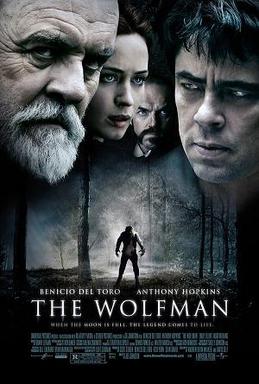
Behind the film
- Year
- 2010
- Director
- Joe Johnston
- Writers
- Andrew Kevin Walker, David Self, Curt Siodmak
- Genres
- Horror, Werewolf, Drama
- Production
- Universal Pictures, Relativity Media, Stuber Pictures
- Country
- United States
- Cast
- Benicio del Toro, Anthony Hopkins, Emily Blunt, Hugo Weaving, Geraldine Chaplin, Art Malik, David Schofield, Clive Russell
About the film
Contains story spoilers.
Lawrence Talbot returns to Blackmoor after his brother Ben's death, rejoining his estranged father, Sir John, and Ben's fiancée, Gwen. A werewolf attacks a Romani camp and bites Lawrence; Maleva tends his wounds. Lawrence later transforms, kills hunters and is arrested. At Lambeth, John reveals that he is the werewolf who killed Ben and Lawrence's mother, and infected his son. Lawrence transforms during Dr. Hoenneger's lecture and escapes across London. Gwen learns there is no cure. Returning to Talbot Hall, Lawrence fights and kills John as the house burns. He bites Inspector Aberline, then pursues Gwen to a gorge. She shoots Lawrence, who returns to human form and thanks her before dying. Aberline's wound and a final howl suggest the curse continues.
Benicio del Toro and producer Rick Yorn developed The Wolfman as an homage to the earlier Universal monster films. Del Toro wanted to update the story without copying the 1941 film frame by frame. Andrew Kevin Walker and David Self's screenplay gave the father and son relationship a larger part, while Joe Johnston identified Lawrence's love for Gwen as the relationship holding the story together. Rick Baker and Dave Elsey kept Jack Pierce's recognizable creature design as their starting point. The surroundings carried the same division between human order and animal nature: Rick Heinrichs added overgrowth to Chatsworth's exterior to turn it into the neglected Talbot home. Milena Canonero separated social classes through clothing, using long, sharp silhouettes and rich fabrics for the wealthy and bundled wool, linen and cotton for workers. Lawrence's transformation costumes had expandable seams and stretchy fabric, including nylon that resembled tweed on camera.
Cinematographer Shelly Johnson built the photography around opposing elements sharing a frame, including hard and soft light and warm and cool colours. Extensive location filming let him stage night scenes on a larger scale than a studio would allow. He varied the moonlight according to each scene instead of repeating one night effect throughout the film. The 1.85:1 frame accommodated threats above Lawrence, particularly the moon and the upper floors of Talbot Hall. City scenes used incandescent light while country scenes favoured candles, a distinction Johnson connected to Lawrence's journey into his past. For Hoenneger's lecture, Johnson drew on Thomas Eakins's painting The Agnew Clinic: a brightly lit central figure surrounded by people falling into shadow. During the forest pursuit, he used a dip in the ground as a light well, illuminating the trees from below while leaving room to look upwards. Colourist Jill Bogdanowicz translated his Photoshop experiments into the digital finish, combining glowing silvery light with deep blacks.
Baker had actively sought the creature assignment. Speaking to Ryan Turek before seeing the finished film, he described returning for six weeks of reshoots after the first edit. Movement on all fours had been added to the plan, and Baker wished he had been more involved in the transformation work. His sculpts and skin designs supplied material for digital models. He favoured combining makeup and digital techniques, while wanting more of del Toro's makeup to appear during the early stages of the change. The actor's physical experiments made the on-set work demanding: he tried gestures drawn from older monster films as well as his own ideas, and the makeup needed repeated repairs after energetic takes.
Visual effects supervisor Steven Begg recalled expecting to blend stages of Baker and Elsey's practical transformation designs. Instead, on the day of filming, he was asked to put tracking dots on del Toro so that the changing appearance could be designed later. Begg attributed that decision to the limited preparation time following the change of director. Del Toro's contortions still guided the animated performance; additional cameras outside the main shot recorded his movements as reference. Begg distinguished that transformation work from the London rampage, which largely used costumes and prosthetics, with digital legs or enlarged jaws where needed. Shots of the creature running on all fours began with a stunt performer on wires and ultimately became entirely digital. His account also describes the conditions behind the night photography: forest shoots involved mud and both real and artificial rain.
MPC joined these different versions of the creature together. Its artists used scans of del Toro and Baker and Elsey's head sculpts to build an animated head capable of passing through intermediate forms. Close views required the digital skin and fur to match the practical makeup. For jaw extensions, the compositors projected live-action face photography onto animated heads and combined it with a digital muzzle, making adjustments almost frame by frame. The company's environments extended the physical locations too. London rooftops combined three-dimensional architecture with matte paintings, using photographs of real buildings and survey information from the sets. Modern details were removed from the building photographs. The gorge at the ending assembled a waterfall filmed in Wales, Lake District rock formations, trees from Bourne Wood and blue-screen elements into one landscape.
Johnston inherited Heinrichs, locations and supporting cast when he replaced Mark Romanek shortly before filming. In his CHUD interview, he described an important change made with editor Walter Murch during post-production. A hunting sequence originally included a clear view of the creature emerging from behind a tree. Murch removed it, leaving brief glimpses and muzzle flashes so that the audience would imagine what remained unseen. Physical limitations also changed the London action: a steam omnibus built for a planned sliding stunt could not reach the required speed, so the creature leapt onto the fallen vehicle instead. Johnston wanted the transformed Lawrence to endanger innocent people as well as threatening figures. That choice followed his conception of the character as a good man sharing a body with a creature whose actions he could not control.