
Behind the film
- Year
- 1973
- Director
- Robin Hardy
- Writers
- Anthony Shaffer
- Genres
- Horror, Mystery, Drama, Dystopian
- Production
- British Lion Films
- Country
- United Kingdom
- Cast
- Christopher Lee, Britt Ekland, Diane Cilento, Ingrid Pitt, Edward Woodward, Lindsay Kemp, John Hallam, John Sharp
About the film
Contains story spoilers.
The Wicker Man sends Sergeant Neil Howie to an island where nobody will acknowledge Rowan Morrison. Her name appears in the school register, but her supposed grave contains a hare. A missing harvest photograph shows Rowan beside empty boxes. Howie concludes that the failed crop has put the girl in danger of sacrifice. Speaking to Vic Pratt for the British Film Institute, director Robin Hardy described the story's construction as an elaborate game devised with screenwriter Anthony Shaffer. They placed strong clues at intervals, allowing spectators to notice things Howie misses. The film stays with the policeman instead of showing the islanders arranging their deception. That restriction gives his questions a double purpose: he is gathering evidence, while the audience has to decide whether his interpretation of it can be trusted. Hardy connected the mixture of seriousness and absurdity to the humour he shared with Shaffer.
Howie encounters a place designed to look inviting. In Paul Risker's interview for FLUX, Hardy explained that he wanted the photography to present Scotland's beauty and the inhabitants' appeal. A persistently gloomy setting would have announced the danger too early; attractive surroundings could make the final revelation more shocking. His account of casting is equally specific. Lindsay Kemp, playing the innkeeper, brought the expressive face and body of a mime to the scene introducing the landlord's daughter. Hardy valued what Kemp could communicate without words. He also felt Edward Woodward conveyed Howie's puritan character as soon as he arrived on the island, making an earlier police-station scene unnecessary. The director rejected the suggestion that the film was anti-religious. He left the competing beliefs open to the audience rather than prescribing a side to take. Howie's certainty and the islanders' confidence can therefore coexist within the same apparently welcoming place, with neither group willing to abandon its convictions.
The spring setting required work behind the camera. Hardy told Paul Rowlands that fake trees in blossom travelled in trucks because filming took place in November and December. He also recalled researching pagan practices in hospital, using The Golden Bough and exchanging material with Shaffer as the screenplay developed. Songs were chosen for places already planned in the story. Hardy selected some from the Cecil Sharp collection, and composer Paul Giovanni supplied new music where songs had several possible melodies. Peter Shaffer worked on lyrics that had been bowdlerised. Hardy resisted calling the film a musical: he considered its music part of the dialogue, alongside the landscapes and performances. His recollection puts the songs inside the island's everyday exchanges, where they can express things Howie finds embarrassing or offensive. The music belongs to the community he is questioning, so his discomfort does not stop it.
The songs had a separate history on record. In Robin Turner's conversation with Jonny Trunk, the label founder recalled spending four years trying to locate the soundtrack. His particular obsession was The Loving Couples, a brief instrumental passage related to Gently Johnny. He wanted to hear that fragment whenever he chose. Telephone calls and faxes led him to Lumiere at Pinewood, but changes of ownership eventually brought him to Canal Plus. Trunk remembered repeatedly calling a number before reaching a woman in Paris who helped him secure permission for a release. He then gained access to the Pinewood archive, where thirteen music-and-effects reels supplied the material. Hearing the reels play after years of searching was, in his account, an extraordinary moment. They went to a Soho studio for transfer to digital audio tape, from which the record was made. Trunk explained that the material came from the short cut, accounting for the absence of Gently Johnny. A later soundtrack release combined it with material from another tape.
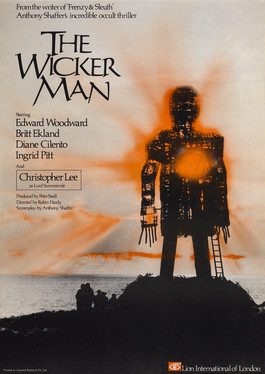
Those omissions also distinguish the film's versions. Pratt's interview describes cuts made without Hardy's involvement, including Gently Johnny and an early appearance by Lord Summerisle. A print previously sent to Roger Corman supplied a new internegative for the medium-length American version. A recovered American print later became the basis of the 2013 Final Cut. The longer version drew on elements of differing quality. These are distinct editions, with different arrangements of the opening and island scenes. For the closing image, Hardy credited cinematographer Harry Waxman's camera position and exposure. The shot had to catch the setting sun as the burning effigy's head fell. Hardy remembered the uncertainty of getting that alignment during a Scottish winter and praised Waxman for capturing it in one attempt.
Unable to leave in his disabled plane, Howie takes the innkeeper's Punch disguise and frees Rowan during the celebrations. She leads him through a cave, then rejoins the islanders. He is their intended victim: a virgin who came willingly, represents the law and has played the fool. His warning that another failed harvest will make Summerisle the next sacrifice goes unheard. The villagers burn Howie alive inside the wicker effigy, singing while he prays.