
Behind the film
- Year
- 2022
- Director
- Darren Aronofsky
- Writers
- Samuel D. Hunter
- Genres
- Drama, Psychological drama
- Production
- Protozoa Pictures
- Country
- United States
- Cast
- Brendan Fraser, Sadie Sink, Hong Chau, Ty Simpkins, Samantha Morton
About the film
Contains story spoilers, including the ending.
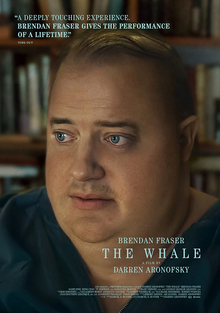
The Whale places Charlie, an online writing teacher played by Brendan Fraser, in an Idaho apartment where he has withdrawn from almost everyone. Darren Aronofsky directs the 2022 adaptation of Samuel D. Hunter's play, with Hunter also writing the screenplay. Charlie teaches with his webcam switched off and tells his class that it is broken. His nurse and friend Liz urges him to obtain hospital treatment for heart failure, but he says he cannot afford it. He wants instead to reconnect with Ellie, the teenage daughter he abandoned when he left his wife Mary for Alan, a male student. Alan has since died, leaving Charlie grieving and increasingly isolated. The apartment brings together people who know different parts of that history, while Charlie tries to decide what he can still give his daughter.
Ellie does not arrive ready to forgive him. Charlie offers her his savings and help with schoolwork in return for spending time together, turning their reunion into a bargain with practical rewards. The money also exposes the contradiction in his refusal of medical care. When Liz discovers that he has substantial savings, she realises that his claim about being unable to pay concealed a choice. Her anger concerns both the deception and the possibility of losing him. Ellie has meanwhile given Charlie a sedative, and Mary's visit brings the family's unresolved grievances back into the room. Charlie's retreat does not protect him from other people's reactions. Dan, the driver who normally leaves his food outside, waits long enough to see him and responds with shock. The encounter is followed by a severe eating binge. Each visitor changes the situation inside the same small home, rather than opening a route away from its accumulating crisis.
Thomas, a young missionary, offers another kind of rescue, but his religious certainty runs into the history of Alan's death. Liz explains that Alan was her brother and that religious guilt contributed to his despair. Thomas nevertheless continues trying to save Charlie. He also has a secret: after Ellie drugs Charlie's food, Thomas admits to stealing from his youth group and running away, while she records the conversation. She sends the confession to his family, whose forgiveness makes it possible for him to return home. His own reconciliation does not give him the understanding he claims to possess about Charlie. When he connects Alan's death with his sexuality, Charlie rejects him. A separate attempt at honesty takes place in the online classroom. After the encounter with Dan, Charlie sends an angry message asking his students to abandon routine coursework and write honestly. He later reads their responses, tells them he has lost his job and finally turns on his webcam. The teacher who has demanded openness exposes himself to their reactions.
Ellie's final visit begins in anger over a failed assignment. Charlie has substituted an old essay she wrote about Moby-Dick for the work she expected him to complete. He asks her to read it aloud, and she eventually stops at the doorway and does so. Charlie is shown rising, approaching her without assistance and lifting into white light; a beach memory follows. The image leaves physical realism behind, preserving their connection without confirming a literal miracle. Hunter has described the ending as open to interpretation. The movement reverses Charlie's earlier inability to walk towards Ellie, giving the reunion a physical expression as well as a verbal one.
The apartment's confined geography shaped Matthew Libatique's cinematography. He and Aronofsky chose a 1.33:1 frame because Charlie would often be seated while other people stood around him: the composition needed height rather than a wide horizontal spread. Rehearsals on a taped-out set allowed the filmmakers to study entrances, exits and the positions of the actors before deciding how the camera should move. They recorded those rehearsals, then used the performers' movement to guide changing angles and eyelines. A remotely operated camera on a gimbal and jib could get close without putting another crew member between the actors. Lighting came largely from low, unobtrusive sources near the floor, leaving darker spaces between them and allowing the performers to move around the room. The days progress from rain and overcast skies towards Friday's sunlight. For the last encounter, powerful lamps supplied the brightness behind Ellie and the light on Charlie, with additional bounced illumination producing the whiteout. That transition was planned as part of the film's lighting language, so the final departure from the room's everyday appearance also completes a progression established throughout the week.
Fraser's physical transformation depended on Adrien Morot's elaborate prosthetics, developed through digital sculpting and three-dimensional printing. The finished pieces carried hand-applied skin detail and hair, while their weight and restrictive torso changed how Fraser could move. The makeup process initially occupied five to six hours a day before the team shortened it. Fraser also consulted the Obesity Action Coalition and spoke with people who had undergone bariatric surgery. These preparations accompanied the intimate performance work: Charlie's difficulty standing, sitting and crossing the room had to remain part of his interactions, rather than disappear whenever the dialogue became demanding.