
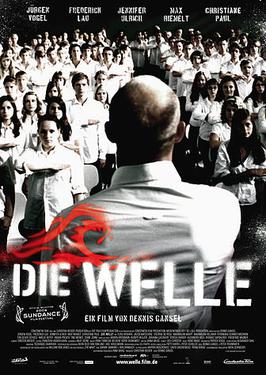
Behind the film
- Year
- 2008
- Director
- Dennis Gansel
- Writers
- Dennis Gansel, Peter Thorwarth
- Genres
- Drama, Teen, Political thriller
- Production
- Rat Pack Filmproduktion, Constantin Film
- Country
- Germany
- Cast
- Jürgen Vogel, Frederick Lau, Max Riemelt, Jennifer Ulrich, Christiane Paul, Elyas M'Barek, Alexander Held, Dennis Gansel
About the film
Contains story spoilers.
Rainer Wenger wants to teach anarchy during project week but receives autocracy instead. He requires formal address and standing answers, pairs pupils at desks and introduces marching. White shirts, a logo and a salute turn the class into The Wave. Tim embraces membership; Karo and Mona resist. Exclusion and graffiti carry the movement beyond school, while Anke challenges her husband's conduct. Violence at a water polo match precedes Marco striking Karo. Alarmed by his behaviour, Marco asks Wenger to stop. At an assembly, Wenger orders Marco's punishment, then reveals the exercise and disbands The Wave. Tim wounds Bomber and dies by suicide. Bomber goes to hospital, Marco and Karo reunite, and Wenger is arrested. The final shot leaves the teacher in a police car, looking towards the camera.
Jürgen Vogel's Wenger was conceived as the teacher Gansel would have liked at school: relaxed, approachable and interested in his pupils. In his Filmportal interview, the director described preferring teachers who made that connection to those who kept an intellectual distance. The character therefore starts with a conviction that he could never become the kind of authority figure the project produces. That choice also informed the writing of his classroom. Gansel and his collaborators visited lessons taught by former schoolmates who had become teachers, listening to the exchanges between staff and pupils. He said every young character had a real counterpart, and their homes also drew on people he knew. Karo's liberal, affluent family came from memories of former neighbours whose children attended a Waldorf school. Peter Thorwarth supplied dialogue, bringing these familiar households and classroom personalities into the screenplay.
The town's prosperity is part of the film's setting, rather than a backdrop for a story about deprivation. Speaking to derStandard, Gansel explained that he wanted to challenge the assumption that this kind of movement belonged somewhere else, among people with less education or fewer resources. His example was the white blouse and jeans: unremarkable on one person, but potentially threatening when a whole crowd wears them together. Asked whether other movements use similar forms of organisation, he distinguished them by what they stand for. Shared clothing and collective rituals alone were not his definition of fascism. He also described changing the original story's beginning, characters and dialogue, treating the premise as material for a contemporary fiction.
The film gives the classroom several points of view. Long shots take in the pupils together, alternating Wenger's position with a view from the back of the room. Medium shots pick out individual responses, including Tim's enthusiasm and Mona's reluctance. Their varied clothes initially distinguish them, before white shirts give the class a coordinated appearance. During the marching exercise, cross-cutting moves to the other class beneath them, whom Wenger has cast as an enemy. Day captions mark how quickly the project advances. Outside school, the nighttime tagging sequence changes the pace: handheld camerawork stays among the teenagers, cuts accelerate, and a montage moves between stickers and spray-painted Wave symbols. Faces disappear from these brief images as the logo spreads across the town. Fast, percussive rock accompanies the activity. Wenger's own introduction uses rock music and a Ramones shirt to establish his informal persona before his classroom demands become increasingly rigid. The movement's imagery thus grows from the schoolroom into streets and public surfaces.
Gansel's memories of adolescence also shaped particular pupils. In Gerhard Busch's VPRO interview, he linked Marco to a friend who played water polo, Karo to a girl he had loved at fourteen, and Tim to someone from his class. He had read The Wave at twelve and remembered wondering what he would have done if it happened at his own school. His youthful certainty that he would resist weakened as he grew older. He consulted Ron Jones because he found differences between the book, the television film and accounts of the original event. For the assembly shoot, the production hired hundreds of extras. Gansel recalled Max Riemelt asking him to make their handling of Marco less rough. According to the director, the extras responded more readily when Vogel intervened. This was his recollection of staging the crowd scene, with an actor needing the action moderated.
The contemporary German setting was a deliberate departure from reconstructing California. Gansel told Pamela Jahn that he used the original event as a starting point to ask whether a similar movement could take hold in the Germany of his film. He questioned his characters' confidence that knowing their country's history protected them from a charismatic leader. That was the premise of his drama. He was also explicit about regarding the classroom exercise as dangerous and a mistaken educational concept. The ending was changed to interrupt the attraction of the group: he recalled young performers using the Wave greeting during filming and wanted the final act to shock an audience that might find membership appealing. In the separate Filmportal interview, producer Christian Becker said they filmed a less dramatic ending as a backup, although they did not intend to use it. The released catastrophe was therefore a chosen fictional conclusion.