
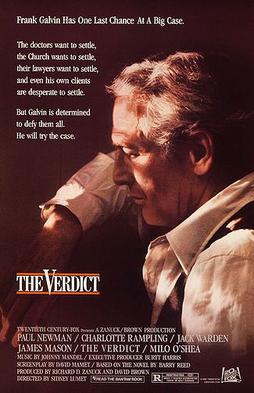
Behind the film
- Year
- 1982
- Director
- Sidney Lumet
- Writers
- David Mamet, Jay Presson Allen
- Runtime
- 2h 9m
- Genres
- Trial, Drama
- Production
- 20th Century Studios
- Country
- United States
- Cast
- Paul Newman, Charlotte Rampling, Jack Warden, James Mason, Milo O'Shea, Lindsay Crouse, Bruce Willis, Edward Binns
About the film
Contains full story spoilers, including the ending.
Frank Galvin begins The Verdict looking for work among people who are grieving. Paul Newman's Boston lawyer visits funeral homes in the hope that a death will lead to a lawsuit, then returns to drinking and solitary games of pinball. His friend Mickey brings him a medical malpractice case involving Deborah Ann Kaye, who suffered permanent brain damage during childbirth and now depends on continuing care. Her sister Sally and brother-in-law Kevin want compensation that will pay for that care and allow them to move west. The case enters Frank's life as a financial opportunity, but it offers something he has not expected: a reason to recover his belief in his profession. Sidney Lumet's 1982 drama keeps that personal need alongside the family's practical burden. A trial may restore the lawyer's sense of purpose while placing his clients' chance of financial security at risk.
The change takes place at Deborah's bedside. Frank has come to take Polaroid photographs for the case, and Lumet lets the images develop before returning to his face. The patient gradually becomes visible in the small prints as Frank begins to face what has happened to her. He refuses the hospital's proposed settlement and commits to a trial against Ed Concannon, a lawyer with an entire team behind him. Mickey supports Frank, but the scale of the opposition makes the decision dangerous. The hospital is connected to the Catholic Church, and its representatives want the case kept out of public view. Charlotte Rampling's Laura Fischer enters Frank's life during this period and becomes romantically involved with him. For a time he appears to have found both a case worth pursuing and someone with whom to share his renewed hopes.
The trial exposes the weakness of Frank's preparation as well as his opponent's power. His principal medical witness disappears, Judge Hoyle refuses a delay, and the settlement he rejected is no longer available. Frank finds a replacement expert, Dr. Thompson, but Concannon attacks the doctor's credibility while the judge interrupts Frank's questions. Another nurse, Maureen Rooney, initially refuses to help. Frank eventually learns how to locate Kaitlin Costello Price, whose record of Deborah's last meal may explain the medical disaster. Meanwhile, Mickey discovers that Laura has been paid by Concannon's firm. The apparent refuge in Frank's personal life is part of the opposition's access to him. He strikes her when he learns the truth, then returns to Boston. Mickey suggests seeking a mistrial, but Frank continues. His decision leaves the case dependent on the witness he has tracked down rather than another chance to begin proceedings again.
Kaitlin testifies that Deborah ate a full meal one hour before admission, and that she was pressured to change the entry to nine hours. She kept a photocopy of the original form. Her account explains how anaesthesia was administered without the warning being properly heeded, but Concannon challenges the copy and Judge Hoyle strikes her testimony from the record. Frank's closing argument then asks the jurors to act from their own sense of justice. They find for the plaintiffs, and the foreman asks whether they may award more than the amount requested. The judge tells them they can. The courtroom victory does not settle Frank's relationship with Laura. After seeing her at the courthouse, he is alone in his office that night while she calls from her room. He moves toward answering, then lets the telephone ring. The released film gives the lawsuit a definite result and leaves that personal connection suspended in the unanswered call.
The rooms surrounding Frank give institutional power a physical presence. Dark wood connects the judge's chambers with the church's offices and continues into the courtroom's large pillars. Lumet often keeps people within those spaces instead of moving straight into close-ups. When Frank argues with Hoyle in chambers, a wide composition holds the judge, Frank and Concannon in different parts of the room. Their positions remain visible throughout the confrontation. In court, a high view makes Frank small within the building that is supposed to deliver justice. Newman's closing speech also begins at a distance, with Frank standing at his table rather than pacing or shouting. The camera gradually moves closer as he approaches the jury. The staging gives the spoken appeal a different scale from the architecture around him: a tired individual asks other individuals to make a decision inside an imposing, resistant institution.
Lumet and cinematographer Andrzej Bartkowiak give the film a dark visual atmosphere, while Johnny Mandel's music is used sparingly. Even the opening titles proceed without the usual support of a score. Much of the emotional weight remains with the actors, the lighting and the spaces between lines. The bedside pause belongs to that approach: the developing photographs are allowed time to change Frank's understanding before he explains his decision. Lumet later recalled another detail that viewers had noticed in The Verdict, the changes in Newman's clothing as the story progressed. He agreed that the observation made sense but said the pattern had not been deliberate. His recollection distinguishes what a film can communicate from what its director consciously planned. Frank's recovery emerges through accumulated details of appearance and behaviour as well as through the testimony and arguments that give the case its public shape.