
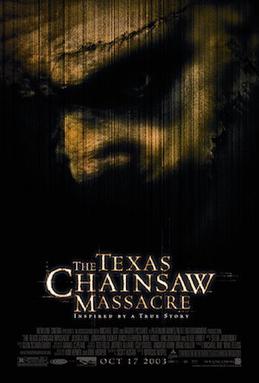
Behind the film
- Year
- 2003
- Director
- Marcus Nispel
- Writers
- Scott Kosar, Michael Bay
- Runtime
- 1h 53m
- Genres
- Horror, Slasher
- Production
- Platinum Dunes, New Line Cinema's House of Horror
- Country
- United States
- Cast
- Jessica Biel, Jonathan Tucker, Erica Leerhsen, Mike Vogel, Eric Balfour, David Dorfman, R. Lee Ermey, John Larroquette
About the film
Contains story spoilers, including the ending.
The Texas Chainsaw Massacre follows a group of young travellers into an isolated home occupied by Leatherface and his family. Jessica Biel plays Erin in Marcus Nispel's 2003 remake, with Jonathan Tucker as Morgan, Mike Vogel as Andy, Erica Leerhsen as Pepper and Eric Balfour as Kemper. The story takes place in 1973, when the friends pick up a distressed hitchhiker while driving through Texas. Her death in their van leaves them looking for the police. A store clerk sends them towards a mill, where a boy directs Erin and Kemper to a house. Kemper disappears inside. When Erin returns with Andy to look for him, the effort to find a missing friend becomes another trap. The sheriff's arrival brings the others no safety either.
Sheriff Hoyt takes Morgan away, while Erin and Pepper try to leave in the van. Leatherface kills Pepper and drives Erin into another apparent refuge. There she discovers that the hitchhiker's baby has been taken by people connected to the same family. Erin is drugged and wakes in the Hewitt house. She finds Andy dying and Morgan captive in the basement; the boy Jedidiah helps her and Morgan get out. Morgan is killed during their flight, leaving Erin to fight Leatherface alone. She wounds him and reaches a trucker, but his attempt to find help takes her back to the gas station. Erin retrieves the baby, steals Hoyt's car and kills the sheriff as she escapes. Leatherface reaches the vehicle but cannot stop her driving away with the child. The police investigation shown around the story ends with more deaths and an open case. Erin survives without bringing the family's violence to an end.
The places the friends are sent form the story's trap. The store, mill and house initially look like separate stops on a search for someone responsible. Each new direction takes them further into the same danger. Hoyt's position makes him especially threatening because the group has specifically asked for police help after the hitchhiker's death. His control over the van and its passengers cuts off an obvious means of leaving. Erin's search for Kemper also means that she keeps returning towards the house rather than treating her own escape as the only task. The family exploits the travellers' need to find one another and explain what has happened.
Daniel Pearl had photographed Tobe Hooper's original film almost thirty years earlier, but deliberately changed his approach for the remake. He described an audience whose visual expectations had developed alongside music videos, work he had also been doing with Nispel and Michael Bay. Copying his earlier photography held little interest for him. The new film's colour came partly from bleach-bypass processing, which left stronger blacks and more subdued colours, especially reds and oranges. Pearl also had resources he lacked in the original. For the van scenes, powerful lights brought the interior exposure closer to the landscape outside, keeping detail visible through the windows. The moving vehicle and the Texas countryside could therefore remain present in the same image. Pearl and Nispel already shared a sense of composition and lighting after years of working together. Their remake takes the familiar journey into a frightening house and gives that journey a different photographic texture, rather than trying to reproduce the earlier film's rough appearance.
Nispel was initially angry at being offered the remake. He wanted his first American feature to express something of his own, and felt that returning to this particular film was almost sacrilegious. Pearl helped change his mind, arguing that Nispel should direct it so the cinematographer could revisit the story at a different stage of his career. Nispel recalled that the decision and the shoot followed each other very quickly. He also described a personal relationship to familiar films that came from growing up in Germany, where American releases could arrive much later. Before seeing them, he would encounter reviews, soundtracks and merchandise, then imagine the film himself. When discussing his remakes, he connected that experience to making something appropriate to his own imagination rather than producing a carbon copy. He came to enjoy the horror genre during the production, including the uncertainty an audience can feel when it does not assume that a famous star must survive.
Pearl's own recollection of accepting the job gives the collaboration a slightly different angle. He had often said that he would not take on the original's subject matter again, yet agreed immediately when Nispel called him about the remake. They had become friends while making commercials and music videos and liked the same kinds of images. He recognised the contradiction only after hanging up. When discussing screen violence, Pearl explained that lighting, focus and camera position have to keep an audience from seeing how an effect is achieved. His comparison was with a magician directing attention towards one hand while the other prepares the trick. That discussion also returned to the first Chainsaw film, where viewers often remembered more explicit violence than was actually shown. Pearl recalled Nispel talking about the power of what people imagine. Both men were working with expectations already attached to Leatherface, while controlling exactly what the new film would let an audience see.