
Behind the film
- Year
- 1999
- Director
- David Lynch
- Writers
- Mary Sweeney, John E. Roach
- Genres
- Drama, Biographical, Adventure, Road movie
- Production
- Film4 Productions, StudioCanal, Walt Disney Pictures
- Country
- France, United Kingdom, United States
- Cast
- Richard Farnsworth, Sissy Spacek, Harry Dean Stanton, Everett McGill, Wiley Harker, Kevin Farley, Jennifer Edwards-Hughes, Jane Galloway Heitz
About the film
Contains story spoilers, including the ending.
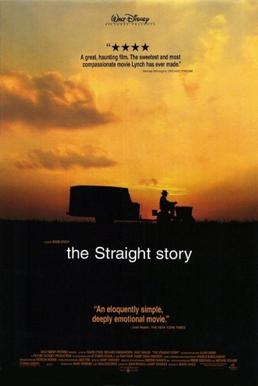
The Straight Story follows Alvin Straight's attempt to reach his brother while he can still make amends. Richard Farnsworth plays Alvin in David Lynch's 1999 film, with Sissy Spacek as his daughter Rose and Harry Dean Stanton as Lyle. Alvin lives with Rose in Iowa. Failing eyesight prevents him from driving, and he needs two canes to walk. News of Lyle's stroke makes their separation urgent, but Alvin has little money and insists on travelling under his own power. A riding lawnmower gives him a way to leave, at a speed that makes every stretch of road an undertaking. The journey draws him into conversations with strangers while keeping a reunion with Lyle as its purpose. The screenplay by John Roach and Mary Sweeney dramatises a journey the real Alvin Straight made in 1994.
Alvin's first mower breaks down, forcing him to begin again with a John Deere. On the road, he shares a meal with a pregnant runaway and tells her about the strength of a family held together. She leaves him a bundle of sticks. Cyclists welcome him at their campsite, and a woman distraught after hitting a deer leaves him an unexpected dinner. Mechanical trouble brings another stop and an offer of a lift, which he refuses. He bargains with the brothers repairing his tractor, then shares wartime memories with another veteran. Alvin admits that he killed an American by mistake and drank heavily after the war. These encounters give his advice about family a history of damage behind it. Near his destination, he tells a priest that anger, vanity and alcohol helped separate him from Lyle. The film never specifies their original argument. When he finally reaches his brother, the mower itself supplies the explanation he struggles to put into words. Lyle asks whether he rode it all that way to see him. Alvin confirms that he did. They sit together under the stars, with the journey ending in shared silence.
Roach recalled that he and Sweeney recognised men from their own Midwestern families in Alvin. Their fathers and their familiarity with rural life entered their conversations while writing. Sweeney had sent him the newspaper report that first caught her attention, and he spoke to Alvin by telephone. By the time they could develop the film, Alvin was no longer available to help them. Roach said they learned about him from relatives and people he had met. They drove his route, interviewing people at his stops and using each account to find the next place. That research supplied a path through the landscape, while the screenplay shaped the meetings into a story. Roach did not claim that every pattern viewers found was planned. Asked about Alvin meeting progressively older people, he said that progression had not been a conscious decision. He did remember enjoying the scene with the quarrelling repairmen, whose argument lets Alvin's bargaining skill turn an expensive interruption into a small victory.
Lynch described his decision to direct as a response to the whole screenplay. Sweeney and Roach had travelled the route and met Alvin's family before giving it to him; reading it settled his involvement. In his interview with Michael Sragow, Lynch also discussed the machines surrounding the characters. The grain elevators, railway tracks and large equipment belonged to a working rural landscape, alongside the fields and the small number of people living among them. Alvin's mower therefore has a place in a world already dependent on machinery, even though he uses it for an unusual task. Lynch found Farnsworth particularly suited to Alvin's dialogue and reactions. Their conversation singles out the brief moment when a mower dealer's remark breaks through Alvin's dignity and makes him laugh. Lynch valued what Farnsworth could communicate physically as well as verbally. His account of directing actors describes watching their eyes and gestures for recognition, then repeating a scene as its unspoken feeling became clearer.
Sweeney brought an editor's judgment to material she had also written and produced. She told Alex Hewitt that she was willing to remove passages from her own screenplay when they did not work, judging the film through her emotional response as its first audience. She associated her editing with transitions and layered exposures that let viewers drift between images. The deliberate pace remained part of this film from writing through direction and editing. In Sweeney's recollection, Lynch regarded its simplicity and slowness as especially difficult to sustain. The landscape was built into the project too. She described filming harvest views with the photography team and moving east as summer gave way to autumn. The production travelled between bases along the route, reaching the Mississippi as the trees changed colour. That changing countryside gives Alvin's patient journey a season as well as a destination. Sweeney's account ties the passage of time to the places the production travelled through, with the land remaining part of the experience rather than merely a backdrop for conversations.