
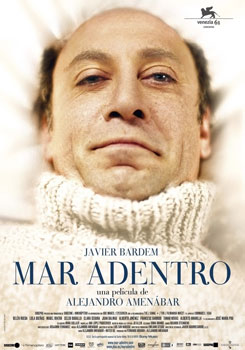
Behind the film
- Year
- 2004
- Director
- Alejandro Amenábar
- Writers
- Alejandro Amenábar, Mateo Gil
- Runtime
- 2h 5m
- Genres
- Biographical, Drama
- Production
- Grupo PRISA, Sogecine, Himenoptero
- Country
- Spain, Italy, France
- Cast
- Javier Bardem, Belén Rueda, Lola Dueñas, Tamar Novas, Andrea Occhipinti, Mabel Rivera, Alberto Jiménez, Josep Maria Pou
About the film
Contains story spoilers.
The Sea Inside opens on Ramón Sampedro in the family home, where care and conversation have become part of the daily routine. A diving accident left the Galician sailor and poet paralysed from the neck down, and for decades his family has cared for him in their country home. He is neither silent nor solemn: Ramón is quick with a joke, writes poetry by holding a pen in his mouth, and watches the people around him with the alertness of someone who has spent years observing small changes. His wish to die is clear from the start, yet the film gives him a busy inner life rather than reducing him to the legal question at the centre of his case.
Ramón’s brother José and sister-in-law Manuela keep the household running, while their son Javi brings a younger generation into the room. Javi understands computers and helps his uncle find a way to write, extending Ramón’s reach beyond speech and the small circle of visitors. The accident itself returns in a flashback to the beach, where a careless dive turns a familiar landscape into the dividing line of his life. The room remains the film’s practical centre: people come in carrying arguments, news, music and affection, while Ramón’s imagined flights above the countryside open a visual route beyond the stillness of his bed.
His legal campaign gains new force when Gené, an advocate for the right to die, connects him with Julia, a lawyer who is herself living with a degenerative neurological illness. Julia understands why he wants the law to recognize his choice, and she helps him bring the question into public hearings. Their bond grows through conversation, written work and an attraction that neither can treat as ordinary courtship. Ramón also asks that whoever represents him should understand what it means to live with a body that is failing. Julia’s sudden collapse makes the parallel between them physical: for a moment, the man usually dependent on others cannot summon anyone to help the woman who has come to defend him.
Rosa arrives from the nearby town with a different purpose. A single mother who works in a factory and hosts a radio program, she has heard about Ramón and believes she can persuade him that life still offers pleasures worth staying for. He answers her visits with humour and patience, but her cheerfulness does not dissolve his decision. Instead, their conversations bring out the gap between loving someone and being able to change what they want. Rosa’s radio dedication, like the records and music Ramón enjoys at home, makes sound one of the few pleasures that can cross the room without asking his body to move. The film returns to these ordinary sensory details whenever its public debate threatens to become abstract.
The campaign meets the limits of Spanish law, and the court cannot simply grant Ramón the permission he seeks. A wheelchair-using priest, Francisco, comes to argue that life belongs to God; Ramón answers him in a heated exchange that mixes philosophical conviction with comic impatience. The scene does not turn into a tidy conversion or a neutral debate. It shows how people who share an impairment can still reach opposing conclusions, while Ramón insists that his choice belongs to him alone. The film is based on Sampedro’s real campaign, but it reshapes parts of his life: Amenábar and Mateo Gil condense the people around him into characters such as Julia and Rosa and arrange their relationships for a drama rather than a documentary record.
The final movement follows a plan that lets Ramón carry out his decision while the people around him divide the practical steps. Rosa, who had hoped to change his mind, provides potassium cyanide dissolved in water; Ramón drinks it through a straw while a small camera records his statement that the choice is his. He also says several people helped, making the act difficult to prosecute as the work of one named person. The film closes with Gené visiting Julia, whose illness has advanced so far that she no longer seems to remember Ramón. The visit returns attention to the people left behind, rather than offering a legal ruling as the story’s final word.
Alejandro Amenábar has said he wanted Ramón’s intellectual arguments to reach viewers as an emotional experience. The film gives that aim a concrete shape by moving between debates in the crowded bedroom and the aerial flights Ramón imagines above the Galician landscape. Those images do not suggest that his body has recovered; they show how he pictures movement while the household keeps caring for him. The ending’s return to Julia gives the story another human consequence: her memory is failing even as Ramón’s recorded words preserve his own decision. The film’s form keeps the argument attached to individual lives and changing bodies.